Bacitracin Methylene Disalicylate (BMD)
1. Introduction
Bacitracin Methylene Disalicylate (BMD) is a feed-grade antibacterial ingredient derived from bacitracin and formulated with methylene disalicylate. It is primarily used in animal nutrition and veterinary feed formulations, particularly for poultry and swine, where it can help control susceptible Gram-positive bacteria and support intestinal health.
Bacitracin is a polypeptide antibiotic produced by strains of Bacillus species. Its antibacterial activity is mainly associated with interference with bacterial cell-wall synthesis. Bacitracin Methylene Disalicylate is formulated in a stable powder form that is convenient for incorporation into animal feed and feed premixes.
In animal production, BMD is used where permitted by applicable regulations as part of feed programs designed to support intestinal microbial balance, feed utilization, growth performance, and overall production efficiency.
Because antimicrobial regulations differ substantially between countries, BMD should only be marketed and used according to the approved indications, species, inclusion levels, withdrawal requirements, and other requirements applicable in the target market.
2. CAS No.
CAS No.: 8027-21-2
Chemical name: Bacitracin Methylene Disalicylate
Abbreviation: BMD
Product category: Feed-grade antibacterial / Veterinary pharmaceutical ingredient
Primary application: Animal feed and feed premixes
Technical note: Bacitracin is a complex of closely related polypeptide components rather than a single chemically pure small molecule. Commercial BMD products may therefore be described using different potency, assay, and specification systems. The CAS number, potency, composition, and regulatory status should be verified against the manufacturer’s current specification, CoA, and SDS for the specific grade.
3. Structural Formula
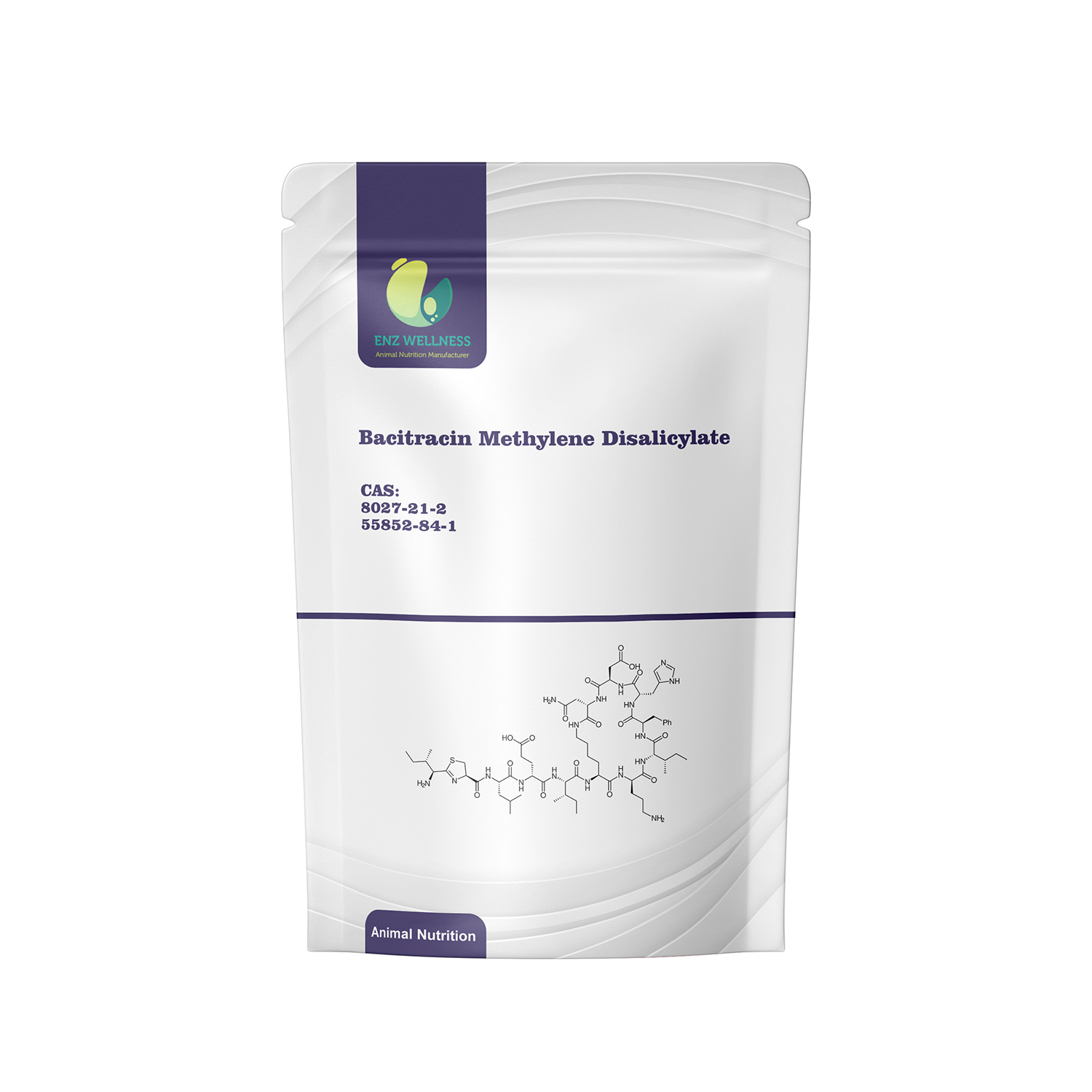
Bacitracin is a complex mixture of related cyclic peptide antibiotics, with bacitracin A generally recognized as the principal active component. Consequently, Bacitracin Methylene Disalicylate does not have one simple structural formula comparable to a single-component chemical compound.
Structural description
Bacitracin complex + methylene disalicylate
The bacitracin portion consists of a cyclic peptide structure containing amino-acid residues and a thiazoline-containing moiety. Methylene disalicylate serves as the associated formulation/stabilizing component in BMD.
Molecular Formula
A single molecular formula is generally not appropriate for commercial Bacitracin Methylene Disalicylate, because bacitracin is a mixture of structurally related components rather than a single molecular species.
For technical and commercial documentation, it is preferable to identify the material by:
- Product: Bacitracin Methylene Disalicylate
- Abbreviation: BMD
- Active: Bacitracin complex
- Form: Powder
- Grade: Feed grade / veterinary use, according to applicable specification
4. Physicochemical Properties
| Property | Description |
|---|---|
| Product name | Bacitracin Methylene Disalicylate |
| Abbreviation | BMD |
| CAS No. | 8027-21-2 |
| Appearance | White to off-white powder |
| Physical form | Powder |
| Odor | Characteristic / slight |
| Active component | Bacitracin complex, predominantly bacitracin A |
| Solubility | Limited solubility in water; dependent on product formulation |
| Stability | Stable when stored under recommended conditions |
| Moisture sensitivity | Protect from moisture |
| Light sensitivity | Protect from excessive light |
| Storage temperature | Store in a cool, dry place according to the manufacturer’s specification |
| Compatibility | Suitable for incorporation into feed and premix formulations |
| Product specification | Potency and quality parameters should be confirmed by the applicable CoA |
Physical Characteristics
BMD is normally supplied as a free-flowing powder suitable for industrial feed manufacturing. Its physical characteristics can vary depending on the manufacturing process, carrier materials, particle-size distribution, and commercial grade.
For this reason, parameters such as potency, moisture, particle size, bulk density, pH, residual solvents, and microbiological limits should be specified according to the individual manufacturer’s product specification rather than treated as universal values.
5. Mechanism of Action
Bacitracin primarily exhibits antibacterial activity against susceptible Gram-positive bacteria.
Its principal antibacterial mechanism involves inhibition of bacterial cell-wall synthesis. Bacitracin interferes with the dephosphorylation and recycling of undecaprenyl phosphate, a lipid carrier required for transporting peptidoglycan precursors during bacterial cell-wall formation.
Disruption of this process compromises bacterial cell-wall synthesis and can lead to inhibition of growth or bacterial death in susceptible organisms.
Bacitracin generally has limited activity against many Gram-negative bacteria because of differences in their outer membrane and other resistance mechanisms.
6. Application
6.1 Poultry Feed
Bacitracin Methylene Disalicylate may be incorporated into poultry feed programs, where permitted, including:
- Broilers
- Layers
- Breeders
- Other poultry categories covered by local approvals
Its use may help control susceptible Gram-positive intestinal bacteria and support intestinal microbial balance.
6.2 Swine Feed
BMD can also be used in swine feed formulations where authorized by local regulations. It may be incorporated into premixes or complete feeds according to the approved product specification and feeding program.
6.3 Feed Premixes
BMD is suitable for use as an active ingredient in:
- Animal feed premixes
- Veterinary feed additives
- Complete animal feeds
- Customized feed formulations
The product should be uniformly distributed throughout the feed to ensure consistent exposure to the intended inclusion level.
7. Application and Benefits
Supports Intestinal Health
BMD can help control susceptible Gram-positive bacteria in the gastrointestinal tract when used under approved conditions. Maintaining an appropriate intestinal microbial environment is important for nutrient utilization and animal performance.
Supports Feed Efficiency
By helping manage susceptible intestinal bacterial populations, BMD may contribute to efficient nutrient utilization and consistent feed performance in approved production systems.
Supports Growth Performance
Effective management of susceptible intestinal bacteria can contribute to maintaining normal growth and production performance, particularly when intestinal microbial challenges are present.
Supports Production Efficiency
Healthy gastrointestinal function is closely associated with feed conversion, growth consistency, and overall production efficiency. BMD may form part of an approved nutritional or veterinary feed program designed to support these objectives.
Convenient Feed-Grade Form
The methylene disalicylate form is supplied as a powder designed for practical handling and incorporation into animal feed and premix systems.
8. Target Animals
Depending on local regulatory approval, BMD may be used in feed programs for:
- Poultry
- Broilers
- Layers
- Breeders
- Swine
- Other approved food-producing animals
Target species, indications, dosage, and duration must always follow the applicable product registration and local regulations.
9. Quality and Product Specification
For professional B2B supply, Bacitracin Methylene Disalicylate should be supplied with appropriate quality documentation.
Typical documentation may include:
- Certificate of Analysis (CoA)
- Safety Data Sheet (SDS)
- Product Specification
- Batch/Lot Number
- Manufacturing Date
- Retest or Expiry Date
- Packaging Information
- Microbiological specifications, where applicable
- Regulatory or registration documentation, where applicable
Important quality parameters may include:
- Bacitracin potency
- Identification
- Appearance
- Moisture
- Particle size
- Bulk density
- Microbiological quality
- Heavy metals and other impurities, according to applicable specifications
10. Recommended Handling and Storage
Store Bacitracin Methylene Disalicylate in its original, tightly closed packaging in a cool, dry and well-ventilated area.
Recommended handling practices include:
- Protect from moisture.
- Protect from excessive heat and direct sunlight.
- Keep the container tightly closed when not in use.
- Avoid unnecessary exposure during handling.
- Use appropriate personal protective equipment according to the SDS.
- Follow the manufacturer’s storage and handling instructions.
The exact storage temperature and shelf life should be taken from the manufacturer’s current product specification and packaging label.
11. Packaging
Bacitracin Methylene Disalicylate can be supplied in packaging suitable for pharmaceutical and feed-additive applications.
Common industrial packaging may include:
- 1 kg bags
- 5 kg bags
- 10 kg bags
- 25 kg bags
- Customized packaging for bulk orders
Actual packaging options depend on the manufacturer’s production capacity, customer requirements, and applicable transportation regulations.
12. Regulatory Considerations
Bacitracin Methylene Disalicylate is an antibacterial substance, and its use in animal feed is regulated differently in different countries.
Before commercial use, import, registration, or distribution, customers should verify:
- Approved animal species
- Permitted indications
- Maximum inclusion levels
- Duration of use
- Withdrawal periods
- Feed-mixing requirements
- Veterinary prescription requirements, where applicable
- Import requirements
- Maximum residue limits, where applicable
- Restrictions on antimicrobial growth-promotion claims
For website marketing, avoid claiming that BMD is universally approved as a growth promoter or feed additive. Product claims should correspond to the regulatory status in the specific destination market.
13. Why Choose Bacitracin Methylene Disalicylate?
Bacitracin Methylene Disalicylate offers several characteristics valued by animal-feed manufacturers:
- Feed-grade antibacterial ingredient
- Primarily active against susceptible Gram-positive bacteria
- Suitable for poultry and swine feed applications where authorized
- Convenient powder form
- Suitable for premix and complete-feed manufacturing
- Supports intestinal microbial management
- Can contribute to consistent animal performance under appropriate conditions
- Available for bulk commercial supply
- Suitable for professional feed and veterinary formulation applications
14. Technical Summary
| Item | Information |
|---|---|
| Product | Bacitracin Methylene Disalicylate |
| Abbreviation | BMD |
| CAS No. | 8027-21-2 |
| Category | Veterinary / Feed-grade antibacterial |
| Active substance | Bacitracin complex |
| Main activity | Antibacterial |
| Main target | Susceptible Gram-positive bacteria |
| Dosage form | Powder |
| Primary applications | Animal feed and feed premixes |
| Target animals | Poultry, swine and other approved species |
| Main benefits | Intestinal microbial management, intestinal health and production performance |
| Storage | Cool, dry and well-ventilated conditions |
| Documentation | CoA, SDS and product specification available according to supplier |
15. Conclusion
Bacitracin Methylene Disalicylate (BMD) is an important feed-grade bacitracin formulation used in animal nutrition and veterinary feed applications. Through its antibacterial action against susceptible Gram-positive bacteria, it can support intestinal microbial management and contribute to efficient animal production when used appropriately.
For feed manufacturers, premix producers, distributors, and veterinary-product companies, BMD provides a practical powder form for incorporation into animal feed formulations. Its use should always comply with the approved application, quality specification, and antimicrobial regulations of the destination market.