Betaine HCL
1. Introduction
Betaine HCl (Betaine Hydrochloride) is the hydrochloride salt of betaine, a naturally occurring trimethylated amino-acid derivative. It is widely used as a source of betaine in animal nutrition and as an acidifying ingredient in feed and nutritional formulations.
Betaine HCl combines the nutritional functions of betaine with the acidic properties of hydrochloride. In animal nutrition, it can provide a source of methyl groups while contributing to the acidification of the gastrointestinal environment.
Betaine plays an important role in cellular metabolism and functions as an osmolyte and methyl donor. It participates in methyl-group metabolism and can contribute to the conversion of homocysteine to methionine.
In feed applications, Betaine HCl is used in nutritional formulations for poultry, swine, ruminants, and aquaculture, depending on local regulatory requirements. It can be incorporated into feed premixes and complete feeds as a functional nutritional ingredient.
Betaine HCl should be distinguished from Betaine Anhydrous and Betaine Monohydrate, as these are different forms with different molecular compositions and specifications.
2. CAS No.
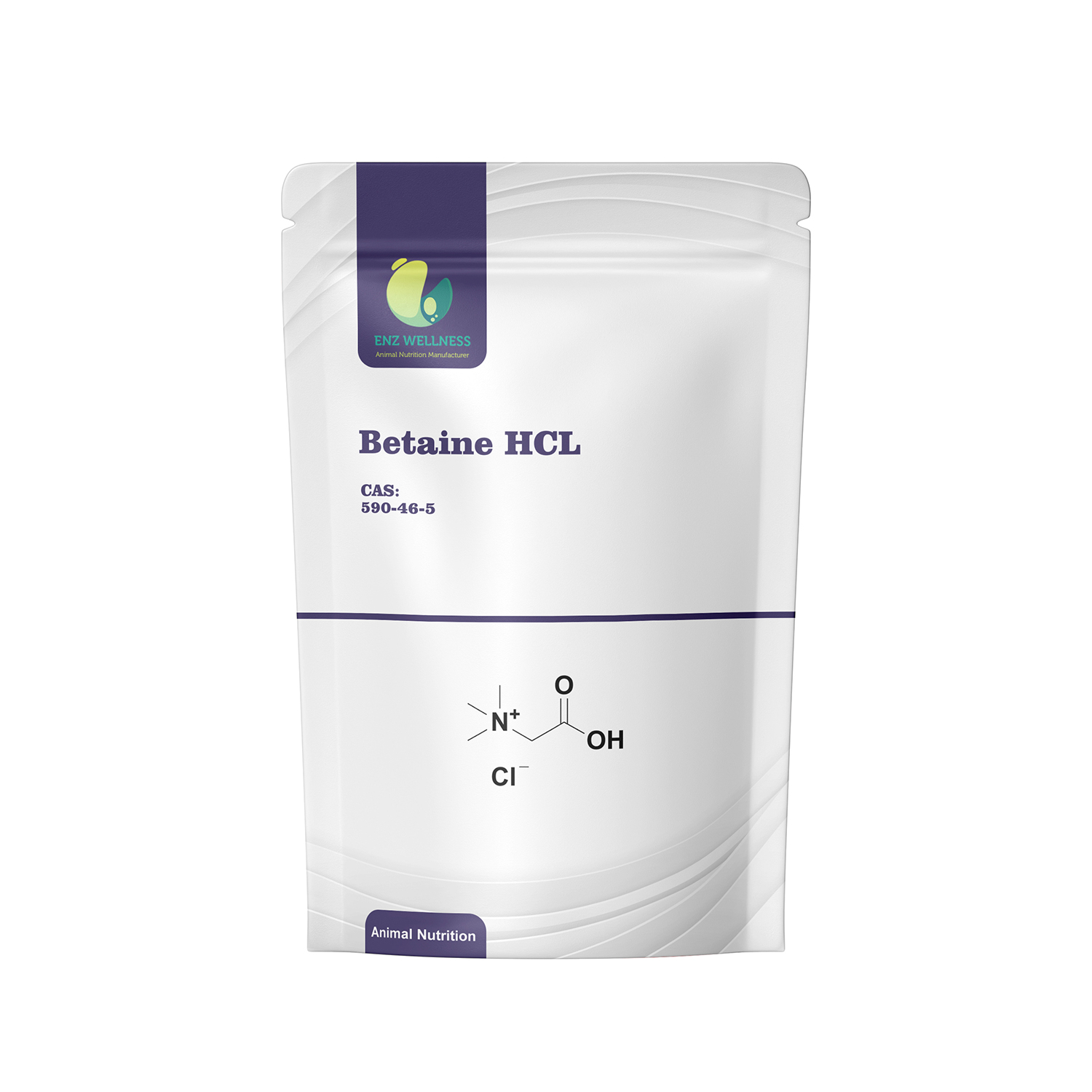
CAS No.: 590-46-5
Chemical name: Betaine Hydrochloride
Common names:
- Betaine HCl
- Betaine Hydrochloride
- Betaine Hydrochloride Salt
- Trimethylglycine Hydrochloride
Molecular formula: C₅H₁₂ClNO₂
Molecular weight: 153.61 g/mol
Product category: Feed additive / Animal nutrition ingredient / Pharmaceutical and nutritional raw material
3. Structural Formula
Betaine HCl consists of betaine associated with hydrochloric acid.
Structural representation
(CH₃)₃N⁺–CH₂–COOH · Cl⁻
It can also be described as the hydrochloride salt of trimethylglycine.
Molecular Formula
C₅H₁₂ClNO₂
Molecular Weight
153.61 g/mol
Betaine HCl contains a quaternary ammonium group and a carboxylic acid functionality associated with chloride. The ionic nature of the compound contributes to its high water solubility.
4. Physicochemical Properties
| Property | Description |
|---|---|
| Product Name | Betaine HCl |
| Chemical Name | Betaine Hydrochloride |
| CAS No. | 590-46-5 |
| Molecular Formula | C₅H₁₂ClNO₂ |
| Molecular Weight | 153.61 g/mol |
| Appearance | White crystalline powder or crystals |
| Odor | Odorless or practically odorless |
| Physical Form | Crystalline powder |
| Water Solubility | Highly soluble in water |
| Chemical Nature | Hydrochloride salt of betaine |
| pH | Acidic in aqueous solution; specification-dependent |
| Stability | Generally stable under recommended storage conditions |
| Hygroscopicity | May absorb moisture under high-humidity conditions |
| Storage | Store in a cool, dry place in tightly closed packaging |
| Light Sensitivity | Generally stable under normal storage conditions |
Important Technical Note
Betaine HCl is chemically different from Betaine Anhydrous:
| Product | Molecular Formula | Molecular Weight |
|---|---|---|
| Betaine Anhydrous | C₅H₁₁NO₂ | 117.15 g/mol |
| Betaine HCl | C₅H₁₂ClNO₂ | 153.61 g/mol |
| Betaine Monohydrate | Betaine + H₂O | ~135.16 g/mol |
Because the hydrochloride salt contains additional HCl, its percentage of betaine by weight is lower than that of anhydrous betaine. When formulating feeds, nutritional calculations should therefore be based on the actual assay and product specification.
5. Nutritional Functions
5.1 Source of Betaine
Betaine HCl provides betaine in a hydrochloride salt form. Betaine is naturally involved in animal metabolism and can serve as a methyl-group donor and organic osmolyte.
5.2 Methyl-Group Donation
Betaine participates in the methionine cycle and can donate a methyl group for the remethylation of homocysteine to methionine.
This metabolic function links betaine with:
- Methionine metabolism
- Homocysteine metabolism
- Protein synthesis
- Methylation reactions
- Lipid metabolism
- General metabolic efficiency
5.3 Osmoregulation
Betaine functions as an organic osmolyte, helping cells maintain water balance and osmotic stability.
This is particularly relevant when animals experience environmental challenges such as:
- High temperatures
- Heat stress
- Dehydration
- Osmotic stress
- Other physiological challenges
5.4 Acidifying Function
Unlike Betaine Anhydrous, Betaine HCl also provides an acidic component due to its hydrochloride form.
When used in feed formulations, it may contribute to the overall acidification characteristics of the diet. However, its effect on gastrointestinal pH depends on the complete diet, dosage, buffering capacity, animal species, and physiological conditions.
6. Application and Benefits
6.1 Poultry Feed
Betaine HCl can be incorporated into poultry nutritional programs for:
- Broilers
- Layers
- Breeders
- Pullets
Potential nutritional benefits include:
- Supporting methyl-group metabolism
- Supporting cellular hydration
- Supporting osmotic balance
- Supporting animals during heat stress
- Supporting nutrient utilization
- Supporting growth and production performance
- Contributing to metabolic efficiency
Betaine HCl can be used as part of a broader nutritional strategy, particularly where environmental heat and metabolic stress are concerns.
6.2 Swine Feed
Betaine HCl can be used in swine nutrition, subject to applicable regulations and product specifications.
Potential applications include:
- Piglet feed
- Grower-finisher feed
- Sow diets
- General swine nutrition
Potential benefits include:
- Supporting methyl metabolism
- Supporting cellular osmotic balance
- Supporting growth performance
- Supporting lean tissue development
- Supporting nutrient utilization
- Supporting animals under environmental stress
6.3 Ruminant Nutrition
Betaine HCl may also be incorporated into nutritional programs for:
- Dairy cattle
- Beef cattle
- Calves
- Sheep
- Goats
Its betaine component contributes to methyl-group metabolism and osmotic regulation.
In dairy production, betaine-containing nutritional strategies may be used to support animals exposed to high environmental temperatures and associated metabolic challenges.
6.4 Aquaculture
Betaine-containing ingredients are also used in aquaculture nutrition.
Potential applications include:
- Fish feed
- Shrimp feed
- Crustacean feed
- Other aquatic animal feeds
Betaine may contribute to:
- Feed palatability
- Feeding response
- Osmotic regulation
- Stress tolerance
- Growth performance
- Nutrient utilization
The suitability of Betaine HCl specifically should be evaluated according to species, formulation requirements, and local feed regulations.
7. Betaine HCl and Heat-Stress Management
Heat stress can significantly affect animal production by reducing feed intake and impairing growth, reproduction, feed efficiency, and other production parameters.
Betaine functions as a compatible organic osmolyte and may help cells maintain water balance during environmental stress.
Therefore, Betaine HCl can be incorporated into nutritional programs where betaine supplementation is appropriate.
However, Betaine HCl should be considered a nutritional support ingredient rather than a standalone treatment for heat stress. Effective heat-stress management should also address drinking water availability, ventilation, stocking density, housing conditions, electrolyte balance, and overall diet formulation.
8. Betaine HCl as a Methyl Donor
Betaine is an important methyl donor in animal metabolism.
A simplified metabolic pathway is:
Betaine → Methyl donation → Homocysteine → Methionine
Through this pathway, betaine contributes to methyl-group metabolism and can support the regeneration of methionine.
This function makes betaine nutritionally relevant in diets where efficient utilization of methyl donors is important.
9. Acidification and Digestive Applications
Betaine HCl is sometimes included in nutritional formulations where an acidic ingredient is desirable.
Its hydrochloride form differentiates it from Betaine Anhydrous because it contributes an acidic character to the formulation.
Potential formulation considerations include:
- Feed acidification
- Gastrointestinal environment
- Nutrient digestion
- Feed formulation balance
- Compatibility with other acidifiers
The actual physiological effect should not be overstated because gastrointestinal pH is influenced by many factors, including feed composition, buffering capacity, gastric secretions, animal age, and species.
10. Target Animals
Depending on local regulatory approval and the intended formulation, Betaine HCl may be used in nutritional products for:
- Broilers
- Layers
- Poultry breeders
- Piglets
- Growing-finishing pigs
- Sows
- Dairy cattle
- Beef cattle
- Sheep
- Goats
- Fish
- Shrimp
- Other aquaculture species
The appropriate inclusion level depends on species, age, production stage, diet composition, product purity, and nutritional objective.
11. Feed Applications
Betaine HCl can be incorporated into:
- Complete animal feed
- Feed premixes
- Concentrated feed
- Functional feed additives
- Poultry feed formulations
- Swine feed formulations
- Ruminant feed
- Aquaculture feed
- Customized animal nutrition products
It can be formulated with other feed ingredients, including amino acids, vitamins, minerals, electrolytes, enzymes, organic acids, and other nutritional additives, subject to compatibility and regulatory requirements.
12. Advantages of Betaine HCl
1. Concentrated Betaine Source
Betaine HCl provides a standardized source of betaine in hydrochloride form.
2. Methyl-Group Donor
It contributes to methyl-group metabolism and the methionine cycle.
3. Osmolyte Function
Betaine supports cellular water balance and osmotic regulation.
4. Useful in Heat-Stress Nutrition
Betaine supplementation can form part of nutritional programs designed to support animals under heat-stress conditions.
5. Acidic Character
The HCl form provides an acidic component that can be useful in specific feed formulations.
6. Broad Nutritional Applications
Betaine-containing products can be used across poultry, swine, ruminant, and aquaculture nutrition.
7. Convenient Powder Form
Betaine HCl is generally supplied as a crystalline powder that is convenient for handling and incorporation into feed premixes.
13. Betaine HCl vs. Betaine Anhydrous
| Feature | Betaine HCl | Betaine Anhydrous |
|---|---|---|
| Chemical name | Betaine Hydrochloride | Betaine |
| CAS No. | 590-46-5 | 107-43-7 |
| Formula | C₅H₁₂ClNO₂ | C₅H₁₁NO₂ |
| Molecular weight | 153.61 g/mol | 117.15 g/mol |
| Main function | Betaine source + hydrochloride form | Betaine source |
| Methyl donor | Yes | Yes |
| Osmolyte | Yes | Yes |
| Acidic character | Yes | Much less pronounced |
| Betaine concentration by weight | Lower | Higher |
| Typical form | White crystalline powder | White crystalline powder |
This distinction is important when calculating the effective betaine contribution of a feed formulation.
14. Quality Control
For professional commercial supply, Betaine HCl should be manufactured according to appropriate quality standards.
Typical quality-control parameters may include:
- Identification
- Betaine HCl assay
- Betaine content
- Appearance
- Moisture
- pH
- Particle size
- Bulk density
- Heavy metals
- Microbiological quality, where applicable
- Other impurities according to the relevant specification
A Certificate of Analysis (CoA) should be available for individual production batches where required.
15. Packaging
Betaine HCl can be supplied in different packaging formats according to customer requirements.
Common industrial packaging options include:
- 1 kg bags
- 5 kg bags
- 10 kg bags
- 20 kg bags
- 25 kg bags
- Customized bulk packaging
Moisture-resistant packaging is recommended to help maintain product quality during transportation and storage.
16. Storage and Handling
Store Betaine HCl in a cool, dry and well-ventilated area.
Recommended practices:
- Keep the original container tightly closed.
- Protect the product from moisture and high humidity.
- Avoid prolonged exposure to excessive heat.
- Protect from contamination.
- Minimize dust generation during handling.
- Follow the manufacturer’s SDS and product-specific storage instructions.
The exact shelf life and recommended storage temperature should be taken from the manufacturer’s current specification and packaging label.
17. Regulatory Considerations
The regulatory status and permitted applications of Betaine HCl vary by country and product category.
Before importing, registering, marketing, or using the product, customers should verify:
- Approved animal species
- Permitted applications
- Maximum inclusion levels
- Feed additive classification
- Labeling requirements
- Purity specifications
- Import requirements
- Local registration requirements
- Permitted nutritional claims
Commercial website claims should be adapted to the regulations of the target market.
18. Safety and Documentation
For commercial and industrial applications, the following documents may be available:
- Certificate of Analysis (CoA)
- Safety Data Sheet (SDS)
- Product Specification
- Technical Data Sheet (TDS)
- Batch information
- Packaging specification
- Regulatory documentation, where applicable
Users should consult the current SDS for detailed handling, occupational safety, and emergency information.
19. Technical Summary
| Item | Information |
|---|---|
| Product Name | Betaine HCl |
| Full Name | Betaine Hydrochloride |
| CAS No. | 590-46-5 |
| Molecular Formula | C₅H₁₂ClNO₂ |
| Molecular Weight | 153.61 g/mol |
| Structural Formula | (CH₃)₃N⁺–CH₂–COOH · Cl⁻ |
| Appearance | White crystalline powder |
| Main Functions | Methyl donor, osmolyte, acidic nutritional ingredient |
| Main Applications | Animal feed and nutritional formulations |
| Target Species | Poultry, swine, ruminants, aquaculture |
| Key Benefits | Supports methyl metabolism, cellular hydration, osmotic balance and heat-stress nutrition |
| Water Solubility | Highly soluble |
| Storage | Cool, dry conditions |
| Form | Crystalline powder |
| Typical Documents | CoA, SDS, TDS, Product Specification |
20. Conclusion
Betaine HCl (Betaine Hydrochloride) is a versatile nutritional ingredient that combines the physiological functions of betaine with the characteristics of a hydrochloride salt. It provides a source of betaine for methyl-group metabolism and cellular osmotic regulation, while its HCl form contributes an acidic character to feed formulations.
It can be incorporated into nutritional programs for poultry, swine, ruminants, and aquaculture where permitted. Its applications include supporting cellular hydration, methyl metabolism, nutrient utilization, production performance, and nutritional strategies for animals exposed to environmental stress.
For feed manufacturers, premix producers, distributors, and animal nutrition companies, Betaine HCl provides a practical and standardized form of betaine for modern feed formulation.