Canthaxanthin
1. Introduction
Canthaxanthin is a naturally occurring red-orange carotenoid pigment belonging to the xanthophyll family. It is widely used as a coloring agent and pigmentation enhancer in animal nutrition, particularly in poultry feed and aquaculture.
In animal feed, canthaxanthin is valued for its ability to deposit carotenoid pigments into tissues and products such as egg yolks, poultry skin, and fish flesh, helping achieve a more desirable and consistent coloration.
Commercial canthaxanthin is generally supplied as a stabilized powder or beadlet preparation, often formulated with carriers and antioxidants to improve stability, dispersion, and handling.
2. Chemical Information
| Property | Information |
|---|---|
| Product Name | Canthaxanthin |
| Chemical Class | Carotenoid / Xanthophyll |
| CAS No. | 514-78-3 |
| Molecular Formula | C₄₀H₅₂O₂ |
| Molecular Weight | 564.84 g/mol |
| Chemical Name | β,β-Carotene-4,4′-dione |
| Appearance | Red to reddish-purple crystalline material or formulated powder/beadlets |
| Color | Red-orange to reddish-purple |
| Water Solubility | Practically insoluble |
| Solubility | Soluble in selected organic solvents; formulation-dependent |
| Pigment Type | Fat-soluble carotenoid |
CAS Number
514-78-3
Molecular Formula
C₄₀H₅₂O₂
Structural Formula
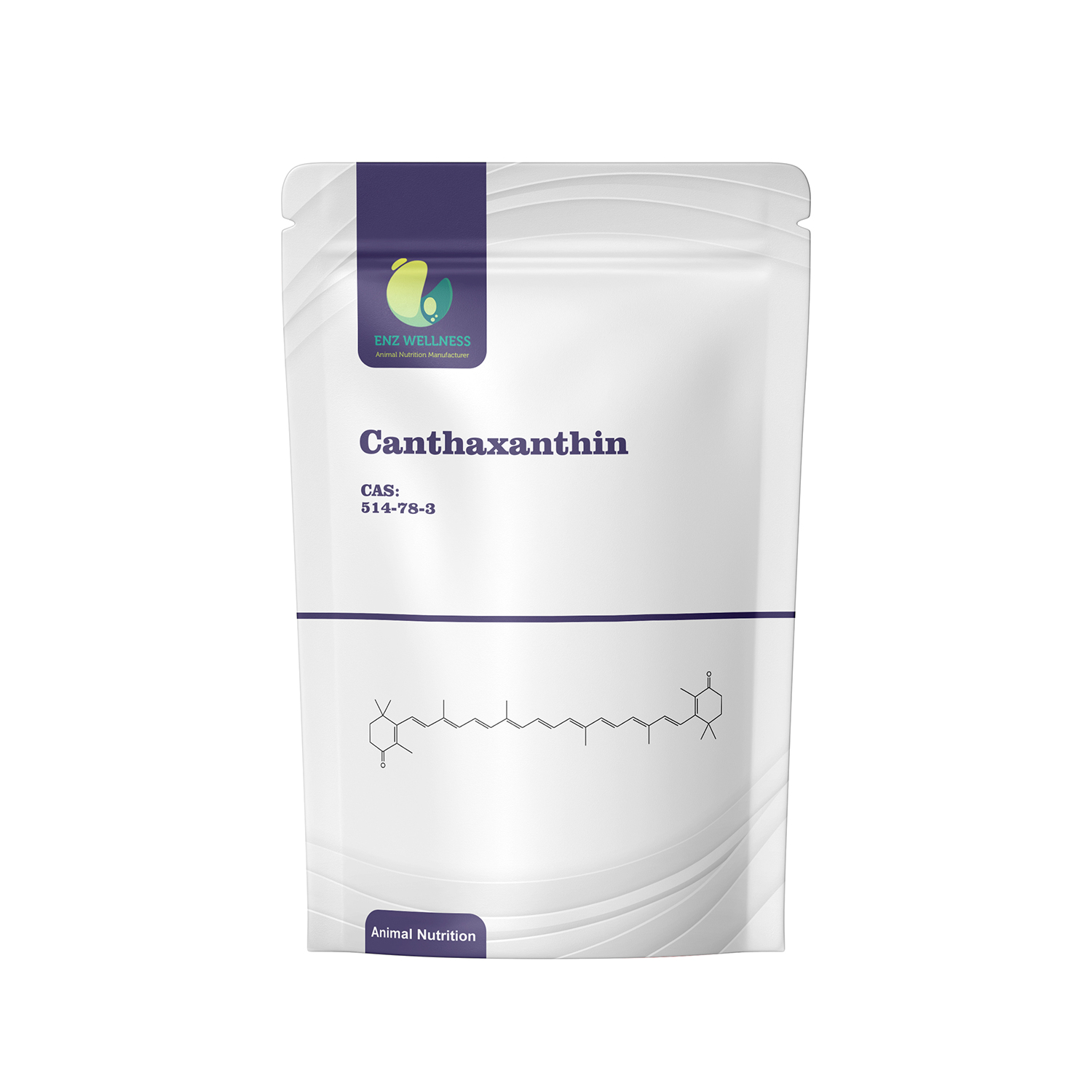
Canthaxanthin is a highly conjugated carotenoid containing a long chain of alternating double bonds with keto groups at the 4 and 4′ positions.
A simplified structural representation is:
β,β-Carotene-4,4′-dione
Its extensive conjugated double-bond system is responsible for its strong characteristic red-orange pigmentation.
3. Physicochemical Properties
Canthaxanthin is a lipophilic carotenoid, meaning it has very low water solubility and is more compatible with oils and lipid-based systems.
| Property | Description |
|---|---|
| Physical Form | Crystalline material or formulated feed-grade powder/beadlets |
| Color | Red-orange / reddish-purple |
| Odor | Generally odorless or practically odorless |
| Water Solubility | Very low |
| Fat Solubility | Good relative to water |
| Light Stability | Sensitive to intense light |
| Oxidation Stability | Sensitive to oxidation |
| Heat Stability | Depends strongly on formulation and processing conditions |
| Hygroscopicity | Generally low for the pure pigment; commercial formulations may differ |
| Stability | Improved by antioxidants, suitable carriers, protective packaging, and controlled storage |
Because pure canthaxanthin has poor water dispersibility, commercial feed products are commonly formulated as beadlets or stabilized preparations to improve mixing and bioavailability.
4. Function and Mechanism
Canthaxanthin primarily functions as a carotenoid pigment source.
After ingestion, carotenoids can be absorbed through the gastrointestinal tract and incorporated into tissues or animal products. Depending on species, diet, dose, and formulation, canthaxanthin can contribute to pigmentation of:
- Egg yolks
- Poultry skin
- Poultry tissues
- Fish flesh
- Other animal products where carotenoid deposition occurs
Its conjugated molecular structure allows it to strongly absorb visible light, producing its characteristic red-orange color.
Main nutritional functions
1. Pigmentation enhancement
Improves the deposition of red-orange carotenoid pigments.
2. Egg yolk coloration
Can contribute to stronger and more uniform yolk pigmentation in laying hens.
3. Poultry skin pigmentation
Can contribute to desirable skin coloration in poultry when included as part of an appropriate pigment program.
4. Aquaculture pigmentation
Can contribute to flesh coloration in certain farmed fish and aquatic species.
5. Carotenoid supplementation
Provides a concentrated source of dietary carotenoid.
5. Applications in Animal Nutrition
Poultry Feed
Canthaxanthin is widely used in poultry nutrition, particularly in layer and broiler pigmentation programs.
Potential applications include:
- Egg yolk pigmentation
- Skin pigmentation
- Meat/tissue pigmentation
- Improving pigmentation consistency
- Supporting market-specific product color requirements
Canthaxanthin is often combined with other carotenoids, such as lutein, zeaxanthin, or other yellow/red pigments, to achieve a specific target color.
Layer Feed
Canthaxanthin can be incorporated into layer diets to enhance egg yolk color.
The final yolk color is influenced by:
- Canthaxanthin inclusion level
- Other dietary carotenoids
- Feed composition
- Hen age
- Breed/genetics
- Feed intake
- Absorption and metabolism
- Storage conditions of the pigment
Broiler Feed
Canthaxanthin may be used in broiler pigmentation programs to support skin and tissue coloration, particularly in markets where consumers prefer more intensely pigmented poultry.
Aquaculture
Canthaxanthin can be used as a carotenoid source in selected aquaculture feeds.
Potential applications include:
- Flesh pigmentation
- Product appearance
- Carotenoid supplementation
- Supporting market-specific color requirements
The response varies significantly between fish species, and the appropriate inclusion strategy should be established according to species-specific feed requirements and local regulations.
6. Key Benefits
Enhanced Pigmentation
Provides strong red-orange pigmentation for animal products.
Improved Color Consistency
Can help achieve a more uniform pigmentation when feed formulation and processing are properly controlled.
High Pigment Potency
Canthaxanthin is a concentrated carotenoid pigment, allowing relatively low inclusion levels in formulated feeds.
Flexible Feed Applications
Suitable for pigmentation programs in poultry and selected aquaculture species.
Compatible with Pigment Blends
Can be combined with yellow and other red carotenoids to achieve specific target shades.
Commercial Appearance
Can contribute to the desired visual characteristics of eggs, poultry products, and certain aquaculture products.
7. Canthaxanthin vs. Other Carotenoids
| Ingredient | Main Color Contribution | Typical Feed Application |
|---|---|---|
| Canthaxanthin | Red-orange | Egg yolk, poultry pigmentation, aquaculture |
| Lutein | Yellow | Egg yolk and poultry pigmentation |
| Zeaxanthin | Yellow-orange | Poultry and egg pigmentation |
| β-Carotene | Yellow-orange | Pigmentation and nutritional carotenoid source |
| Astaxanthin | Red | Aquaculture pigmentation, especially selected fish/crustaceans |
A combination of carotenoids can often provide better control over the final pigmentation than relying on a single pigment.
8. Recommended Feed Applications
The exact inclusion rate should be determined according to the active canthaxanthin concentration of the commercial preparation, target pigmentation, animal species, total dietary carotenoid contribution, and applicable regulations.
Typical commercial products may have different concentrations, such as:
- Pure/high-purity canthaxanthin
- Stabilized canthaxanthin powder
- Canthaxanthin beadlets
- Canthaxanthin premixes
Therefore, it is preferable to specify dosage based on mg of active canthaxanthin per kg of complete feed, rather than giving a universal product dosage.
For a commercial website, you can state:
Usage: Use according to animal species, target pigmentation, product specification, and applicable feed regulations. The recommended inclusion rate should be calculated based on the active canthaxanthin concentration of the commercial preparation.
9. Quality Control
High-quality feed-grade canthaxanthin should be evaluated for:
- Assay / active canthaxanthin content
- Identification
- Pigment purity
- Moisture
- Particle size
- Carrier composition
- Residual solvents, where applicable
- Heavy metals
- Microbiological quality
- Oxidative stability
- Dispersion characteristics
- Stability during feed processing and storage
For formulated products, assay and stability should be evaluated according to the manufacturer’s specification and CoA.
10. Packaging
Commercial packaging may include:
- Aluminum foil bags
- Light-resistant laminated bags
- Fiber drums
- Cartons
- Customized packaging for premix applications
Packaging should provide protection from:
- Light
- Oxygen
- Moisture
- Excessive heat
11. Storage
Store canthaxanthin products in a cool, dry and well-ventilated environment, protected from direct sunlight and excessive heat.
Recommended practices include:
- Keep the container tightly closed.
- Minimize exposure to air and moisture.
- Protect from direct light.
- Avoid prolonged exposure to high temperatures.
- Use according to the manufacturer’s shelf-life specification.
Because carotenoids are susceptible to oxidation and light degradation, appropriate packaging and storage are particularly important for maintaining pigment potency.
12. Regulatory Considerations
Canthaxanthin is used as a feed additive/coloring substance in various markets, but regulatory status, permitted species, maximum use levels, labeling requirements, and purity specifications differ by country or region.
For products intended for food-producing animals, manufacturers and feed formulators should verify:
- Local feed-additive authorization
- Permitted animal species
- Maximum inclusion levels
- Labeling requirements
- Purity specifications
- Feed manufacturing requirements
- Import requirements
The commercial specification should always be aligned with the regulations of the target market.
13. Technical Summary
| Parameter | Specification / Information |
|---|---|
| Name | Canthaxanthin |
| CAS No. | 514-78-3 |
| Formula | C₄₀H₅₂O₂ |
| Molecular Weight | 564.84 g/mol |
| Category | Carotenoid / Xanthophyll |
| Color | Red-orange / reddish-purple |
| Solubility | Practically insoluble in water |
| Primary Function | Pigmentation |
| Major Applications | Poultry, layers, broilers, selected aquaculture |
| Main Targets | Egg yolk, poultry skin/tissue, fish flesh |
| Storage | Cool, dry, protected from light and oxygen |
| Commercial Form | Powder, stabilized preparation, beadlets, premix |