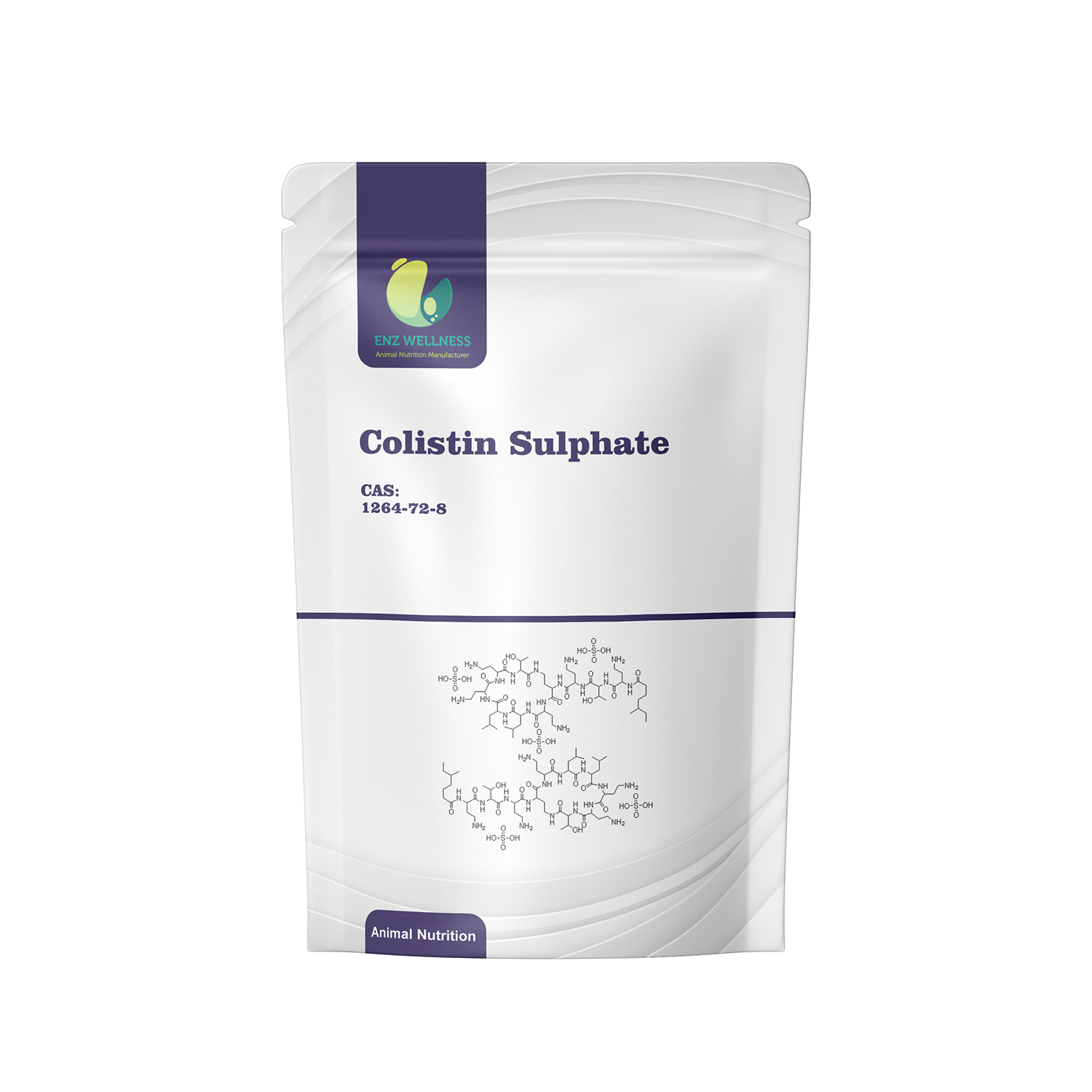
Colistin Sulphate
1. Introduction
Colistin Sulphate is the sulfate salt of colistin, a polymyxin-class antimicrobial used in veterinary medicine and animal health applications. It is particularly active against susceptible Gram-negative bacteria.
Colistin is a cyclic polypeptide antibiotic that interacts with the bacterial outer membrane, disrupting membrane integrity and leading to bacterial cell death. In veterinary products, colistin sulfate has historically been used in formulations for poultry, swine, calves, and other food-producing animals, subject to the regulations of the target market.
Because colistin is also an important antimicrobial in human medicine, its veterinary use is subject to significant antimicrobial-resistance and stewardship considerations. Commercial use must therefore follow the applicable national regulations, authorized indications, dosage requirements, and withdrawal periods.
2. Chemical Information
| Property | Information |
|---|---|
| Product Name | Colistin Sulphate |
| Alternative Spelling | Colistin Sulfate |
| Chemical Class | Polymyxin antibiotic |
| CAS No. | 1264-72-8 |
| Molecular Formula | C₅₂H₉₈N₁₆O₁₃ · 5H₂SO₄ (commonly represented for colistin sulfate complex) |
| Active Components | Primarily colistin A and colistin B |
| Appearance | White to off-white powder |
| Main Activity | Antibacterial |
| Target Organisms | Mainly susceptible Gram-negative bacteria |
CAS Number
1264-72-8
Chemical Nature
Unlike a simple single-component small-molecule API, commercial colistin sulfate is generally associated with a mixture of closely related polymyxin components, principally colistin A (polymyxin E1) and colistin B (polymyxin E2).
Consequently, commercial specifications should be assessed according to the applicable pharmacopoeial or manufacturer specification rather than treating the material as an absolutely single molecular species.
Structural Characteristics
Colistin is a cyclic lipopeptide/polymyxin consisting of:
- A cyclic peptide ring
- Multiple positively charged amino groups
- A fatty acyl side chain
- Several amino-acid residues
- Sulfate salt counterions in the commercial sulfate form
Its amphipathic structure is fundamental to its antibacterial activity.
3. Physicochemical Properties
| Property | Description |
|---|---|
| Physical Form | Fine powder |
| Color | White to off-white |
| Odor | Generally characteristic or practically odorless |
| Water Solubility | Soluble in water |
| Lipid Character | Amphipathic molecule |
| Stability | Product- and formulation-dependent |
| Light Sensitivity | Protect from excessive light |
| Moisture Sensitivity | Store in a dry environment |
| pH | Specification- and concentration-dependent |
Because colistin sulfate is a peptide antibiotic and commercial material may contain multiple related components, assay, potency, component profile, moisture, and microbiological quality should be controlled according to the applicable specification.
4. Mechanism of Action
Colistin is primarily active against Gram-negative bacteria.
Its mechanism involves interaction with the bacterial outer membrane.
Step 1 — Electrostatic interaction
Colistin contains positively charged groups that interact with negatively charged components of the bacterial outer membrane, particularly lipopolysaccharide (LPS).
Step 2 — Membrane disruption
Colistin displaces stabilizing divalent cations associated with the bacterial membrane and disrupts the organization of the outer membrane.
Step 3 — Increased membrane permeability
The damaged membrane becomes increasingly permeable, causing leakage of cellular components.
Step 4 — Bacterial cell death
Severe membrane disruption results in loss of cellular integrity and ultimately bacterial death.
This membrane-directed mechanism differs from antibiotics that primarily inhibit protein synthesis, DNA replication, or cell-wall synthesis.
5. Antibacterial Spectrum
Colistin primarily demonstrates activity against susceptible Gram-negative organisms.
Depending on susceptibility and bacterial strain, relevant organisms may include:
- Escherichia coli
- Salmonella spp.
- Klebsiella spp.
- Pseudomonas spp. — susceptibility is variable
- Other susceptible Enterobacterales
Activity against Gram-positive bacteria is generally poor, because the structure of their cell envelope differs substantially from that of Gram-negative bacteria.
Important
Susceptibility should not be assumed solely from bacterial species. Antimicrobial susceptibility testing and local veterinary guidance are important because resistance to colistin has become an important global concern.
6. Applications in Veterinary Medicine
Historically, colistin sulfate has been used in veterinary medicine for susceptible bacterial infections, particularly those involving the gastrointestinal tract.
Potential veterinary applications have included:
Poultry
Used historically for susceptible Gram-negative bacterial infections, particularly those involving:
- E. coli
- Salmonella spp.
- Enteric bacterial disease
Swine
Historically used in pigs for susceptible enteric bacterial infections, including certain E. coli-associated diseases.
Calves and Other Livestock
Depending on local authorization, colistin-containing veterinary medicines may be used for selected susceptible bacterial infections.
Use must always follow the approved product label and veterinary direction.
7. Key Advantages
Strong Activity Against Susceptible Gram-Negative Bacteria
Colistin has a distinctive membrane-targeting mechanism and activity against a range of Gram-negative organisms.
Established Veterinary API
Colistin sulfate has a long history of use in veterinary pharmaceutical formulations.
Water-Soluble Salt Form
The sulfate form provides useful water solubility for certain pharmaceutical formulations.
Distinct Mechanism
Its membrane-disrupting mechanism differs from many other antibacterial classes.
Suitable for Pharmaceutical Formulation
Depending on the approved product, colistin sulfate can be formulated into suitable veterinary dosage forms.
8. Antimicrobial Resistance Considerations
This section is particularly important for a commercial website.
Colistin is considered a critically important antimicrobial because of its importance in human medicine. The emergence and spread of mobile colistin-resistance mechanisms, including mcr genes, has resulted in increased international concern regarding inappropriate or unnecessary colistin use.
Therefore:
- Do not position colistin as a routine growth promoter.
- Avoid claims that it should be used routinely for prevention.
- Use only where legally authorized.
- Follow veterinary diagnosis and susceptibility considerations.
- Observe approved dosage and treatment duration.
- Observe applicable withdrawal periods.
- Follow antimicrobial stewardship requirements.
- Avoid unnecessary or indiscriminate use.
For an international B2B website, wording such as “for veterinary use where permitted and approved” is strongly recommended.
9. Quality Control
A high-quality colistin sulfate API should be evaluated for:
- Identification
- Potency/assay
- Colistin A content
- Colistin B content
- Component profile
- Water/moisture
- pH
- Sulfate content, where applicable
- Microbiological quality
- Related substances
- Residual solvents, where applicable
- Heavy metals/elemental impurities
- Endotoxin, where applicable to the intended dosage form
- Stability
Because colistin sulfate is a complex of closely related components, chromatographic component profiling is particularly relevant to quality control.
10. Pharmaceutical Forms
Colistin sulfate can be used as an API for various veterinary pharmaceutical preparations, depending on regulatory authorization.
Potential dosage forms include:
- Oral powders
- Soluble powders
- Premixes
- Oral solutions
- Veterinary pharmaceutical formulations
- Other approved dosage forms
The appropriate formulation depends on the target species, indication, route of administration, product registration, and local regulations.
11. Storage
Store colistin sulfate according to the manufacturer’s approved specification, generally in a:
- Cool
- Dry
- Well-sealed
- Light-protected
environment.
Recommended practices include:
- Keep the original packaging tightly closed.
- Protect from moisture.
- Avoid prolonged exposure to heat.
- Protect from direct sunlight.
- Prevent contamination.
- Follow the manufacturer’s specified temperature and shelf-life requirements.
12. Packaging
Common commercial packaging may include:
- Aluminum foil bags
- Double polyethylene-lined bags
- Fiber drums
- HDPE containers
- Pharmaceutical-grade sealed containers
- Customized packaging
Packaging should provide appropriate protection from moisture, contamination, light, and environmental exposure.
13. Regulatory Considerations
Colistin has significant regulatory restrictions in many markets, particularly because of antimicrobial resistance and its importance in human medicine.
The regulatory status can differ substantially between countries.
Before marketing or supplying colistin sulfate, confirm:
- Whether veterinary use is permitted
- Permitted animal species
- Authorized indications
- Maximum dosage/inclusion level
- Route of administration
- Treatment duration
- Withdrawal period
- Maximum residue limits (MRLs), where applicable
- Import requirements
- API quality standards
- Local antimicrobial stewardship regulations
Do not state that colistin sulfate is universally approved for animal feed or veterinary use.
For a global website, the safer commercial positioning is:
Colistin Sulphate is a veterinary antimicrobial API for use in authorized pharmaceutical formulations and markets where permitted by applicable regulations.
14. Colistin Sulphate vs. Colistin Methanesulfonate
These two forms should not be presented as interchangeable products.
| Feature | Colistin Sulphate | Colistin Methanesulfonate |
|---|---|---|
| Salt/form | Sulfate | Methanesulfonate |
| Common abbreviation | Colistin sulfate | CMS |
| Chemical behavior | Different salt form | Prodrug/derivative form |
| Water solubility | Soluble | Highly water soluble |
| Pharmaceutical use | Certain veterinary/oral applications | Used in specific pharmaceutical applications |
| Regulatory status | Market-dependent | Market-dependent |
The appropriate form depends on the route of administration and registered formulation.
15. Technical Summary
| Parameter | Information |
|---|---|
| Product Name | Colistin Sulphate |
| Alternative Name | Colistin Sulfate |
| CAS No. | 1264-72-8 |
| Class | Polymyxin antibiotic |
| Main Active Components | Colistin A and Colistin B |
| Appearance | White to off-white powder |
| Water Solubility | Soluble |
| Primary Target | Susceptible Gram-negative bacteria |
| Mechanism | Bacterial outer-membrane disruption |
| Applications | Veterinary pharmaceutical formulations |
| Target Species | Market/registration dependent |
| Storage | Cool, dry, sealed and protected from light |
| Regulatory Status | Highly market-dependent |
| Key Consideration | Antimicrobial resistance and stewardship |