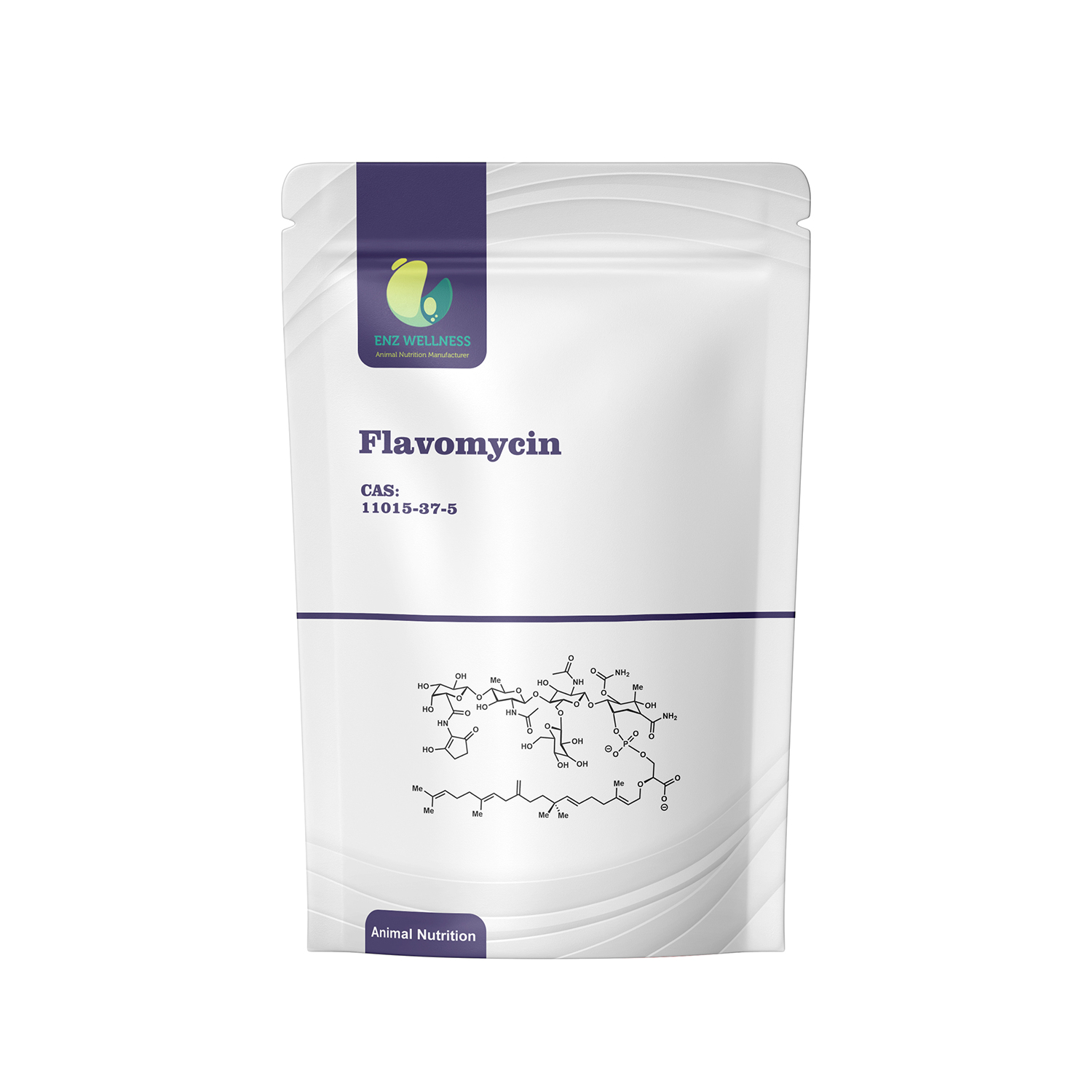
Flavomycin
Introduction
Flavomycin, commonly known as flavophospholipol (FPL), is a fermentation-derived phosphoglycolipid antibacterial feed additive used in animal nutrition. It has activity primarily against susceptible Gram-positive bacteria and has been used in poultry and swine diets to support intestinal microbial balance and production performance where permitted by local regulations.
Unlike conventional single-molecule APIs, commercial flavomycin is generally characterized by its antibacterial potency and composition of related phosphoglycolipid components, rather than by a single molecular formula.
Chemical Information
| Property | Details |
|---|---|
| Product Name | Flavomycin |
| Common Name | Flavophospholipol (FPL) |
| Chemical Class | Phosphoglycolipid antibacterial |
| Origin | Fermentation-derived |
| CAS No. | 11015-37-5 |
| Active Components | Mixture of related flavophospholipol/phosphoglycolipid components |
| Molecular Formula | Not represented by one simple formula for the commercial mixture |
| Molecular Weight | Component-dependent |
| Typical Form | Fine powder |
| Color | White to pale yellow/yellowish |
| Water Solubility | Very low/practically insoluble |
| Commercial Standardization | Usually based on antibacterial activity/potency |
Note: Because commercial flavomycin is a fermentation-derived complex rather than a conventional single-component chemical, the exact composition, potency and analytical specifications should be confirmed against the applicable CoA, specification and regulatory dossier.
Structural Characteristics
Flavomycin belongs to the phosphoglycolipid class of antibacterial compounds. Its active molecules contain structural features that enable interaction with bacterial cell-wall biosynthesis.
The commercial material may contain several closely related active components, so it is more appropriate to describe flavomycin structurally as a phosphoglycolipid complex rather than assigning one molecular structure to the finished feed additive.
Key structural characteristics
- Phosphoglycolipid-type antibacterial compounds
- Fermentation-derived active substances
- Multiple related components may be present
- Lipophilic and polar structural regions contribute to bacterial target interaction
- Activity is primarily directed toward susceptible Gram-positive bacteria
Physicochemical Properties
| Property | Typical Characteristics |
|---|---|
| Appearance | White to pale yellow powder |
| Odor | Characteristic/slight |
| Water Solubility | Practically insoluble |
| Stability | Sensitive to formulation, moisture and storage conditions |
| pH Behavior | Specification/formulation dependent |
| Thermal Stability | Product- and formulation-dependent |
| Light Stability | Should be protected from prolonged exposure |
| Hygroscopicity | Generally low to moderate depending on formulation |
| Assay Basis | Potency/activity rather than simple chemical purity |
Exact values should be established from the specific commercial grade and manufacturer specification.
Mechanism of Action
Flavomycin acts primarily against Gram-positive bacteria by interfering with bacterial cell-wall biosynthesis.
Its active phosphoglycolipid components interact with membrane-associated processes involved in the transport and utilization of peptidoglycan precursors, thereby interfering with the formation of the bacterial cell wall.
This mechanism makes flavomycin particularly relevant to intestinal bacteria such as susceptible Clostridium spp.
Functional effects in the digestive tract may include:
- Reduction of susceptible Gram-positive bacterial populations
- Suppression of undesirable bacterial overgrowth
- Improved microbial balance
- Support for intestinal integrity
- Reduced competition between microorganisms and the host for nutrients
Applications in Animal Nutrition
Poultry
Flavomycin has been used in poultry nutrition where approved, particularly for:
- Broilers
- Layers
- Breeding poultry
- Other poultry production systems
Potential nutritional applications include:
- Supporting intestinal microbial balance
- Managing susceptible Gram-positive bacteria
- Supporting intestinal health
- Improving nutrient utilization
- Supporting feed efficiency
- Maintaining production performance under appropriate management conditions
Swine
Flavomycin can be incorporated into swine feed where permitted.
Potential applications include:
- Piglets
- Grower-finisher pigs
- Breeding animals
It may be used to support:
- Intestinal microbial balance
- Feed utilization
- Growth performance
- Digestive health
- Management of susceptible Gram-positive intestinal bacteria
Other Livestock
Use in other species should follow the relevant local registration, label and veterinary-feed regulations.
Key Benefits
1. Gram-Positive Antibacterial Activity
Flavomycin is primarily active against susceptible Gram-positive bacteria, making it useful for specific intestinal microbial-management applications.
2. Intestinal Microbial Balance
Its selective antibacterial activity can help manage populations of susceptible undesirable bacteria in the gastrointestinal tract.
3. Feed Efficiency Support
Under appropriate nutritional and management conditions, flavomycin may contribute to improved feed utilization and production efficiency.
4. Poultry and Swine Applications
It has established applications in animal nutrition, particularly in poultry and swine production, subject to regulatory approval.
5. Fermentation-Derived Product
Flavomycin is produced through microbial fermentation and is commercially supplied as a standardized feed additive.
Flavomycin vs. Other Feed Antibacterials
| Characteristic | Flavomycin | Enramycin | Bacitracin | Chlortetracycline |
|---|---|---|---|---|
| Chemical class | Phosphoglycolipid | Glycopeptide | Cyclic peptide | Tetracycline |
| Origin | Fermentation | Fermentation | Fermentation | Fermentation/chemical processing |
| Main activity | Mainly Gram-positive | Mainly Gram-positive | Mainly Gram-positive | Broader spectrum |
| Primary target | Cell-wall precursor processes | Cell-wall synthesis | Cell-wall synthesis | 30S ribosome |
| Typical feed use | Poultry/swine where permitted | Poultry/swine where permitted | Livestock/poultry where permitted | Veterinary/feed applications where permitted |
| Commercial assay | Often potency-based | Potency-based | Potency-based | Chemical assay/purity |
The appropriate choice depends on the target organisms, animal species, production system, regulatory status and antimicrobial stewardship requirements.
Typical Commercial Specifications
Commercial flavomycin is generally specified by activity/potency, rather than simply reporting a percentage of chemically pure active ingredient.
A technical specification may include:
| Parameter | Typical Specification Approach |
|---|---|
| Appearance | Conforms |
| Identification | Positive |
| Antibacterial potency | Specified activity level |
| Active component profile | Conforms |
| Moisture | Within specification |
| Carrier | Declared according to formulation |
| Microbiological quality | Conforms |
| Heavy metals | Within applicable limits |
| Residual solvents/contaminants | Where applicable |
| Stability | Conforms to shelf-life specification |
The actual potency should always be stated according to the manufacturer’s CoA and product specification.
Quality Control
A professional feed-grade flavomycin manufacturing and QC program may include:
- Raw material identification
- Fermentation-process control
- Active-component identification
- Potency/activity assay
- Chromatographic profile
- Moisture determination
- Microbiological examination
- Heavy-metal testing
- Physical appearance
- Particle-size control where applicable
- Stability testing
- Batch-to-batch consistency
- Packaging integrity
Because flavomycin is a fermentation-derived complex, potency and component profile are particularly important quality attributes.
Packaging
Common commercial packaging options include:
- 10 kg bags
- 20 kg bags
- 25 kg bags
- Customized packaging for bulk orders
Packaging should provide adequate protection against:
- Moisture
- Contamination
- Excessive heat
- Direct sunlight
Final packaging specifications should be confirmed according to the customer’s market and regulatory requirements.
Storage
Store in a cool, dry and well-ventilated area in tightly closed original packaging.
Recommended conditions:
- Avoid direct sunlight
- Protect from moisture
- Avoid excessive heat
- Keep container tightly sealed
- Prevent contamination
- Follow the manufacturer’s specified storage temperature and shelf life
Always refer to the product-specific SDS, label and CoA for definitive storage requirements.
Regulatory & Antimicrobial Stewardship
Flavomycin is an antimicrobial feed additive, so its use is jurisdiction-dependent.
For international B2B supply:
- Use only in species and applications for which it is legally authorized.
- Follow the approved inclusion rate and labeling requirements.
- Observe applicable withdrawal periods where required.
- Do not promote antimicrobial products as universally appropriate for growth promotion.
- Follow responsible antimicrobial-use principles.
- Consider local restrictions on veterinary antimicrobial feed additives.
- Product registration requirements may differ substantially between countries.
For export markets, the final product specification and labeling should be aligned with the regulations of the destination country.
Technical Summary
| Item | Specification |
|---|---|
| Product | Flavomycin |
| Common Name | Flavophospholipol |
| CAS No. | 11015-37-5 |
| Class | Phosphoglycolipid antibacterial |
| Source | Fermentation-derived |
| Active Nature | Complex/mixture of related active components |
| Main Spectrum | Primarily Gram-positive bacteria |
| Main Mechanism | Interference with bacterial cell-wall precursor processes |
| Main Species | Poultry, swine and other approved species |
| Typical Application | Feed additive |
| Commercial Assay | Activity/potency-based |
| Water Solubility | Practically insoluble |
| Form | Powder |
| Regulatory Status | Country- and application-dependent |