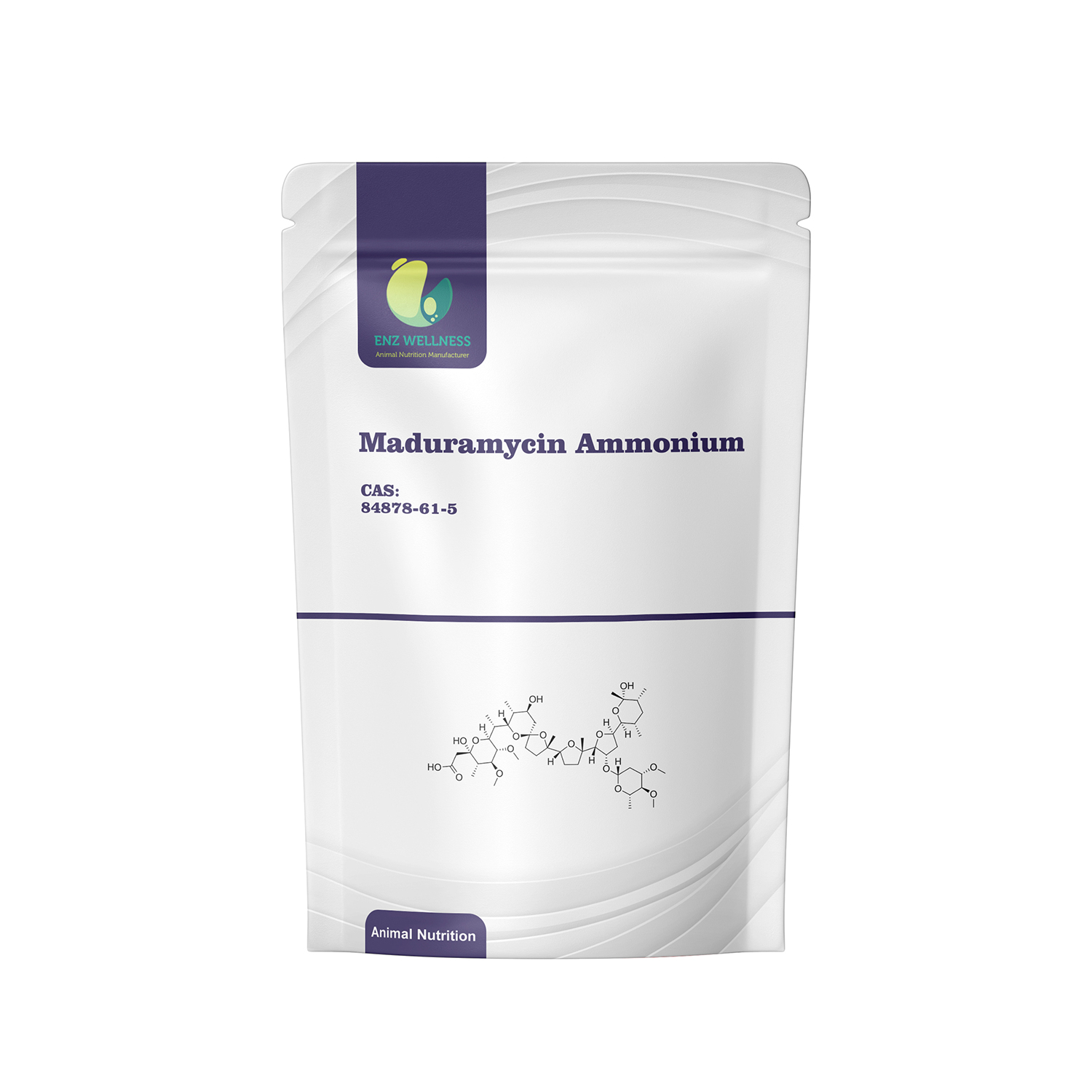
Maduramycin Ammonium
Introduction
Maduramycin Ammonium is a polyether ionophore anticoccidial feed additive used primarily in poultry nutrition for the prevention and control of coccidiosis caused by susceptible Eimeria species, where approved by the relevant regulatory authority.
It is the ammonium salt of maduramycin, a fermentation-derived polyether compound. Maduramycin acts by transporting ions across parasite cell membranes, disrupting ionic balance and ultimately impairing the survival of susceptible coccidia.
Because maduramycin ammonium is an anticoccidial veterinary feed additive, its use should follow the approved species, inclusion rate, withdrawal requirements and local regulatory framework.
Chemical Information
| Property | Details |
|---|---|
| Product Name | Maduramycin Ammonium |
| Common Name | Ammonium Maduramycin |
| Chemical Class | Polyether ionophore |
| Pharmacological Class | Ionophore anticoccidial |
| CAS No. | 84878-61-5 |
| Active Substance | Maduramycin ammonium |
| Molecular Formula | C47H83NO17 |
| Molecular Weight | 930.18 g/mol |
| Appearance | White to pale yellow powder |
| Water Solubility | Practically insoluble / very slightly soluble |
| Origin | Fermentation-derived |
| Commercial Form | Active ingredient or formulated feed-grade preparation |
| Typical Assay Basis | Chemical content/potency according to applicable specification |
Chemical Name
Maduramycin is a complex polyether ionophore produced by microbial fermentation. Commercial maduramycin ammonium is generally supplied as a defined active substance or standardized preparation rather than as a conventional simple synthetic chemical.
Specification note: Exact assay, purity, component profile and physical characteristics should always be confirmed against the product-specific CoA, specification and regulatory dossier.
Structural Characteristics
Maduramycin belongs to the polyether ionophore family.
Its molecular structure contains multiple ether oxygen atoms arranged within a large polyether framework. These oxygen-containing groups enable the molecule to coordinate with and transport cations.
The ammonium salt form improves the handling and commercial presentation of the active ingredient.
Key structural characteristics
- Large polyether structure
- Multiple ether oxygen atoms
- Ion-binding capability
- Lipophilic molecular regions
- Fermentation-derived
- Forms complexes with physiologically important cations
- Functions as an ion carrier across biological membranes
Physicochemical Properties
| Property | Typical Characteristics |
|---|---|
| Molecular Formula | C47H83NO17 |
| Molecular Weight | 930.18 g/mol |
| Physical Form | Powder |
| Color | White to pale yellow |
| Odor | Slight/characteristic |
| Water Solubility | Very low |
| Organic Solvent Solubility | Depends on solvent and formulation |
| Chemical Nature | Polyether ionophore |
| Stability | Product- and storage-condition dependent |
| Light Sensitivity | Protect from excessive exposure |
| Moisture Sensitivity | Store in tightly closed packaging |
| Assay | According to applicable pharmacopoeial/manufacturer method |
Mechanism of Action
Maduramycin acts as an ionophore.
It interacts with cations and facilitates their transport across biological membranes. In susceptible coccidia, this disturbs normal intracellular ion concentrations and membrane function.
Simplified mechanism
Maduramycin → ion binding → transmembrane ion transport → ionic imbalance → cellular dysfunction → death of susceptible coccidia
The resulting disturbances may include changes in:
- Sodium concentration
- Potassium concentration
- Calcium homeostasis
- Membrane potential
- Cellular osmotic balance
- Energy metabolism
These effects are particularly important during susceptible stages of the Eimeria life cycle.
Anticoccidial Activity
Maduramycin ammonium is primarily used against susceptible Eimeria species affecting poultry.
Potentially relevant species include:
- Eimeria tenella
- Eimeria acervulina
- Eimeria maxima
- Eimeria necatrix
- Other susceptible Eimeria species depending on the production system and regulatory approval
The exact spectrum and practical effectiveness depend on:
- Local parasite populations
- Susceptibility
- Dosage
- Feed formulation
- Management conditions
- Rotation/shuttle programs
- Regulatory requirements
Applications in Animal Nutrition
Broilers
Maduramycin ammonium is primarily associated with broiler feed applications.
It may be used to:
- Prevent coccidiosis
- Control susceptible Eimeria populations
- Reduce coccidiosis-associated intestinal damage
- Support intestinal integrity
- Help maintain feed utilization
- Support growth and production performance indirectly through coccidiosis control
It should be used according to the approved label and veterinary-feed program.
Poultry
Depending on the jurisdiction, approved applications may include specific poultry production categories.
Use in:
- Broilers
- Other poultry
must be determined by the applicable registration and product label.
Important
Maduramycin ammonium should not automatically be assumed suitable for layers, breeders or birds producing eggs for human consumption. Species and production-stage restrictions can be important.
Key Benefits
1. Effective Ionophore Anticoccidial
Maduramycin provides anticoccidial activity through a distinct ionophore mechanism.
2. Coccidiosis Prevention
It can help prevent clinical and production losses associated with susceptible Eimeria infections when used correctly.
3. Intestinal Protection
By controlling susceptible coccidia, maduramycin may help reduce intestinal lesions and associated nutrient losses.
4. Feed Efficiency Support
Effective coccidiosis management can contribute to maintaining:
- Feed conversion
- Growth performance
- Nutrient utilization
- Production efficiency
5. Different Mode of Action
As a polyether ionophore, maduramycin has a different mechanism from non-ionophore anticoccidials, making it relevant to anticoccidial rotation and shuttle programs where permitted.
Maduramycin Ammonium vs. Other Anticoccidials
| Characteristic | Maduramycin Ammonium | Monensin | Salinomycin | Nicarbazin |
|---|---|---|---|---|
| Class | Polyether ionophore | Polyether ionophore | Polyether ionophore | Non-ionophore |
| Main use | Coccidiosis control | Coccidiosis control | Coccidiosis control | Coccidiosis control |
| Ionophore | Yes | Yes | Yes | No |
| Mechanism | Ion transport | Ion transport | Ion transport | Interferes with parasite metabolism |
| Primary application | Poultry | Poultry/livestock depending approval | Poultry/livestock depending approval | Poultry |
| Commercial use | Feed additive | Feed additive | Feed additive | Feed additive |
| Resistance management | Rotation/shuttle programs | Rotation/shuttle programs | Rotation/shuttle programs | Often combined/rotated strategically |
Selection should be based on the target Eimeria profile, resistance situation, production stage and local regulatory approval.
Commercial Specifications
For feed-grade maduramycin ammonium, specifications may include:
| Parameter | Typical Specification |
|---|---|
| Appearance | White to pale yellow powder |
| Identification | Conforms |
| Assay | According to product specification |
| Purity | Within approved specification |
| Moisture | Within specification |
| Residual solvents | Where applicable |
| Heavy metals | Within applicable limits |
| Microbiological quality | Conforms |
| Particle size | According to formulation |
| Stability | Meets shelf-life requirements |
For formulated feed additives, the specification may additionally include:
- Maduramycin ammonium concentration
- Carrier composition
- Homogeneity
- Particle-size distribution
- Mixing characteristics
- Feed stability
Quality Control
A professional manufacturing QC program should include:
- Raw material identification
- Active-ingredient assay
- Related substances/impurity testing
- Moisture
- Residual solvent testing where applicable
- Heavy metals
- Microbiological testing
- Particle-size control
- Batch homogeneity
- Stability testing
- Packaging integrity
For formulated feed additives, uniform distribution in premixes and complete feed is particularly important because anticoccidials are used at relatively low inclusion levels.
Feed Manufacturing Considerations
Maduramycin ammonium should be thoroughly and uniformly incorporated into feed.
Important formulation considerations include:
- Accurate premixing
- Uniform distribution
- Appropriate carrier selection
- Prevention of cross-contamination
- Feed-processing stability
- Compatibility with other feed additives
- Compliance with approved inclusion levels
Because anticoccidials can be active at relatively low concentrations, manufacturing facilities should implement appropriate sequencing and cleaning procedures to reduce unintended carryover into non-target feeds.
Anticoccidial Resistance Management
As with other anticoccidial products, prolonged or inappropriate use can contribute to reduced sensitivity in Eimeria populations.
Good coccidiosis-management programs may use:
- Rotation between anticoccidial classes
- Shuttle programs
- Appropriate vaccination strategies where applicable
- Good litter management
- Biosecurity
- Monitoring of flock performance
- Monitoring of coccidiosis pressure
- Veterinary oversight
Maduramycin should not be presented as a universal solution for all coccidiosis challenges.
Safety & Regulatory Considerations
Maduramycin ammonium is a veterinary anticoccidial, not a general nutritional supplement.
For international B2B supply:
- Use only in species for which it is approved.
- Follow the registered inclusion rate.
- Observe applicable withdrawal periods.
- Check restrictions for layers and breeding birds.
- Follow local maximum-residue requirements.
- Prevent unintended exposure to non-target animals.
- Follow appropriate worker-safety procedures.
- Comply with destination-country feed-additive registration requirements.
Important Safety Point
Ionophore anticoccidials can be toxic to certain non-target species and animals at excessive exposure levels. Particular attention should therefore be paid to formulation accuracy, cross-contamination control and species-specific labeling.
The final product should always be supplied with an appropriate SDS, CoA, technical specification and regulatory documentation.
Packaging
Typical commercial packaging may include:
- 1 kg
- 5 kg
- 10 kg
- 20 kg
- 25 kg
For industrial customers, customized packaging can be arranged according to product specification and destination-market requirements.
Packaging should provide protection from:
- Moisture
- Excessive heat
- Direct sunlight
- Contamination
Storage
Store in a cool, dry and well-ventilated place.
Recommended conditions:
- Keep container tightly closed.
- Protect from moisture.
- Protect from excessive heat.
- Avoid direct sunlight.
- Keep away from incompatible materials.
- Minimize repeated opening.
- Follow the manufacturer’s specified storage temperature and shelf life.
Technical Summary
| Item | Specification |
|---|---|
| Product | Maduramycin Ammonium |
| Common Name | Ammonium Maduramycin |
| CAS No. | 84878-61-5 |
| Chemical Class | Polyether ionophore |
| Pharmacological Class | Anticoccidial |
| Molecular Formula | C47H83NO17 |
| Molecular Weight | 930.18 g/mol |
| Origin | Fermentation-derived |
| Main Target | Susceptible Eimeria spp. |
| Primary Application | Poultry feed |
| Main Function | Coccidiosis prevention/control |
| Mechanism | Ion transport and disruption of parasite ionic balance |
| Form | Powder / formulated feed additive |
| Water Solubility | Very low |
| Assay | Product-specific specification |
| Regulatory Status | Country- and species-dependent |