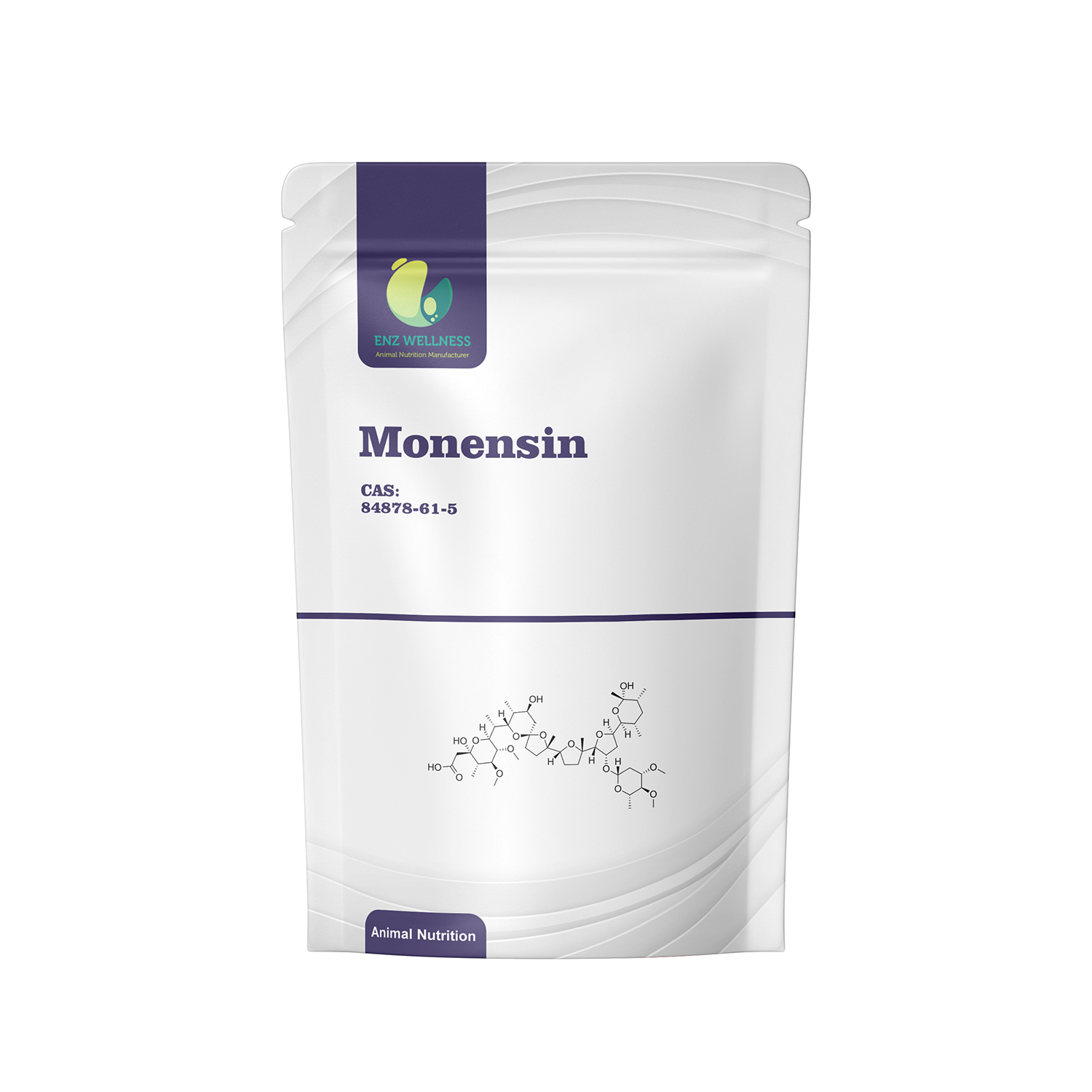
Monensin
Introduction
Monensin is a polyether ionophore anticoccidial and antimicrobial feed additive produced by microbial fermentation. It is widely used in animal nutrition, particularly in poultry and cattle, to help control susceptible Eimeria species and, in cattle, to improve feed efficiency and manage rumen fermentation.
Monensin acts by forming complexes with cations and transporting them across biological membranes. This disrupts normal ionic balance in susceptible microorganisms and protozoa.
Commercial monensin is commonly supplied as monensin sodium, the sodium salt of monensin, for incorporation into animal feed.
Important: Monensin products are highly species- and dose-specific. Regulatory approvals, permitted species, inclusion rates, withdrawal periods and production claims vary by market.
Chemical Information
| Property | Details |
|---|---|
| Product Name | Monensin |
| Common Commercial Form | Monensin Sodium |
| Chemical Class | Polyether ionophore |
| Pharmacological Class | Ionophore anticoccidial / rumen modifier |
| CAS No. | 17090-79-8 for monensin sodium |
| Molecular Formula | C36H61NaO11 |
| Molecular Weight | 692.85 g/mol |
| Active Substance | Monensin |
| Salt Form | Sodium salt |
| Origin | Fermentation-derived |
| Appearance | White to pale yellow powder |
| Water Solubility | Limited; formulation-dependent |
| Commercial Assay | Typically based on monensin content/potency |
Chemical Name
Monensin is a naturally occurring polyether ionophore produced by Streptomyces cinnamonensis.
Commercial feed products commonly use the sodium salt, which provides suitable physical and formulation characteristics for feed applications.
Structural Characteristics
Monensin belongs to the polyether ionophore family.
Its structure contains multiple ether oxygen atoms arranged within a large cyclic/polyether framework. These oxygen-containing groups allow monensin to bind cations and facilitate their movement across lipid membranes.
Key structural characteristics
- Polyether ionophore structure
- Multiple oxygen-containing functional groups
- Strong cation-binding capability
- Lipophilic character
- Fermentation-derived
- Commercially used primarily as monensin sodium
Physicochemical Properties
| Property | Typical Characteristics |
|---|---|
| Molecular Formula | C36H61NaO11 |
| Molecular Weight | 692.85 g/mol |
| Physical Form | Powder |
| Color | White to pale yellow |
| Odor | Characteristic/slight |
| Water Solubility | Limited |
| Chemical Nature | Polyether ionophore |
| Salt Form | Sodium salt |
| Stability | Product- and storage-dependent |
| Light Stability | Protect from excessive exposure |
| Moisture Stability | Store in tightly closed packaging |
| Assay | Product-specific analytical method |
Exact physical and chemical specifications should be confirmed from the relevant CoA and product specification.
Mechanism of Action
Monensin functions as an ion carrier.
It binds cations such as Na⁺ and K⁺ and facilitates their movement across biological membranes.
Simplified mechanism
Monensin → cation binding → membrane transport → ionic imbalance → cellular dysfunction
This can interfere with:
- Intracellular ion concentrations
- Membrane potential
- Osmotic balance
- Energy metabolism
- Nutrient transport
The result is inhibition or death of susceptible protozoa and microorganisms.
Anticoccidial Mechanism
In poultry, monensin acts against susceptible Eimeria species involved in coccidiosis.
Its ionophore activity disrupts essential ion gradients in susceptible coccidia, particularly during vulnerable stages of the parasite’s life cycle.
Potentially relevant species include:
- Eimeria tenella
- Eimeria acervulina
- Eimeria maxima
- Eimeria necatrix
- Other susceptible Eimeria species
Actual efficacy depends on parasite susceptibility, management conditions and the approved use pattern.
Applications in Animal Nutrition
Poultry
Monensin is widely associated with poultry feed applications for coccidiosis management, particularly in broiler production where approved.
Potential functions include:
- Prevention and control of susceptible coccidiosis
- Reduction of intestinal coccidial damage
- Support for intestinal integrity
- Maintenance of feed efficiency
- Support of growth performance under effective coccidiosis control
Broilers
Monensin may be incorporated into broiler feed according to the approved label and local regulations.
Layers and Breeders
Use in laying birds or breeders must not be assumed. Specific restrictions may apply depending on the country and production stage.
Cattle
Monensin has an important role in ruminant nutrition, especially cattle.
Unlike its anticoccidial application in poultry, its nutritional use in cattle is strongly associated with rumen fermentation modulation.
Potential functions include:
- Improved feed efficiency
- Improved energy utilization
- Reduced excessive ruminal energy losses
- Modulation of rumen microbial populations
- Support for controlled rumen fermentation
- Coccidiosis control where specifically approved
Monensin can alter rumen fermentation by selectively affecting certain microbial populations, particularly Gram-positive bacteria.
This can influence the production of volatile fatty acids and the overall energy economy of the animal.
Rumen Modulation
Monensin is particularly important because of its selective effects on rumen microorganisms.
It tends to suppress certain Gram-positive bacteria more strongly than many Gram-negative bacteria.
This can alter rumen fermentation patterns and may contribute to:
- Increased propionate production
- Reduced acetate-to-propionate ratio
- Reduced methane-associated energy loss
- Improved energy utilization
- Improved feed conversion
The actual nutritional response depends on:
- Diet composition
- Forage-to-concentrate ratio
- Animal category
- Feeding level
- Management conditions
- Baseline rumen fermentation
Key Benefits
1. Effective Ionophore Anticoccidial
Monensin is an established ionophore for coccidiosis management in approved poultry applications.
2. Rumen Fermentation Modulation
In cattle, monensin can modify rumen microbial populations and fermentation patterns.
3. Feed Efficiency Support
Appropriate use may improve the efficiency with which dietary nutrients are converted into animal production.
4. Broad Production Applications
Monensin has applications across different livestock systems, subject to regulatory approval.
5. Distinct Mode of Action
Its ionophore mechanism distinguishes it from non-ionophore anticoccidials and many conventional veterinary antimicrobials.
Monensin vs. Other Ionophore Feed Additives
| Characteristic | Monensin | Salinomycin | Maduramycin | Lasalocid |
|---|---|---|---|---|
| Class | Polyether ionophore | Polyether ionophore | Polyether ionophore | Polyether ionophore |
| Main use | Poultry/cattle depending approval | Mainly poultry | Mainly poultry | Poultry/cattle depending approval |
| Coccidiosis control | Yes | Yes | Yes | Yes |
| Rumen application | Important | Limited/market-dependent | No | Yes in approved cattle uses |
| Main action | Ion transport | Ion transport | Ion transport | Ion transport |
| Fermentation-derived | Yes | Yes | Yes | Yes |
| Commercial form | Often sodium salt | Often sodium salt | Ammonium salt | Often sodium salt |
The choice of ionophore should be based on the animal species, target organisms, production objective, regulatory status and resistance-management strategy.
Anticoccidial Resistance Management
As with other anticoccidials, repeated exposure can contribute to reduced susceptibility in Eimeria populations.
A comprehensive coccidiosis-management program may incorporate:
- Anticoccidial rotation
- Shuttle programs
- Vaccination where appropriate
- Litter management
- Biosecurity
- Monitoring of flock performance
- Monitoring of coccidial challenge
- Veterinary supervision
Monensin should be used according to the approved program rather than continuously or indiscriminately.
Commercial Specifications
Commercial monensin feed additives may be supplied as an active ingredient or standardized formulation.
Typical specifications include:
| Parameter | Specification Approach |
|---|---|
| Appearance | White to pale yellow powder |
| Identification | Conforms |
| Monensin content | Within declared specification |
| Assay | Validated analytical method |
| Moisture | Within specification |
| Related substances | Within applicable limits |
| Residual solvents | Where applicable |
| Heavy metals | Within applicable limits |
| Microbiological quality | Conforms |
| Particle size | According to formulation |
| Stability | Meets shelf-life requirements |
For formulated feed additives, additional specifications may include:
- Active concentration
- Carrier composition
- Homogeneity
- Mixing performance
- Feed stability
Quality Control
A professional QC system for monensin should include:
- Raw material identification
- Active ingredient assay
- Identity testing
- Related substances
- Moisture
- Residual solvent testing where applicable
- Heavy-metal analysis
- Microbiological testing
- Particle-size analysis
- Batch homogeneity
- Stability testing
- Packaging integrity
For low-inclusion feed additives, homogeneous distribution and accurate dosing are especially important.
Feed Manufacturing Considerations
Monensin should be accurately incorporated into premixes and complete feeds.
Important manufacturing controls include:
- Accurate weighing
- Proper premixing
- Uniform distribution
- Appropriate carrier selection
- Cross-contamination prevention
- Feed-processing stability
- Equipment cleaning
- Production sequencing
Because ionophore anticoccidials may have significant biological activity at relatively low inclusion levels, feed mills should implement appropriate procedures to prevent unintended carryover into non-target feeds.
Safety Considerations
Monensin has a relatively narrow safety margin in certain animal species and at excessive exposure levels.
Particular care should be taken with:
- Horses
- Donkeys
- Other non-target equids
Monensin can be highly toxic to horses and other equids.
Therefore:
- Prevent cross-contamination of equine feed.
- Clearly identify monensin-containing feeds.
- Maintain dedicated or carefully controlled production procedures.
- Follow approved species restrictions.
- Keep products away from unintended animal exposure.
This is one of the most important safety considerations when manufacturing or handling monensin-containing feed products.
Regulatory Considerations
Monensin is a regulated veterinary feed additive, and its approved applications vary by country.
For international B2B supply:
- Confirm approved animal species.
- Confirm approved production stage.
- Follow the registered inclusion rate.
- Observe withdrawal requirements where applicable.
- Follow maximum-residue requirements.
- Verify whether the product is approved for poultry, cattle or other species in the destination market.
- Follow local feed-additive registration requirements.
- Provide appropriate CoA, SDS and technical documentation.
Claims relating to growth promotion, feed efficiency, methane reduction or disease prevention should only be made where supported by the applicable regulatory framework.
Packaging
Typical commercial packaging may include:
- 1 kg
- 5 kg
- 10 kg
- 20 kg
- 25 kg
Customized packaging may be available for industrial and export customers.
Packaging should protect the product against:
- Moisture
- Excessive heat
- Direct sunlight
- Contamination
Storage
Store in a cool, dry and well-ventilated area.
Recommended practices:
- Keep the original container tightly closed.
- Protect from moisture.
- Avoid excessive heat.
- Protect from direct sunlight.
- Prevent contamination.
- Keep away from feeds intended for non-approved species.
- Follow the manufacturer’s specified storage conditions and shelf life.
Technical Summary
| Item | Specification |
|---|---|
| Product | Monensin |
| Common Commercial Form | Monensin Sodium |
| CAS No. | 17090-79-8 |
| Chemical Class | Polyether ionophore |
| Pharmacological Class | Ionophore anticoccidial / rumen modifier |
| Molecular Formula | C36H61NaO11 |
| Molecular Weight | 692.85 g/mol |
| Origin | Fermentation-derived |
| Main Target | Susceptible Eimeria spp. / rumen microorganisms |
| Primary Applications | Poultry and cattle, depending on approval |
| Main Poultry Function | Coccidiosis management |
| Main Cattle Function | Rumen fermentation and feed-efficiency support |
| Mechanism | Cation transport across biological membranes |
| Form | Powder / formulated feed additive |
| Water Solubility | Limited |
| Assay | Product-specific |
| Key Safety Concern | High toxicity to equids |
| Regulatory Status | Country-, species- and application-dependent |