Propylene Glycol
Introduction
Propylene Glycol (PG) is a clear, colorless, hygroscopic liquid widely used in animal nutrition as an energy source, humectant, solvent, and functional feed ingredient. In livestock nutrition, it is particularly important in dairy cattle during the transition and early-lactation period, where it can provide a rapidly available glucogenic energy source and support glucose metabolism.
For feed applications, the appropriate feed-grade specification should be selected according to the target species, regulatory requirements, purity, and intended use.
Chemical Information
| Property | Specification |
|---|---|
| Product Name | Propylene Glycol |
| Common Abbreviation | PG |
| Chemical Name | 1,2-Propanediol |
| Chemical Class | Diol / Polyol |
| CAS No. | 57-55-6 |
| Molecular Formula | C₃H₈O₂ |
| Molecular Weight | 76.09 g/mol |
| IUPAC Name | Propane-1,2-diol |
| Appearance | Clear, colorless, viscous liquid |
| Odor | Slight or practically odorless |
| Water Solubility | Completely miscible |
| Feed Application | Energy source, glucogenic substrate, humectant, carrier/solvent |
Structural Formula
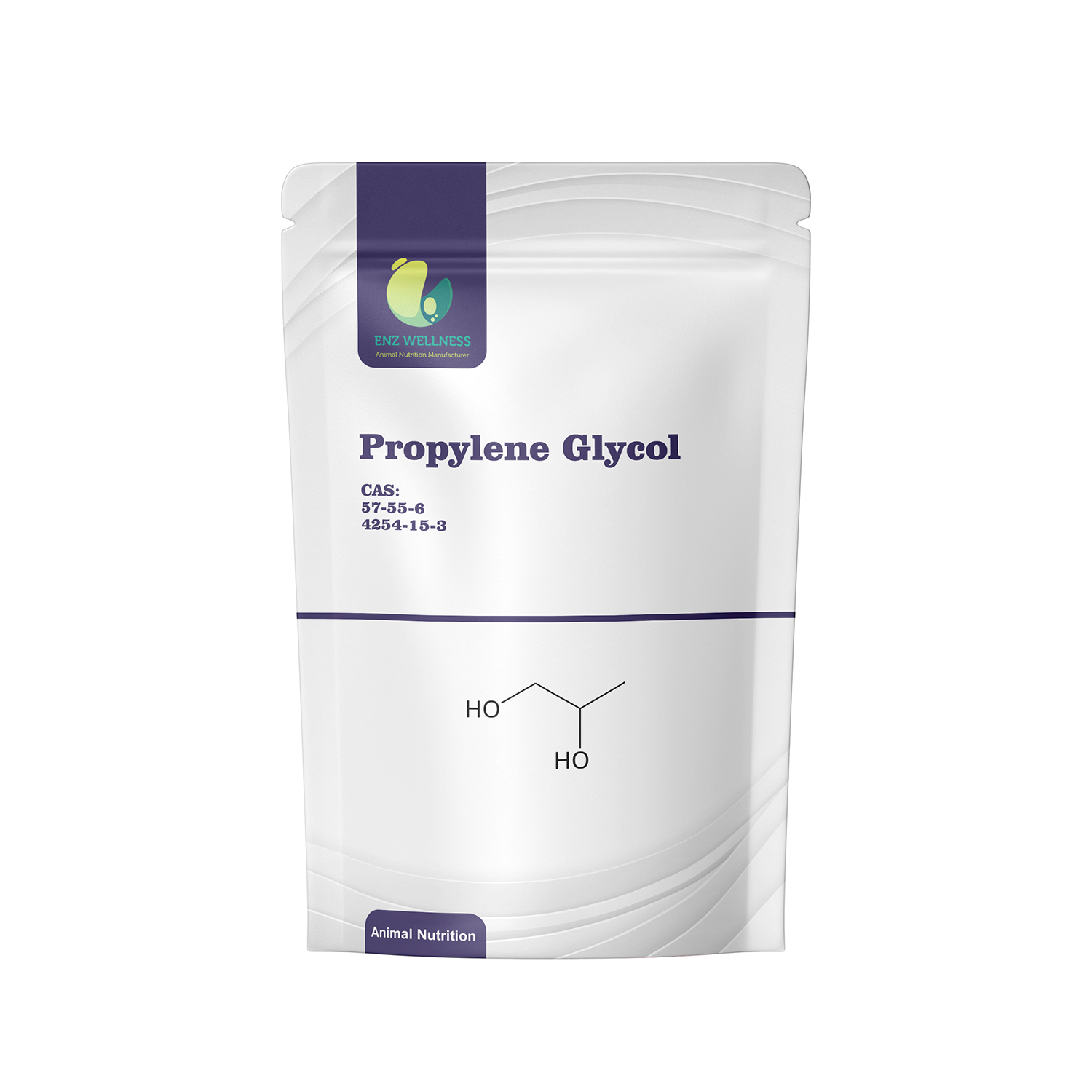
CH₃–CH(OH)–CH₂OH
Propylene glycol contains two hydroxyl groups and is therefore highly water soluble and hygroscopic.
Physicochemical Properties
| Parameter | Typical Characteristic |
|---|---|
| Molecular weight | 76.09 g/mol |
| Physical state | Liquid |
| Color | Colorless |
| Density | Approximately 1.03–1.04 g/mL at 20°C |
| Melting point | Approximately −59°C |
| Boiling point | Approximately 188°C |
| Water solubility | Completely miscible |
| Hygroscopicity | Hygroscopic |
| Flammability | Combustible |
| pH | Approximately neutral to mildly acidic depending on specification |
| Optical activity | Commercial material is commonly supplied as a mixture of stereoisomers |
Nutritional Function and Mechanism
1. Glucogenic Energy Source
Propylene glycol is rapidly metabolized and can contribute to glucose production, making it particularly useful when animals have an increased demand for glucose.
In dairy cattle, this is especially relevant during early lactation, when energy requirements increase substantially.
2. Support for Glucose Metabolism
Propylene glycol is metabolized primarily through pathways associated with hepatic energy metabolism and can contribute to the production of glucose.
This makes it useful as part of nutritional strategies designed to support animals experiencing negative energy balance.
3. Support During the Transition Period
For dairy cows, the transition from late gestation to early lactation involves major changes in energy metabolism.
Propylene glycol can be incorporated into feeding programs to provide a concentrated source of rapidly available energy during this period.
4. Feed Processing and Formulation Functions
In addition to its nutritional role, propylene glycol can function as:
- A humectant
- A carrier
- A solvent for selected feed ingredients
- A moisture-management ingredient
- A formulation aid
Applications in Animal Nutrition
Dairy Cattle
Propylene glycol has its most established nutritional application in dairy cattle, particularly:
- Close-up dry cows
- Transition cows
- Fresh cows
- Early-lactation cows
It may be included in nutritional programs designed to:
- Provide supplemental energy
- Support glucose availability
- Help manage negative energy balance
- Support normal metabolic adaptation around calving
- Complement transition-cow feeding programs
Beef Cattle
Propylene glycol can also be used as a supplemental energy ingredient in beef cattle diets where additional readily available energy is required.
Potential applications include:
- High-energy feeding programs
- Periods of nutritional stress
- Cattle requiring supplemental glucogenic energy
- Formulated liquid energy supplements
Goats and Sheep
Propylene glycol may be incorporated into small-ruminant nutritional programs as a readily available energy source, particularly around periods of elevated energy demand.
The appropriate inclusion rate should be determined according to species, body weight, diet, production stage, and local feed regulations.
Swine
Propylene glycol can be used as a functional ingredient or carrier in selected feed formulations. However, its nutritional role and inclusion level should be determined based on the formulation objective rather than assuming the same application used in dairy cattle.
Poultry
In poultry nutrition, propylene glycol is more commonly relevant as a formulation, carrier, humectant, or processing ingredient than as a primary glucogenic supplement.
Its use should follow the applicable feed regulations and formulation requirements.
Key Advantages
- Highly water soluble
- Readily available energy source
- Useful glucogenic substrate
- Particularly relevant to transition dairy cattle
- Liquid and easy to incorporate into liquid feed systems
- Useful as a carrier and formulation aid
- Hygroscopic and effective as a humectant
- Suitable for a range of feed and nutritional formulations
Propylene Glycol vs. Glycerol
| Feature | Propylene Glycol | Glycerol |
|---|---|---|
| Chemical class | Diol | Triol |
| Formula | C₃H₈O₂ | C₃H₈O₃ |
| Physical form | Liquid | Liquid |
| Water solubility | Completely miscible | Completely miscible |
| Nutritional role | Readily available glucogenic energy | Energy source and gluconeogenic substrate |
| Dairy transition application | Common | Also used in some formulations |
| Humectant function | Excellent | Excellent |
| Typical feed use | Energy + formulation | Energy + formulation |
The two ingredients should not be considered interchangeable in every formulation because their metabolic pathways and formulation characteristics differ.
Typical Feed-Grade Specification
Commercial specifications can vary by manufacturer and regulatory market. A typical feed-grade product may be controlled for:
| Quality Parameter | Typical Requirement |
|---|---|
| Appearance | Clear, colorless liquid |
| Propylene glycol assay | High-purity, specification-dependent |
| Water | Controlled according to grade |
| Acidity | Controlled |
| Specific gravity | Controlled |
| Refractive index | Controlled where applicable |
| Heavy metals | Compliant with applicable limits |
| Impurities | Controlled according to specification |
| Microbiological quality | Compliant with feed requirements |
Important: Exact assay, water content, impurity limits, and other numerical specifications should be taken from the manufacturer’s current specification sheet and CoA, because commercial feed grades can differ.
Quality Control
A professional feed-grade Propylene Glycol specification should normally include controls for:
- Identification
- Assay/purity
- Water content
- Specific gravity
- Acidity
- Refractive index where applicable
- Color and appearance
- Relevant impurities
- Heavy metals where required
- Residual solvents or process-related impurities where applicable
- Compliance with applicable feed regulations
Packaging
Depending on the supply volume and customer requirements, Propylene Glycol can typically be supplied in:
- 25 kg drums
- 200 kg drums
- 220 kg drums
- 1,000 kg IBC tanks
- Bulk tanker
Packaging should be selected to minimize moisture contamination and facilitate safe handling of the liquid product.
Storage
- Store in a cool, dry and well-ventilated area.
- Keep containers tightly closed.
- Protect from contamination and excessive moisture.
- Avoid unnecessary exposure to heat.
- Use clean, compatible containers and transfer equipment.
- Follow the manufacturer’s SDS for detailed handling and storage requirements.
Safety and Regulatory Considerations
Propylene Glycol has applications across food, pharmaceutical, industrial, and feed industries, but feed-grade material should not automatically be substituted with an industrial-grade product.
For animal feed applications:
- Use material meeting the relevant feed-grade specification.
- Verify compliance with the regulations of the destination market.
- Confirm species-specific permitted uses and maximum inclusion levels where applicable.
- Maintain CoA and traceability documentation.
- Follow the supplier’s SDS and handling instructions.
For international B2B supply, it is recommended to provide customers with CoA, SDS, product specification, origin information, and applicable regulatory/compliance documentation.
Technical Summary
| Item | Details |
|---|---|
| Product | Propylene Glycol |
| Abbreviation | PG |
| CAS | 57-55-6 |
| Formula | C₃H₈O₂ |
| Molecular Weight | 76.09 g/mol |
| Chemical Name | 1,2-Propanediol |
| Form | Clear, colorless liquid |
| Main nutritional role | Glucogenic energy source |
| Major target | Dairy cattle, especially transition/early lactation |
| Additional functions | Humectant, carrier, solvent, formulation aid |
| Water solubility | Completely miscible |
| Storage | Cool, dry, tightly closed |
| Grade | Feed grade |
| Key documentation | Specification, CoA, SDS |