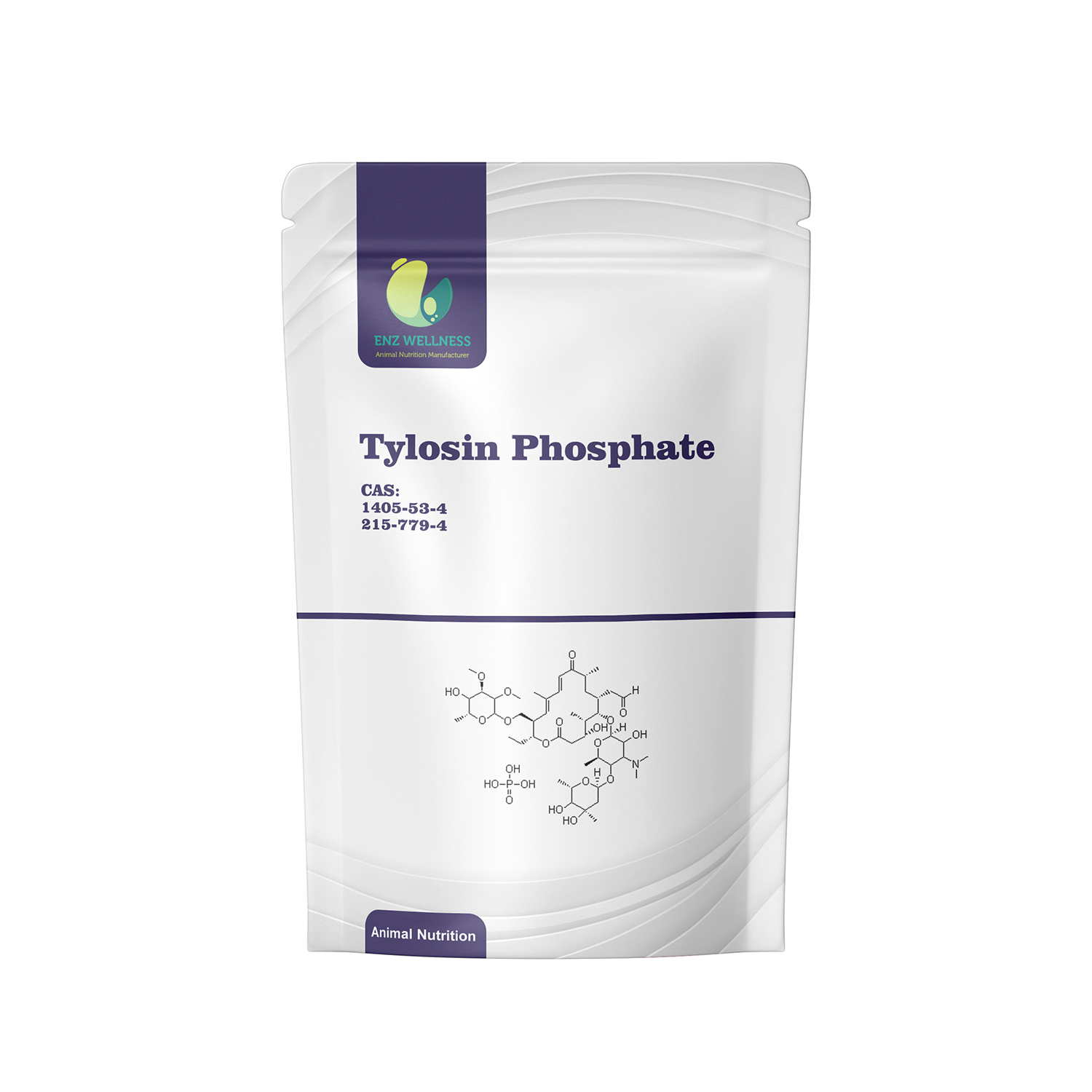
Tylosin Phosphate
Introduction
Tylosin Phosphate is a macrolide veterinary antimicrobial and a phosphate salt of tylosin, a fermentation-derived antibiotic produced by Streptomyces fradiae. It is primarily active against susceptible Gram-positive bacteria and certain other susceptible organisms, including Mycoplasma species.
In animal nutrition and veterinary medicine, tylosin products have been used particularly in poultry and swine, with applications depending on local authorization, formulation, target disease, and production stage.
Tylosin phosphate is commonly supplied as a feed-grade or veterinary-grade powder, with commercial specifications based on tylosin activity/potency rather than simply treating the material as an ordinary nutritional feed ingredient.
Regulatory note: Tylosin is an antimicrobial. Its use should follow the approved indication, species, dosage, withdrawal period, prescription/veterinary requirements, and antimicrobial-stewardship rules of the destination market.
Chemical Information
| Property | Specification |
|---|---|
| Product Name | Tylosin Phosphate |
| Common Abbreviation | Tylosin Phosphate / Tylosin Phosphate Premix |
| Chemical Class | Macrolide Antibiotic |
| Category | Veterinary Antimicrobial |
| CAS No. | 1405-53-4 |
| Active Moiety | Tylosin |
| Molecular Formula | C₄₆H₇₇NO₁₇ for tylosin; phosphate salt is commonly represented as a tylosin phosphate salt |
| Molecular Weight | Tylosin: approximately 916.1 g/mol |
| Origin | Fermentation-derived |
| Typical Form | White to pale yellow powder |
| Water Solubility | Solubility depends on formulation and pH |
| Primary Applications | Approved veterinary antimicrobial applications |
Important Chemical Note
Tylosin is a complex macrolide antibiotic containing several related components, with tylosin A generally being the principal active component.
Commercial tylosin phosphate products should therefore be specified using the manufacturer’s approved assay/potency and component profile, rather than assuming that every commercial material behaves as a single perfectly pure molecular species.
Structural Characteristics
Tylosin is a 16-membered macrolide containing a large lactone ring with attached sugar moieties.
Its structural characteristics include:
- Large macrolide lactone ring
- Multiple hydroxyl groups
- Glycosidically linked sugar components
- Dimethylamino-containing sugar moiety
- Multiple stereogenic centers
- Phosphate salt formation in tylosin phosphate
The macrolide structure is important for its interaction with the bacterial ribosome.
Mechanism of Action
1. Ribosomal Binding
Tylosin binds to the 50S subunit of susceptible bacterial ribosomes.
This interferes with bacterial protein synthesis and inhibits bacterial growth.
2. Primarily Bacteriostatic Activity
At typical concentrations, tylosin is generally considered primarily bacteriostatic, although its activity can vary according to:
- Organism
- Concentration
- Susceptibility
- Environmental conditions
- Exposure time
3. Activity Against Mycoplasma
Tylosin is particularly relevant to veterinary medicine because of its activity against susceptible Mycoplasma species.
This is one reason macrolides such as tylosin have historically been important in poultry and swine production.
Antimicrobial Spectrum
Tylosin may have activity against susceptible:
- Mycoplasma spp.
- Certain Gram-positive bacteria
- Selected Gram-negative organisms
- Other susceptible veterinary pathogens
However, susceptibility varies significantly among organisms and geographic populations.
Tylosin should not be described as a universal broad-spectrum antibiotic.
Applications in Animal Health
Poultry
Tylosin products have been used in poultry for approved veterinary indications involving susceptible organisms, particularly Mycoplasma-associated disease.
Depending on local authorization, applications may include management of susceptible:
- Mycoplasma gallisepticum
- Mycoplasma synoviae
- Certain respiratory disease complexes
Potential production-related benefits from effective disease management include:
- Improved respiratory health
- Reduced impact of susceptible bacterial infections
- Improved flock performance when disease is appropriately controlled
- Reduced production losses associated with susceptible infections
The product should only be used for approved indications and species.
Swine
Tylosin can be used in swine veterinary medicine for certain approved infections involving susceptible organisms.
Depending on the regulatory jurisdiction, applications may include management of susceptible:
- Respiratory pathogens
- Enteric pathogens
- Mycoplasma-associated infections
Disease diagnosis and antimicrobial susceptibility should guide treatment decisions where appropriate.
Cattle and Other Livestock
Tylosin has veterinary applications in certain cattle and other livestock systems, but approved species, indications, administration routes, and withdrawal periods vary by country.
The same product should not automatically be assumed to be authorized for every livestock species.
Key Advantages
1. Macrolide Antimicrobial
Tylosin provides a well-established macrolide mechanism based on inhibition of bacterial protein synthesis.
2. Mycoplasma Activity
Its activity against susceptible Mycoplasma species makes it particularly relevant to veterinary respiratory disease management.
3. Fermentation-Derived
Tylosin is produced through microbial fermentation and subsequently processed and standardized for pharmaceutical/veterinary applications.
4. Feed-Compatible Formulation
Tylosin phosphate can be formulated into appropriate veterinary feed products where such use is authorized.
5. Established Veterinary Application
Tylosin has a long history of veterinary use in poultry, swine, cattle, and other approved animal species.
Tylosin Phosphate vs. Tylosin Tartrate
| Feature | Tylosin Phosphate | Tylosin Tartrate |
|---|---|---|
| Active moiety | Tylosin | Tylosin |
| Drug class | Macrolide | Macrolide |
| Main mechanism | 50S ribosome inhibition | 50S ribosome inhibition |
| Salt form | Phosphate | Tartrate |
| Typical application | Veterinary/feed formulations depending approval | Veterinary formulations, including water-soluble applications depending approval |
| Physical properties | Salt/formulation dependent | Salt/formulation dependent |
| Water solubility | Grade-dependent | Generally selected where soluble formulation is required |
| Potency basis | Tylosin activity | Tylosin activity |
| Interchangeability | Not automatic | Not automatic |
The two salts contain the same pharmacologically active moiety, but their physical properties, formulation behavior, permitted routes of administration, and regulatory status can differ.
Commercial Grades and Specifications
Tylosin phosphate is commonly supplied in standardized veterinary/feed grades.
A professional specification should identify:
| Parameter | Typical Control |
|---|---|
| Active ingredient | Tylosin phosphate |
| Tylosin potency | Specification-dependent |
| Tylosin A content | Controlled where applicable |
| Appearance | White to pale yellow powder |
| Identification | Conforms |
| Moisture | Controlled |
| Residue/ash | Controlled |
| Related substances | Controlled |
| Heavy metals | Applicable limits |
| Microbiological quality | Applicable requirements |
| Particle size | Controlled where required |
| Stability | Verified for shelf life |
Potency vs. Purity
For tylosin, it is important to distinguish chemical purity from antibiotic potency.
Commercial veterinary products are commonly evaluated according to their tylosin activity/potency, and the exact numerical specification should be taken from the supplier’s current CoA and technical specification.
Quality Control
A robust Tylosin Phosphate QC program should normally include:
- Identification
- Tylosin assay/potency
- Tylosin A profile
- Related substances
- Moisture
- Residual solvents where applicable
- Heavy metals
- Microbiological quality
- Particle-size distribution
- Bulk density where relevant
- Stability testing
- Uniformity/homogeneity for premix products
For export B2B supply, the product documentation should ideally include:
- Certificate of Analysis
- SDS
- Product Specification
- Manufacturing information
- Batch number and traceability
- Regulatory documentation applicable to the destination market
Antimicrobial Resistance and Stewardship
Because Tylosin is an antimicrobial, responsible use is essential.
Repeated or inappropriate exposure may contribute to the selection of antimicrobial-resistant organisms.
Good stewardship practices include:
- Use only for approved indications.
- Follow veterinary guidance.
- Use the correct dose and treatment duration.
- Avoid unnecessary routine antimicrobial use.
- Follow applicable withdrawal periods.
- Avoid unauthorized growth-promotion claims.
- Monitor treatment response.
- Consider susceptibility information where appropriate.
- Prevent cross-contamination between medicated and non-medicated feeds.
Tylosin resistance can occur through several mechanisms, including changes affecting the bacterial ribosomal target and active drug efflux.
Regulatory Considerations
The legal status of Tylosin Phosphate differs between countries.
For international B2B supply, confirm:
- Approved animal species
- Approved indication
- Approved administration route
- Maximum permitted dosage/inclusion level
- Withdrawal period
- Maximum residue limits
- Prescription/veterinary requirements
- Feed-medication labeling requirements
- Import registration requirements
- Local antimicrobial-use restrictions
Do not publish one global dosage or withdrawal period on the website. These parameters should be tied to the destination market and approved product label.
Packaging
Depending on the product grade and customer requirements, Tylosin Phosphate may be supplied in:
- 5 kg bags
- 10 kg bags
- 20 kg bags
- 25 kg bags
- Fiber drums
- PE-lined bags
- Customized export packaging
Packaging should protect the product from:
- Moisture
- Excessive heat
- Contamination
- Physical degradation
- Cross-contamination with other feed ingredients
Storage
- Store in a cool, dry and well-ventilated area.
- Keep containers tightly closed.
- Protect from direct sunlight and excessive heat.
- Avoid moisture exposure.
- Store separately from incompatible materials.
- Maintain batch identification and traceability.
- Prevent accidental incorporation into unauthorized feeds.
- Follow the manufacturer’s SDS and stability data.
Safety Considerations
Tylosin Phosphate should be handled as an active veterinary antimicrobial, rather than as an ordinary nutritional feed ingredient.
Appropriate precautions include:
- Avoid unnecessary dust exposure.
- Use appropriate personal protective equipment during industrial handling.
- Prevent cross-contamination.
- Follow occupational exposure controls.
- Keep away from unauthorized animal species and feed streams.
- Follow the SDS for detailed handling and emergency procedures.
Tylosin Phosphate in Modern Veterinary Practice
Tylosin should be positioned on a professional B2B website as a veterinary antimicrobial API/feed-grade active ingredient, not simply as a general feed additive.
A strong product positioning would emphasize:
Fermentation-derived macrolide → 50S ribosomal inhibition → activity against susceptible veterinary pathogens, particularly Mycoplasma → approved poultry/swine/livestock applications.
This positioning is more technically accurate than describing tylosin as a general-purpose “growth promoter.”
Technical Summary
| Item | Details |
|---|---|
| Product | Tylosin Phosphate |
| Active moiety | Tylosin |
| Chemical class | Macrolide antibiotic |
| CAS No. | 1405-53-4 |
| Tylosin formula | C₄₆H₇₇NO₁₇ |
| Tylosin MW | Approx. 916.1 g/mol |
| Origin | Fermentation-derived |
| Main mechanism | 50S ribosomal protein-synthesis inhibition |
| Primary target | Susceptible bacteria and Mycoplasma |
| Major veterinary applications | Poultry, swine and other approved livestock |
| Commercial form | Powder / veterinary formulation / premix |
| Potency basis | Tylosin activity, specification-dependent |
| Key concern | Antimicrobial resistance |
| Regulatory status | Country- and product-specific |
| Documentation | CoA, SDS, specification, regulatory documents |