Zinc Bacitracin
Introduction
Zinc Bacitracin is a zinc-stabilized form of bacitracin, a polypeptide antibiotic used primarily as a feed-grade antibacterial ingredient in animal nutrition. It is particularly associated with poultry and swine feed applications where regulations permit its use.
Zinc bacitracin is valued for its activity against susceptible Gram-positive bacteria, especially organisms associated with intestinal microbial imbalance. It is commonly supplied as a standardized, potency-based feed additive rather than as a single chemically pure compound.
1. Chemical Information
| Item | Specification |
|---|---|
| Product Name | Zinc Bacitracin |
| Common Names | Bacitracin Zinc, Zinc Bacitracin |
| Chemical Class | Polypeptide antibiotic |
| Antibiotic Group | Bacitracin |
| CAS No. | 1405-89-6 |
| Principal Active Component | Bacitracin A, together with related bacitracin components |
| Form | Zinc-containing bacitracin complex |
| Appearance | White to pale yellow/yellowish powder, depending on grade |
| Solubility | Limited in water; formulation-dependent |
| Commercial Assay | Normally expressed as antibiotic activity/potency rather than simple chemical purity |
Important Chemical Note
Zinc bacitracin is not best represented as one simple molecular compound. Bacitracin itself is a naturally derived mixture of closely related cyclic peptide antibiotics, with bacitracin A being an important active component. Commercial zinc bacitracin therefore should be characterized by potency, component profile, and product specification, rather than by assigning one molecular formula to the entire commercial product.
2. Structural Characteristics
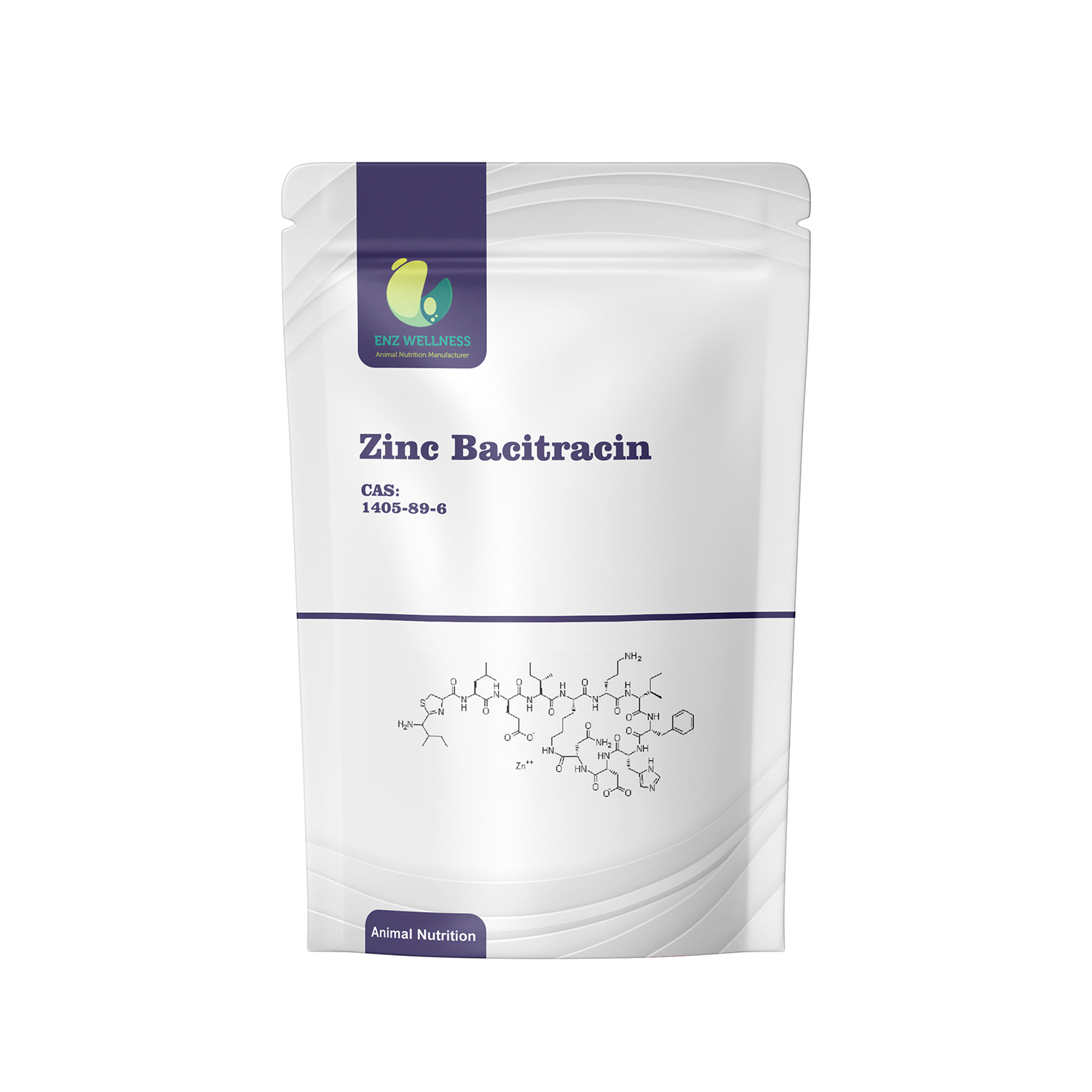
Bacitracin consists of cyclic peptide structures containing multiple amino-acid residues and a characteristic thiazoline-containing ring system. Zinc is associated with the bacitracin complex and contributes to product stability and formulation characteristics.
A simplified representation is:
Bacitracin complex + Zn²⁺ → Zinc Bacitracin
The biologically active bacitracin components interact with bacterial cell-wall synthesis intermediates rather than acting through a conventional small-molecule receptor.
3. Physicochemical Properties
| Property | Typical Characteristic |
|---|---|
| Physical Form | Fine powder |
| Color | White to pale yellow/yellowish |
| Odor | Characteristic/slight |
| Water Solubility | Limited; depends on pH and formulation |
| Stability | Sensitive to environmental conditions; grade-dependent |
| Light Sensitivity | May require protection |
| Hygroscopicity | Generally low to moderate, depending on carrier/formulation |
| pH Stability | pH-dependent |
| Commercial Standardization | Activity/potency-based |
For commercial products, the CoA and manufacturer’s specification should be used for exact assay, moisture, particle size, zinc content, and stability parameters.
4. Mechanism of Action
Zinc bacitracin exerts its antibacterial effect through the bacitracin component.
Bacitracin interferes with bacterial cell-wall synthesis by disrupting the recycling of undecaprenyl phosphate, a lipid carrier required for transporting peptidoglycan precursors across the bacterial cell membrane.
Simplified pathway:
Bacterial cell-wall precursor → lipid carrier → transport/recycling → peptidoglycan synthesis
Bacitracin interferes with the recycling step, reducing the availability of the carrier required for continued cell-wall construction.
Result
This can lead to:
- Impaired bacterial cell-wall formation
- Reduced growth of susceptible bacteria
- Increased susceptibility of affected bacteria to cellular damage
- Suppression of certain Gram-positive intestinal bacteria
Bacitracin is therefore primarily considered active against susceptible Gram-positive organisms.
5. Applications in Animal Nutrition
Poultry
Zinc bacitracin has traditionally been used in poultry feed programs, where authorized, for management of susceptible Gram-positive intestinal bacteria.
Potential nutritional applications include:
- Supporting intestinal microbial balance
- Supporting intestinal health
- Managing susceptible bacterial populations
- Supporting feed utilization
- Supporting production performance under appropriate feeding programs
It may be relevant to broiler and other poultry production systems depending on the registration and permitted use in the destination market.
Swine
In swine nutrition, zinc bacitracin may be incorporated into approved feed programs for:
- Intestinal microbial management
- Supporting gut health
- Supporting feed efficiency
- Supporting growth performance
- Managing susceptible Gram-positive bacterial populations
Use should follow the approved species, production stage, inclusion level, and regulatory requirements of the target market.
Other Livestock
Potential applications in other livestock species are highly dependent on local authorization and product registration.
Therefore, a commercial product page should avoid presenting one universal dosage or application rate for all species.
6. Key Advantages
1. Established Bacitracin-Based Antibacterial
Zinc bacitracin provides the antibacterial activity of bacitracin in a commercially useful zinc-associated form.
2. Activity Against Gram-Positive Bacteria
Its primary antibacterial spectrum is associated with susceptible Gram-positive organisms.
3. Feed-Compatible Form
Standardized feed-grade products can be incorporated into premixes and compound feeds according to formulation requirements.
4. Supports Intestinal Microbial Management
Where authorized and appropriately formulated, zinc bacitracin can be used as part of a broader intestinal health and microbial management program.
5. Potency-Based Standardization
Commercial products are typically standardized according to antibiotic activity, making potency an important quality parameter.
7. Zinc Bacitracin vs. Bacitracin Methylene Disalicylate
| Feature | Zinc Bacitracin | Bacitracin Methylene Disalicylate |
|---|---|---|
| Active antimicrobial | Bacitracin | Bacitracin |
| Form | Zinc-associated bacitracin complex | Stabilized/formulated bacitracin derivative |
| Antibiotic class | Polypeptide | Polypeptide |
| Primary activity | Mainly Gram-positive | Mainly Gram-positive |
| Commercial specification | Usually potency/activity-based | Usually potency/activity-based |
| Feed application | Poultry, swine and other approved species | Poultry, swine and other approved species |
| Formulation considerations | Zinc-associated form | Methylene disalicylate stabilization |
| Regulatory status | Market-specific | Market-specific |
Both products are bacitracin-based feed antimicrobials, but their chemical/formulation forms and commercial specifications are different.
8. Typical Commercial Specifications
Commercial zinc bacitracin is normally specified according to activity, rather than simply reporting the percentage of a single pure molecule.
Typical specification parameters may include:
| Parameter | Quality Control |
|---|---|
| Appearance | Conforms |
| Bacitracin Potency | Meets declared specification |
| Bacitracin A / Component Profile | Controlled according to specification |
| Zinc Content | Specification-dependent |
| Moisture | Controlled |
| Particle Size | Controlled for feed application |
| Heavy Metals | Complies with applicable limits |
| Microbiological Quality | Complies with applicable requirements |
| Related Substances | Controlled where applicable |
| Stability | Evaluated under defined storage conditions |
The exact potency should be stated according to the commercial grade and CoA, rather than presenting one potency as universal.
9. Quality Control
A professional zinc bacitracin manufacturing program should include controls for:
- Raw material identity
- Bacitracin potency
- Bacitracin component profile
- Zinc content where specified
- Moisture
- Particle size
- Microbiological quality
- Heavy metals
- Arsenic, lead and other applicable contaminants
- Stability
- Packaging integrity
- Batch-to-batch potency consistency
Because zinc bacitracin is a biologically derived antibiotic complex, activity-based testing is particularly important.
10. Packaging
Common commercial packaging options include:
- 25 kg fiber drums
- 25 kg kraft bags with inner PE bags
- 20–25 kg woven bags
- Customized packaging for bulk orders
Packaging should provide adequate protection against:
- Moisture
- Light
- Contamination
- Physical damage
Actual packaging should follow the product’s stability requirements and customer’s import regulations.
11. Storage
Store zinc bacitracin in a:
- Cool
- Dry
- Well-ventilated
environment.
Keep the container tightly closed and protect the product from excessive moisture, heat, and direct sunlight.
The manufacturer’s SDS, CoA, and stability data should be followed for the exact storage temperature and shelf life.
12. Regulatory & Antimicrobial Stewardship
Zinc bacitracin is an antimicrobial feed ingredient, so its use is subject to regulatory requirements that vary significantly between countries.
For international B2B supply, product documentation should clearly specify:
- Approved species
- Approved production stage
- Permitted inclusion level
- Approved indications
- Withdrawal requirements, where applicable
- Maximum residue requirements, where applicable
- Feed-use restrictions
- Registration status in the destination market
Responsible Use
Zinc bacitracin should be used only where legally authorized and according to veterinary/feed regulations.
Antimicrobial use should be part of a responsible animal-health program that includes:
- Appropriate diagnosis
- Good farm hygiene
- Biosecurity
- Vaccination programs where applicable
- Appropriate nutrition
- Antimicrobial stewardship
- Resistance monitoring where appropriate
Do not present zinc bacitracin as a universal growth promoter or as a substitute for veterinary diagnosis.
13. Technical Summary
| Category | Details |
|---|---|
| Product | Zinc Bacitracin |
| CAS | 1405-89-6 |
| Category | Veterinary/feed antimicrobial |
| Chemical Class | Polypeptide antibiotic |
| Active Complex | Bacitracin components, including Bacitracin A |
| Physical Form | Powder |
| Main Activity | Mainly susceptible Gram-positive bacteria |
| Mechanism | Interferes with bacterial cell-wall synthesis |
| Primary Applications | Poultry and swine feed, where authorized |
| Commercial Standard | Potency/activity-based |
| Key Function | Intestinal microbial management |
| Quality Focus | Potency, component profile, moisture, microbiology, contaminants |
| Storage | Cool, dry, protected from moisture and direct light |
| Regulatory Status | Country/market-specific |