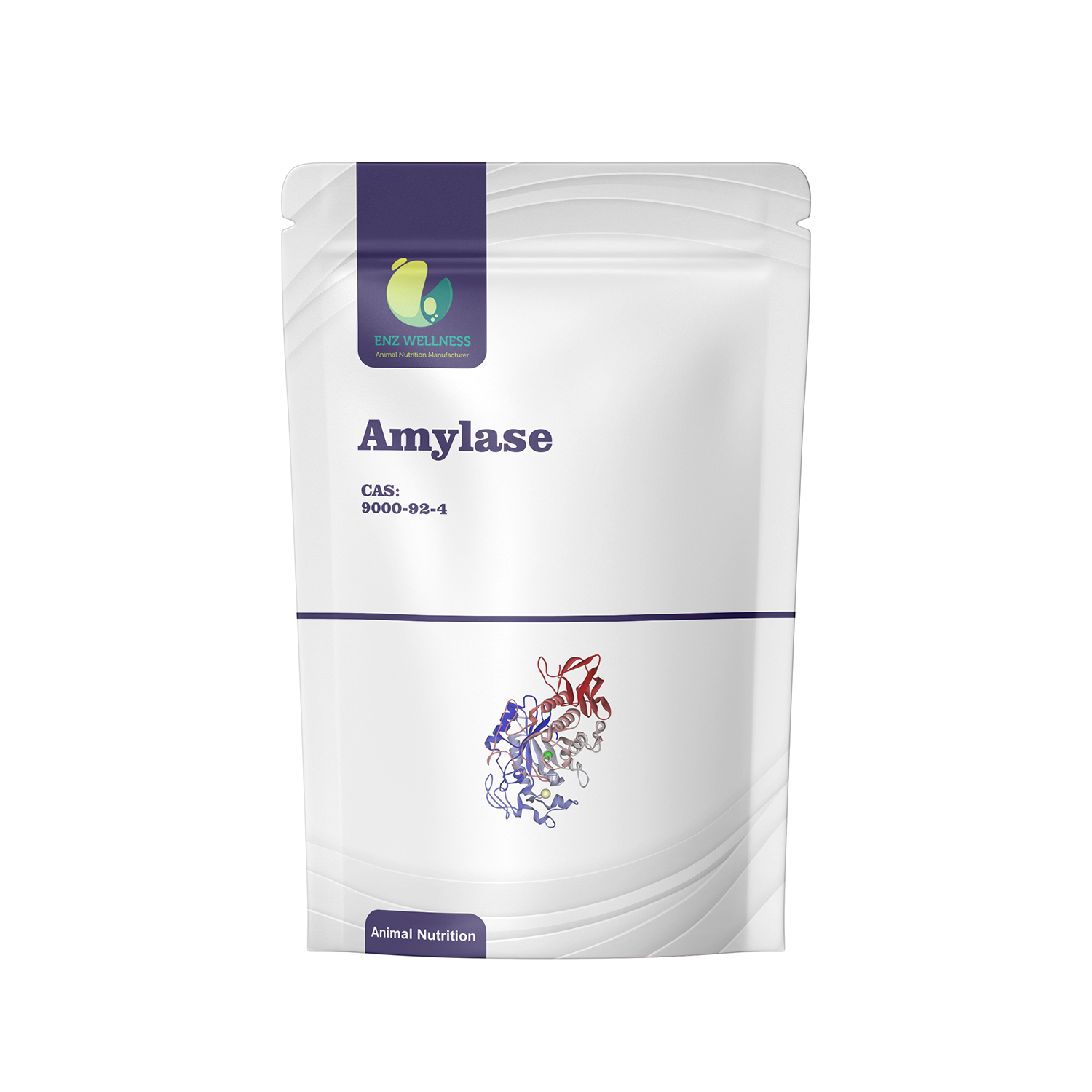
Amylase
1. Introduction
Amylase is a group of starch-degrading enzymes that catalyze the hydrolysis of α-1,4-glycosidic bonds in starch and related polysaccharides. By breaking down complex starch molecules into smaller carbohydrates, such as dextrins and maltose, amylase can improve the accessibility and utilization of dietary starch.
As a feed enzyme additive, amylase is widely used in poultry, swine, livestock, and other animal nutrition applications, particularly in diets containing high levels of cereal grains or other starch-rich ingredients.
2. CAS No.
9000-92-4
3. Structural Formula
Complex protein / enzyme
Amylase is a protein enzyme and therefore does not have a single simple molecular structural formula. Its molecular characteristics vary according to the enzyme source and production process.
4. Physicochemical Properties
- Appearance: White to light-yellow powder or liquid, depending on the formulation
- Solubility: Generally soluble or dispersible in water or suitable buffer solutions
- Enzyme nature: Protein-based biological catalyst
- pH stability: Varies according to the enzyme source and formulation
- Temperature stability: Sensitive to excessive heat; enzyme activity may decrease under high-temperature processing conditions
- Storage: Store in a cool, dry environment and protect from moisture and excessive heat
5. Application and Benefits
Amylase is primarily used as a feed enzyme additive to improve starch digestion and nutrient utilization.
Its major applications include:
- Starch degradation: Hydrolyzes starch into smaller carbohydrates that can be more readily utilized.
- Improved starch utilization: Helps increase the accessibility and digestion of dietary starch.
- Nutrient utilization: Improved starch digestion can contribute to more efficient utilization of energy from cereal-based feed ingredients.
- Feed efficiency: Better utilization of dietary energy may support efficient feed conversion and animal performance.
- Young animal nutrition: Can be particularly useful in young animals whose endogenous digestive enzyme capacity is still developing.
- High-starch diets: Suitable for feed formulations containing substantial levels of corn, wheat, barley, and other starch-rich ingredients.
- Broad application: Commonly used in poultry and swine feed and can also be applied in other livestock nutrition programs.
The effectiveness of amylase depends on enzyme activity, dosage, feed composition, processing conditions, animal species, age, and gastrointestinal conditions. Product specifications should clearly state the declared enzyme activity and recommended inclusion level.