Betaine Anhydrous
1. Introduction
Betaine Anhydrous is a naturally occurring organic compound and an important functional ingredient used in animal nutrition, feed additives, food applications, and other industries. In animal feed, betaine is primarily valued for its roles as an osmolyte and methyl-group donor, helping animals maintain cellular water balance and support normal metabolic processes.
Betaine anhydrous is the water-free form of betaine and is commonly supplied as a white crystalline powder with high purity. Compared with hydrated forms of betaine, the anhydrous form contains no crystal water, providing a concentrated source of active betaine.
In animal nutrition, betaine can help animals cope with environmental and physiological stresses, particularly heat stress, while supporting nutrient metabolism, liver function, cellular hydration, and production performance.
Betaine is widely used in formulations for broilers, layers, pigs, ruminants, aquaculture species, and other livestock, subject to the requirements and regulations of the destination market.
2. CAS No.
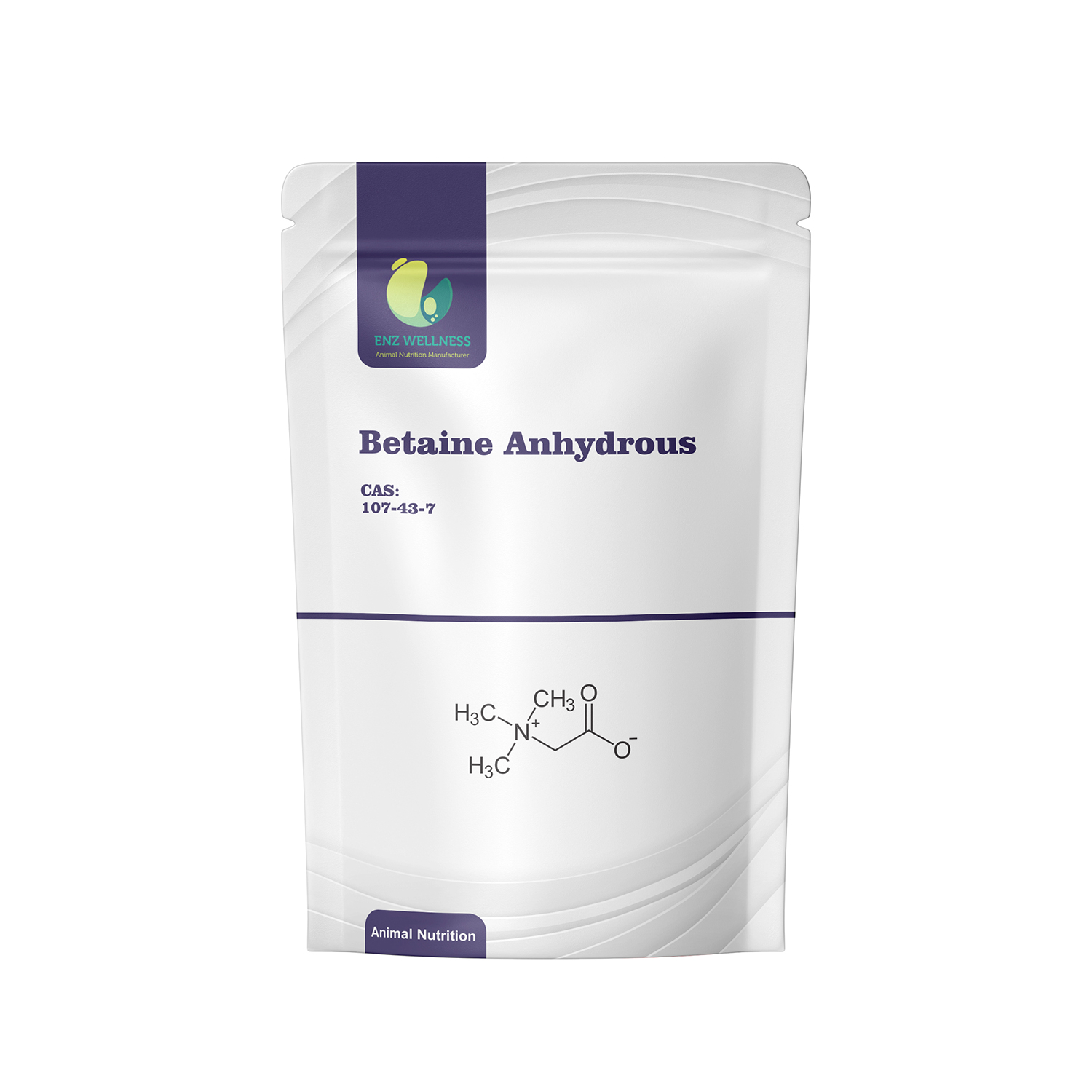
CAS No.: 107-43-7
Chemical name: Betaine
IUPAC name: 2-(Trimethylazaniumyl)acetate
Common names:
- Betaine
- Betaine Anhydrous
- Trimethylglycine
- Glycine betaine
Molecular formula: C₅H₁₁NO₂
Molecular weight: 117.15 g/mol
Product category: Animal nutrition ingredient / Feed additive
3. Structural Formula
Betaine is a zwitterionic quaternary ammonium compound derived from glycine.
Structural formula
(CH₃)₃N⁺–CH₂–COO⁻
Molecular formula
C₅H₁₁NO₂
Molecular weight
117.15 g/mol
Betaine contains a positively charged quaternary ammonium group and a negatively charged carboxylate group. This zwitterionic structure contributes to its high water affinity and its important physiological role as an osmolyte.
4. Physicochemical Properties
| Property | Description |
|---|---|
| Product Name | Betaine Anhydrous |
| CAS No. | 107-43-7 |
| Chemical Name | Betaine |
| IUPAC Name | 2-(Trimethylazaniumyl)acetate |
| Molecular Formula | C₅H₁₁NO₂ |
| Molecular Weight | 117.15 g/mol |
| Appearance | White crystalline powder |
| Odor | Odorless or practically odorless |
| Taste | Characteristically sweet |
| Physical Form | Powder / crystals |
| Water Solubility | Highly soluble in water |
| Chemical Nature | Zwitterionic quaternary ammonium compound |
| pH | Typically near neutral in aqueous solution; specification-dependent |
| Moisture | Anhydrous form contains no crystal water; actual moisture depends on product specification |
| Stability | Generally stable under recommended storage conditions |
| Hygroscopicity | May absorb moisture under humid conditions |
| Storage | Store tightly closed in a cool, dry place |
| Light Sensitivity | Generally stable under normal storage; protect from excessive environmental exposure |
Important Technical Note
Betaine anhydrous should not be confused with Betaine Hydrochloride (Betaine HCl) or Betaine Monohydrate.
- Betaine Anhydrous: C₅H₁₁NO₂; water-free betaine
- Betaine Monohydrate: betaine associated with one molecule of water
- Betaine HCl: hydrochloride salt of betaine with different chemical and nutritional specifications
For commercial feed applications, the purity, betaine content, moisture, particle size, bulk density, and other parameters should be confirmed through the manufacturer’s current product specification and CoA.
5. Nutritional and Physiological Functions
Betaine has several important physiological functions in animals.
5.1 Osmoregulation
Betaine is an effective osmolyte, helping cells maintain water balance and normal cellular volume.
Under conditions such as high environmental temperature, animals may experience increased water and electrolyte loss. Betaine can help cells maintain hydration and osmotic stability without disrupting normal cellular metabolism.
5.2 Methyl-Group Donation
Betaine acts as an important methyl donor in animal metabolism.
Through the methionine cycle, betaine can donate a methyl group to homocysteine, contributing to the regeneration of methionine.
This function links betaine with:
- Methionine metabolism
- Homocysteine metabolism
- Methylation reactions
- Protein synthesis
- Lipid metabolism
- Overall metabolic efficiency
5.3 Supports Cellular Protection
As an organic osmolyte, betaine can help protect cells against osmotic and environmental stress while supporting normal cellular functions.
5.4 Supports Lipid Metabolism
Betaine is involved in methyl-group metabolism and may influence lipid metabolism and fat deposition. In livestock production, appropriate betaine supplementation can be used as part of nutritional strategies designed to optimize carcass composition and production efficiency.
6. Application and Benefits
6.1 Poultry Nutrition
Betaine is widely used in poultry feed, including:
- Broilers
- Layers
- Breeders
- Pullets
Potential benefits in poultry include:
- Supporting heat-stress management
- Maintaining cellular hydration
- Supporting feed intake and production performance
- Supporting nutrient metabolism
- Supporting protein synthesis
- Supporting liver and metabolic function
- Supporting efficient utilization of methyl donors
- Helping maintain production performance under challenging environmental conditions
For broilers, betaine is often incorporated into nutritional programs aimed at supporting growth performance and carcass quality.
6.2 Swine Nutrition
Betaine is used in pig and swine nutrition as a functional feed ingredient.
Potential benefits include:
- Supporting osmotic balance
- Supporting metabolism
- Supporting growth performance
- Supporting lean tissue development
- Supporting carcass quality
- Supporting animals during environmental stress
- Contributing to efficient nutrient utilization
Betaine may be particularly useful in nutritional programs where maintaining performance during heat stress is an important consideration.
6.3 Ruminant Nutrition
Betaine can also be used in diets for:
- Dairy cattle
- Beef cattle
- Calves
- Sheep
- Goats
Its functions as an osmolyte and methyl donor may support normal metabolic activity and cellular hydration.
In dairy production, betaine may be incorporated into nutritional strategies designed to help animals cope with environmental heat stress and maintain production performance.
6.4 Aquaculture
Betaine is also used in aquaculture feed formulations.
Potential applications include:
- Fish feed
- Shrimp feed
- Crustacean feed
- Other aquatic animal feeds
Betaine can act as an osmoprotectant and may also function as a feeding stimulant for certain aquatic species.
Potential nutritional benefits include:
- Supporting feed palatability
- Supporting feed intake
- Supporting growth
- Supporting stress tolerance
- Supporting osmotic regulation
- Supporting nutrient utilization
7. Betaine and Heat-Stress Management
One of the most important applications of betaine in modern animal nutrition is heat-stress management.
High temperatures can negatively affect animals by reducing:
- Feed intake
- Growth rate
- Feed efficiency
- Egg production
- Milk production
- Reproductive performance
- General production efficiency
Heat stress can also increase water and electrolyte loss and place additional demands on cellular metabolism.
Because betaine functions as an organic osmolyte, dietary supplementation can help animals maintain cellular osmotic balance and hydration.
Therefore, betaine can be incorporated into comprehensive nutritional strategies for animals exposed to hot or challenging environmental conditions.
Betaine should be considered a nutritional support ingredient rather than a standalone treatment for heat stress.
8. Betaine as a Methyl Donor
Betaine is an important methyl donor in the methionine cycle.
The metabolic pathway can be summarized as:
Betaine → Methyl donation → Homocysteine → Methionine
This function can help support the body’s methylation metabolism and may allow betaine to contribute to the efficient utilization of other methyl-group-related nutrients.
The nutritional value of betaine therefore extends beyond its osmoprotective function.
9. Target Animals
Betaine Anhydrous may be used in nutritional formulations for:
- Broilers
- Layers
- Poultry breeders
- Swine
- Piglets
- Dairy cattle
- Beef cattle
- Sheep
- Goats
- Fish
- Shrimp
- Other aquaculture species
The appropriate inclusion rate depends on species, production stage, diet composition, environmental conditions, product purity, and the intended nutritional objective.
10. Typical Feed Applications
Betaine Anhydrous can be incorporated into:
- Complete animal feed
- Concentrated feed
- Feed premixes
- Functional feed additives
- Poultry nutrition products
- Swine nutrition products
- Ruminant feed formulations
- Aquaculture feed
- Customized animal nutrition formulations
It can be combined with other nutritional ingredients such as vitamins, minerals, amino acids, electrolytes, enzymes, organic acids, and other functional feed additives, provided compatibility and regulatory requirements are properly evaluated.
11. Advantages of Betaine Anhydrous
High Concentration
Because it is an anhydrous form, Betaine Anhydrous does not contain the crystal water associated with betaine monohydrate. This provides a concentrated source of betaine per unit weight.
Dual Nutritional Function
Betaine provides two major nutritional functions:
- Osmolyte / cellular water-balance support
- Methyl-group donation
Heat-Stress Support
Betaine is particularly valuable in nutritional programs designed for animals exposed to high environmental temperatures.
Broad Species Application
Betaine can be used across poultry, swine, ruminant, and aquaculture nutrition.
Easy Feed Formulation
The crystalline powder form is convenient for incorporation into feed premixes and complete-feed formulations.
12. Quality Control
For professional feed-additive supply, Betaine Anhydrous should be manufactured under appropriate quality-control systems.
Typical quality-control parameters include:
- Identification
- Betaine assay / purity
- Appearance
- Moisture
- Particle size
- Bulk density
- pH
- Heavy metals
- Microbiological parameters
- Other impurities according to the applicable specification
A current Certificate of Analysis (CoA) should be provided for each commercial batch where required.
13. Packaging
Betaine Anhydrous can be supplied in various industrial packaging formats according to customer requirements.
Common options include:
- 1 kg bags
- 5 kg bags
- 10 kg bags
- 20 kg bags
- 25 kg bags
- Customized bulk packaging
Packaging should provide adequate protection against moisture contamination during storage and transportation.
14. Storage and Handling
Store Betaine Anhydrous in a cool, dry and well-ventilated area.
Recommended practices:
- Keep the product in its original sealed packaging.
- Protect from moisture and high humidity.
- Avoid prolonged exposure to excessive heat.
- Keep containers tightly closed when not in use.
- Avoid contamination during handling.
- Follow the manufacturer’s SDS and handling recommendations.
Because betaine can attract moisture under humid conditions, proper packaging and humidity control are particularly important for maintaining product quality and flowability.
15. Regulatory and Compliance Information
Betaine is used in animal nutrition in many markets, but the regulatory classification, approved applications, purity requirements, labeling requirements, and maximum inclusion levels may differ by country and product category.
Before commercial use, import, registration, or distribution, customers should verify:
- Applicable feed-additive regulations
- Approved animal species
- Permitted claims
- Maximum inclusion levels
- Feed labeling requirements
- Purity specifications
- Import requirements
- Local registration requirements
Any nutritional or performance claims on a commercial website should be consistent with the regulations applicable to the destination market.
16. Safety and Handling Note
Betaine Anhydrous should be handled according to the manufacturer’s current Safety Data Sheet (SDS).
Avoid unnecessary dust generation during industrial handling. Appropriate workplace hygiene and personal protective equipment should be used where required.
For feed applications, use only the appropriate feed-grade material and follow the manufacturer’s product specification and applicable regulations.
17. Technical Summary
| Item | Information |
|---|---|
| Product Name | Betaine Anhydrous |
| CAS No. | 107-43-7 |
| Chemical Name | Betaine |
| Common Name | Trimethylglycine |
| Molecular Formula | C₅H₁₁NO₂ |
| Molecular Weight | 117.15 g/mol |
| Structural Formula | (CH₃)₃N⁺–CH₂–COO⁻ |
| Appearance | White crystalline powder |
| Main Functions | Osmolyte and methyl donor |
| Main Applications | Animal feed and nutrition |
| Target Species | Poultry, swine, ruminants, aquaculture |
| Key Benefits | Cellular hydration, methyl metabolism, heat-stress support, nutrient utilization |
| Solubility | Highly soluble in water |
| Storage | Cool and dry conditions |
| Form | Anhydrous powder |
| Typical Documentation | CoA, SDS, Product Specification |
18. Conclusion
Betaine Anhydrous is a versatile functional feed ingredient with important roles in osmotic regulation and methyl-group metabolism. Its ability to support cellular hydration and methylation metabolism makes it useful in modern animal nutrition programs.
It can be incorporated into poultry, swine, ruminant, and aquaculture feeds and is particularly relevant to nutritional strategies addressing heat stress, metabolic efficiency, feed utilization, growth performance, and production consistency.
As a concentrated, water-free form of betaine, Betaine Anhydrous is well suited to feed premixes and complete-feed formulations where efficient delivery of betaine is required.