
Chlortetracycline
1. Introduction
Chlortetracycline (CTC) is a broad-spectrum tetracycline-class antibacterial compound widely used in veterinary medicine and animal health applications. It is effective against a range of susceptible Gram-positive and Gram-negative bacteria as well as certain other susceptible microorganisms.
Chlortetracycline works primarily by inhibiting bacterial protein synthesis. It binds to the bacterial 30S ribosomal subunit, preventing the attachment of aminoacyl-tRNA to the ribosome and thereby interfering with the incorporation of amino acids into newly synthesized proteins.
In veterinary applications, Chlortetracycline has been used in formulations for poultry, swine, cattle, and other livestock, depending on the approved indication and regulations of the target market.
Chlortetracycline is commercially available in different pharmaceutical and feed-related forms, including Chlortetracycline Hydrochloride, which is commonly used as a pharmaceutical or veterinary active ingredient. The specific grade, potency, formulation, and regulatory status should always be confirmed for the intended application.
2. CAS No.
CAS No.: 57-62-5
Chemical name: Chlortetracycline
Common abbreviation: CTC
Chemical class: Tetracycline antibiotic
Molecular formula: C₂₂H₂₃ClN₂O₈
Molecular weight: 478.88 g/mol
Product category: Veterinary pharmaceutical ingredient / Antibacterial active ingredient
Common salt form: Chlortetracycline Hydrochloride
3. Structural Formula
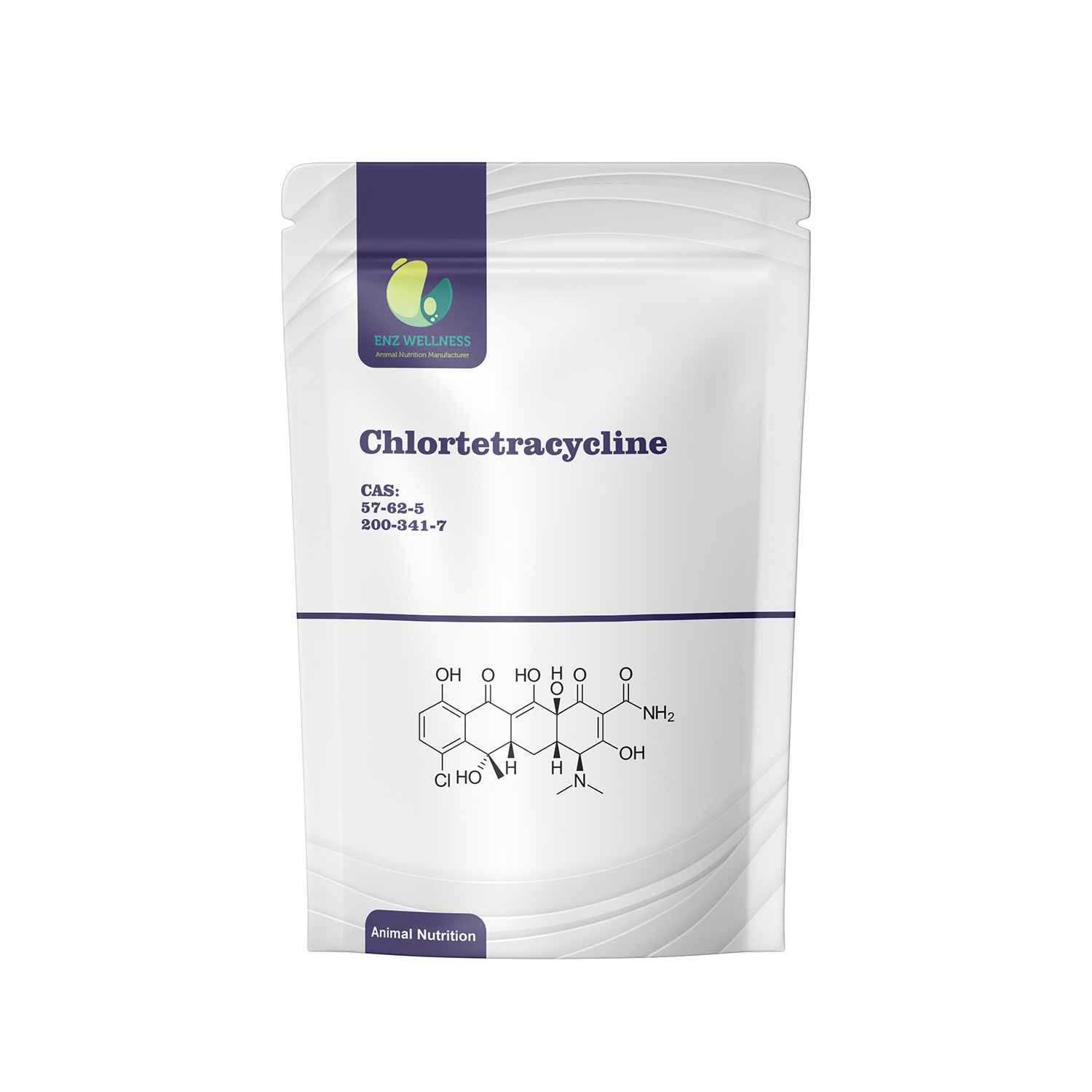
Chlortetracycline is a tetracycline derivative characterized by a four-ring tetracyclic structure with multiple hydroxyl, carbonyl, amide, and dimethylamino functional groups.
Molecular Formula
C₂₂H₂₃ClN₂O₈
Molecular Weight
478.88 g/mol
Structural Characteristics
The molecular structure contains:
- Four fused hydrocarbon rings
- A chlorine substituent
- Dimethylamino functionality
- Multiple hydroxyl groups
- Carbonyl and amide functionalities
- Conjugated structural features characteristic of tetracycline antibiotics
The chlorine substitution distinguishes chlortetracycline from several other members of the tetracycline family.
4. Physicochemical Properties
| Property | Description |
|---|---|
| Product Name | Chlortetracycline |
| Abbreviation | CTC |
| CAS No. | 57-62-5 |
| Chemical Class | Tetracycline antibiotic |
| Molecular Formula | C₂₂H₂₃ClN₂O₈ |
| Molecular Weight | 478.88 g/mol |
| Appearance | Yellow to yellow-orange crystalline powder |
| Physical Form | Powder |
| Odor | Practically odorless |
| Solubility | Slightly soluble to sparingly soluble in water; solubility depends on pH and formulation |
| Light Sensitivity | Sensitive to light |
| Moisture | Protect from excessive moisture |
| Stability | Stability depends on pH, temperature, light exposure and formulation |
| Chemical Nature | Amphoteric tetracycline compound |
| Storage | Store in a cool, dry place and protect from light |
Important Technical Note
Chlortetracycline can exist in different forms and formulations. Chlortetracycline base and Chlortetracycline Hydrochloride should not be treated as identical materials for specification or formulation purposes.
Commercial specifications should clearly state:
- Active form
- Assay/potency
- Water content
- Identification
- Related substances
- Residual solvents, where applicable
- Particle size, where applicable
- Microbiological quality
- Packaging and storage requirements
5. Mechanism of Action
Chlortetracycline is primarily a bacteriostatic antibiotic.
Its principal antibacterial action occurs through binding to the 30S subunit of bacterial ribosomes. This prevents aminoacyl-tRNA from attaching to the messenger RNA-ribosome complex.
As a result:
Chlortetracycline → 30S ribosomal binding → inhibition of aminoacyl-tRNA attachment → inhibition of bacterial protein synthesis → suppression of bacterial growth
Its activity can cover a variety of susceptible organisms, although susceptibility varies among bacterial species and resistance is an important consideration.
6. Antibacterial Spectrum
Chlortetracycline has activity against a range of susceptible:
- Gram-positive bacteria
- Gram-negative bacteria
- Certain atypical bacteria
- Other susceptible microorganisms
The actual clinical effectiveness depends on the organism, antimicrobial susceptibility, dosage, route of administration, tissue distribution, resistance profile, and approved indication.
Because antimicrobial resistance can substantially affect treatment outcomes, veterinary use should be based on appropriate professional guidance and applicable regulations.
7. Application in Veterinary Medicine
Chlortetracycline has been used in veterinary pharmaceutical and animal-health products for the management of infections caused by susceptible bacteria.
Depending on local registration and approved indications, applications may include:
- Poultry
- Swine
- Cattle
- Other livestock
- Veterinary pharmaceutical formulations
- Medicated feed applications where legally authorized
Specific indications and formulations vary between countries.
8. Application in Poultry
Chlortetracycline has been used in poultry veterinary applications for bacterial infections caused by susceptible organisms.
Potential veterinary applications may include management of susceptible bacterial conditions affecting:
- Respiratory system
- Gastrointestinal system
- Systemic infections
- Other approved bacterial conditions
The exact disease indication, dosage, treatment duration, withdrawal period, and permitted route of administration must follow the approved veterinary product label in the target market.
9. Application in Swine
Chlortetracycline has applications in swine veterinary medicine against susceptible bacterial infections.
Depending on local authorization, it may be incorporated into veterinary pharmaceutical products or medicated-feed programs.
Potential areas of use include bacterial conditions involving:
- Respiratory tract
- Gastrointestinal tract
- Systemic infections
- Other susceptible bacterial diseases
Veterinary diagnosis and antimicrobial susceptibility considerations should be used when selecting treatment.
10. Application in Cattle and Other Livestock
Chlortetracycline may also be used in veterinary applications for cattle and other livestock where approved.
Its broad antibacterial activity makes it a useful active ingredient in certain veterinary formulations.
However, tetracycline use should take into account:
- Animal species
- Age
- Disease condition
- Bacterial susceptibility
- Route of administration
- Approved dosage
- Withdrawal requirements
- Local antimicrobial regulations
11. Key Benefits
Broad-Spectrum Antibacterial Activity
Chlortetracycline has activity against a broad range of susceptible bacterial organisms, including both Gram-positive and Gram-negative bacteria.
Established Veterinary Application
CTC has a long history of use in veterinary medicine and animal-health formulations.
Well-Characterized Mechanism
Its inhibition of bacterial protein synthesis through interaction with the 30S ribosomal subunit is well established.
Versatile Veterinary Applications
Depending on regulatory approval, CTC can be incorporated into veterinary products for several livestock species.
Suitable for Pharmaceutical Formulation
High-quality Chlortetracycline and its appropriate salt forms can be used as active pharmaceutical ingredients in veterinary formulations.
12. Common Product Forms
Chlortetracycline may be encountered in different commercial forms, including:
- Chlortetracycline Base
- Chlortetracycline Hydrochloride
- Veterinary powders
- Soluble powders
- Premix products
- Medicated-feed products
- Other approved veterinary formulations
The choice of form depends on the intended route of administration, formulation characteristics, stability, solubility requirements, and regulatory registration.
13. Chlortetracycline vs. Other Tetracyclines
Chlortetracycline belongs to the tetracycline family and is structurally related to compounds such as:
- Tetracycline
- Oxytetracycline
- Doxycycline
- Minocycline
The presence of a chlorine substituent is a characteristic structural feature of chlortetracycline.
Although these compounds share a general mechanism of antibacterial action, they differ in:
- Chemical structure
- Pharmacokinetics
- Solubility
- Tissue distribution
- Half-life
- Approved veterinary applications
- Formulation characteristics
- Regulatory status
They should therefore not be considered interchangeable on a milligram-for-milligram basis.
14. Quality Control
High-quality Chlortetracycline intended for pharmaceutical or veterinary applications should be manufactured and tested according to the applicable quality standards.
Typical quality-control parameters include:
- Identification
- Assay/potency
- Appearance
- Related substances
- Water content
- Residual solvents, where applicable
- Heavy metals/elemental impurities, where applicable
- Microbiological quality
- Particle size, where applicable
Depending on the intended market, quality may be evaluated against relevant pharmacopoeial or customer specifications.
Typical documentation may include:
- Certificate of Analysis (CoA)
- Safety Data Sheet (SDS)
- Technical Data Sheet (TDS)
- Product Specification
- Batch information
- Regulatory documentation, where applicable
15. Packaging
Chlortetracycline can be supplied in pharmaceutical-grade packaging appropriate for active pharmaceutical ingredients.
Common packaging formats may include:
- 1 kg
- 5 kg
- 10 kg
- 25 kg
- Customized bulk packaging
Packaging should provide adequate protection against light, moisture, contamination, and environmental exposure during storage and transportation.
16. Storage and Handling
Store Chlortetracycline in a cool, dry and well-ventilated place, protected from direct light and excessive moisture.
Recommended handling practices include:
- Keep containers tightly closed.
- Protect from direct sunlight.
- Avoid prolonged exposure to heat.
- Minimize dust generation.
- Prevent contamination.
- Use appropriate personal protective equipment according to the SDS.
- Follow the manufacturer’s storage conditions and product-specific shelf-life requirements.
Exact storage temperature and shelf life should be obtained from the current manufacturer’s specification and packaging label.
17. Regulatory Considerations
Chlortetracycline is an antimicrobial active ingredient, and its veterinary use is subject to country-specific regulations.
Regulatory requirements may cover:
- Approved animal species
- Approved indications
- Dosage and administration
- Route of administration
- Maximum residue limits
- Withdrawal periods
- Veterinary prescription requirements
- Medicated-feed regulations
- Import and registration requirements
- Antimicrobial-use restrictions
The legal status of Chlortetracycline can differ significantly between markets. Website content should therefore avoid implying universal approval or unrestricted use.
For food-producing animals, withdrawal periods and residue requirements are particularly important.
18. Antimicrobial Resistance
As with other antibacterial agents, inappropriate or excessive use of Chlortetracycline can contribute to the development and selection of antimicrobial resistance.
Responsible use should include:
- Appropriate veterinary diagnosis
- Use against susceptible organisms
- Compliance with approved dosage and treatment duration
- Avoidance of unnecessary antimicrobial use
- Compliance with local veterinary regulations
- Appropriate withdrawal periods for food-producing animals
Antimicrobial stewardship is an important consideration when using CTC in veterinary applications.
19. Safety Information
Chlortetracycline should be handled as a pharmaceutical active ingredient.
Workers should avoid unnecessary exposure to powder and follow the applicable SDS for:
- Personal protective equipment
- Dust control
- Accidental release procedures
- First-aid measures
- Fire and chemical safety
- Storage requirements
- Disposal requirements
For veterinary use, administration should be performed according to the approved product label and professional veterinary guidance.
20. Technical Summary
| Item | Information |
|---|---|
| Product Name | Chlortetracycline |
| Abbreviation | CTC |
| CAS No. | 57-62-5 |
| Chemical Class | Tetracycline antibiotic |
| Molecular Formula | C₂₂H₂₃ClN₂O₈ |
| Molecular Weight | 478.88 g/mol |
| Appearance | Yellow to yellow-orange powder |
| Main Mechanism | Inhibition of bacterial protein synthesis |
| Primary Target | 30S bacterial ribosomal subunit |
| Antibacterial Type | Primarily bacteriostatic |
| Spectrum | Susceptible Gram-positive and Gram-negative bacteria and certain other microorganisms |
| Main Applications | Veterinary medicine and animal health |
| Target Animals | Poultry, swine, cattle and other approved species |
| Common Salt Form | Chlortetracycline Hydrochloride |
| Storage | Cool, dry and protected from light |
| Typical Documents | CoA, SDS, TDS, Product Specification |
21. Conclusion
Chlortetracycline (CTC) is a well-established tetracycline-class antibacterial ingredient used in veterinary medicine and animal-health applications. Its primary mechanism involves binding to the bacterial 30S ribosomal subunit and inhibiting protein synthesis, resulting in suppression of susceptible bacterial growth.
With applications across poultry, swine, cattle, and other approved livestock species, Chlortetracycline can serve as an important active ingredient for veterinary pharmaceutical formulations where authorized.
For pharmaceutical manufacturers, veterinary-product companies, distributors, and animal-health formulators, high-quality Chlortetracycline offers a well-characterized antibacterial active ingredient with established formulation applications. Its use must always comply with applicable veterinary regulations, antimicrobial stewardship principles, residue requirements, and approved product specifications.