Choline Chloride
1. Introduction
Choline Chloride is an essential nutritional feed additive and an important source of choline, a water-soluble nutrient involved in lipid metabolism, cell membrane structure, methyl-group metabolism, and normal physiological function.
In animal nutrition, choline chloride is widely used in poultry, swine, ruminant, aquaculture, and other livestock feeds. It is particularly important in high-performance production systems where adequate choline supply supports fat metabolism, liver function, growth, reproduction, and production performance.
Commercial feed-grade choline chloride is commonly available as aqueous solution, powder, or carrier-based preparations, with 50%, 60%, 70%, and higher assay grades depending on the product specification and application.
2. Chemical Information
| Property | Information |
|---|---|
| Product Name | Choline Chloride |
| Chemical Name | Choline Chloride |
| CAS No. | 67-48-1 |
| Molecular Formula | C₅H₁₄ClNO |
| Molecular Weight | 139.62 g/mol |
| IUPAC Name | 2-Hydroxyethyl(trimethyl)azanium chloride |
| Chemical Class | Quaternary ammonium compound |
| Active Nutrient | Choline |
| Appearance | White crystalline material or commercial formulated powder/solution |
| Water Solubility | Highly soluble |
| Feed Grade | Commonly 50%, 60%, 70% and other specifications |
CAS Number
67-48-1
Molecular Formula
C₅H₁₄ClNO
Molecular Weight
139.62 g/mol
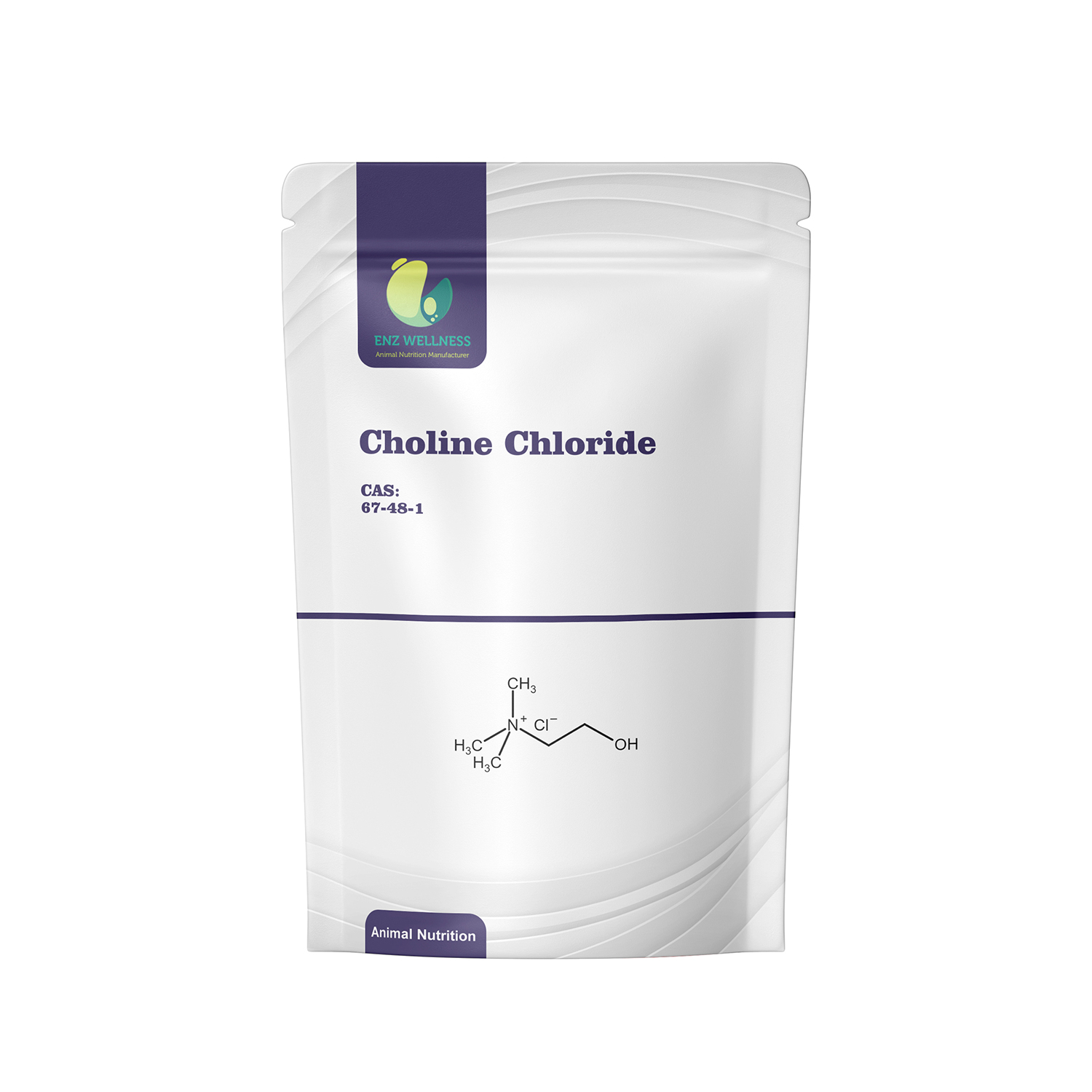
Structural Formula
A simplified structural representation is:
[(CH₃)₃N⁺–CH₂–CH₂–OH]Cl⁻
Choline chloride consists of a quaternary ammonium cation associated with a chloride anion.
3. Physicochemical Properties
| Property | Description |
|---|---|
| Physical Form | Crystalline solid or formulated feed-grade preparation |
| Color | White to off-white |
| Odor | Characteristic, generally mild |
| Water Solubility | Highly soluble |
| Hygroscopicity | Hygroscopic |
| Melting/Decomposition Behavior | Specification-dependent; may decompose upon heating |
| pH | Aqueous solution is generally near neutral to mildly alkaline/acidic depending on concentration and specification |
| Stability | Stable under appropriate storage conditions |
| Compatibility | Highly compatible with water-soluble feed formulations |
Choline chloride is strongly hygroscopic, so moisture-resistant packaging and appropriate storage are important, particularly for concentrated powder grades.
4. Nutritional Functions
Choline performs several important biological functions in animals.
4.1 Lipid Metabolism
Choline is involved in the metabolism and transport of lipids. Adequate choline supply helps support normal fat metabolism and lipid transport, particularly in the liver.
4.2 Phospholipid and Cell Membrane Formation
Choline contributes to the synthesis of important phospholipids, including phosphatidylcholine, which is an important structural component of cell membranes.
4.3 Methyl-Group Metabolism
Choline can participate in methyl-group metabolism through its conversion to betaine, which functions as a methyl donor.
4.4 Acetylcholine Synthesis
Choline is a precursor of acetylcholine, an important neurotransmitter involved in normal nerve and muscle function.
4.5 Liver Function
Adequate dietary choline supports normal lipid metabolism and helps maintain healthy liver function.
5. Applications in Animal Nutrition
Poultry Feed
Choline chloride is extensively used in broiler, layer, breeder, and other poultry diets.
Potential nutritional applications include:
- Supporting normal growth
- Supporting liver function
- Supporting lipid metabolism
- Supporting cell membrane formation
- Supporting nervous-system function
- Supporting reproductive performance
- Maintaining adequate dietary choline supply
Broiler Feed
Fast-growing broilers have significant nutritional requirements, and choline is commonly included in broiler diets as part of a balanced vitamin and mineral program.
It can contribute to:
- Normal growth and development
- Efficient lipid metabolism
- Liver health
- Nutrient utilization
- Overall production performance
Layer Feed
Choline is also important in layer nutrition, where adequate dietary supply supports:
- Normal metabolism
- Liver function
- Egg production
- Reproductive performance
- General physiological health
6. Swine Feed
Choline chloride is commonly incorporated into piglet, grower, finisher, sow, and breeder diets.
Potential applications include:
- Supporting growth and development
- Supporting lipid metabolism
- Supporting liver function
- Supporting reproductive performance
- Maintaining adequate choline nutrition
For breeding animals, dietary choline contributes to normal reproductive and physiological functions.
7. Ruminant Nutrition
Choline can also be used in dairy cattle and other ruminant nutrition programs.
It is particularly relevant in high-producing dairy animals because of the important role of choline in lipid metabolism and liver function.
Applications may include:
- Dairy cow nutrition
- Transition cow diets
- Calf nutrition
- Beef cattle diets
- Ruminant premixes
For dairy cattle, rumen-protected choline is a specialized form used when the objective is to deliver more choline to the small intestine because conventional choline chloride can undergo substantial ruminal degradation.
8. Aquaculture
Choline is an important nutrient in many aquaculture diets.
It may be incorporated into feeds for:
- Fish
- Shrimp
- Crustaceans
- Other cultured aquatic species
Potential nutritional roles include:
- Supporting growth
- Lipid metabolism
- Cell membrane formation
- Normal development
- Nutrient utilization
The actual dietary requirement varies considerably according to species, life stage, feed composition, and production conditions.
9. Key Benefits
Supports Lipid Metabolism
Choline contributes to normal lipid transport and metabolism.
Supports Liver Function
Adequate choline nutrition helps support normal hepatic lipid metabolism.
Supports Cell Membrane Structure
Choline contributes to phospholipid synthesis and cell membrane integrity.
Supports Growth and Production
Adequate dietary choline helps animals meet their nutritional requirements during growth and production.
Supports Reproductive Function
Choline is involved in normal reproductive and physiological processes.
Supports Methyl Metabolism
Through conversion to betaine, choline contributes to methyl-group metabolism.
Broad Animal Nutrition Application
Choline chloride is widely used across poultry, swine, ruminants, and aquaculture.
10. Choline Chloride Grades
Commercial choline chloride is available in several concentrations.
| Grade | Typical Active Content | Common Application |
|---|---|---|
| Choline Chloride 50% | ≥50% | Feed premixes and animal feed |
| Choline Chloride 60% | ≥60% | General feed applications |
| Choline Chloride 70% | ≥70% | Higher-concentration feed formulations |
| Choline Chloride 75%+ | Specification-dependent | Specialized formulations |
The exact assay, moisture, carrier, and physical properties should always be confirmed against the product specification and CoA.
Common Commercial Forms
1. Liquid choline chloride
Usually supplied as an aqueous concentrate and commonly used in feed manufacturing.
2. Powder choline chloride
Usually formulated with a carrier such as plant-based or mineral carrier materials to produce a free-flowing feed additive.
3. Granulated/beadlet forms
Designed to improve handling, flowability, mixing characteristics, and formulation performance.
11. Choline Chloride vs. Betaine
Choline and betaine are related nutrients but should not be treated as identical ingredients.
| Feature | Choline Chloride | Betaine |
|---|---|---|
| Primary nutrient | Choline | Betaine |
| Main functions | Phospholipid synthesis, acetylcholine, methyl metabolism | Osmoregulation and methyl donation |
| Lipid metabolism | Important | Important but different metabolic role |
| Methyl donation | Indirectly via betaine | Direct methyl donor |
| Cell membrane role | Major | Different/indirect |
| Common applications | Poultry, swine, ruminants, aquaculture | Poultry, swine, aquaculture, ruminants |
| Typical feed form | Powder/liquid | Anhydrous/HCl/other preparations |
12. Quality Control
Feed-grade choline chloride should be evaluated for:
- Choline chloride assay
- Moisture
- Carrier content, where applicable
- Free-flowing characteristics
- Particle size
- pH
- Heavy metals
- Microbiological quality
- Impurities
- Stability
- Packaging integrity
For concentrated commercial products, the active choline chloride percentage should be clearly declared.
A reliable CoA should identify the product grade and relevant analytical specifications.
13. Packaging
Common packaging formats include:
- 25 kg bags
- 500 kg or 1,000 kg big bags
- Plastic-lined woven bags
- Moisture-resistant laminated bags
- Drums or customized packaging
Because choline chloride is hygroscopic, packaging should provide adequate protection against moisture absorption and contamination.
14. Storage
Store in a cool, dry and well-ventilated area, protected from moisture and direct sunlight.
Recommended practices:
- Keep containers tightly sealed.
- Avoid humid storage environments.
- Protect from rain and water.
- Minimize prolonged exposure to air.
- Avoid contamination from incompatible materials.
- Follow the manufacturer’s recommended shelf-life conditions.
For powder products, moisture control is particularly important because absorption of water can cause caking and deterioration of physical handling properties.
15. Regulatory and Feed Safety Considerations
Choline chloride is widely used in animal nutrition, but the permitted specifications, labeling requirements, feed-grade standards, and maximum use levels may differ between countries and regions.
For commercial products, verify:
- Applicable feed-additive regulations
- Permitted animal species
- Required assay
- Feed labeling requirements
- Contaminant limits
- Import requirements
- Local feed manufacturing standards
For food-producing animals, formulations should comply with the regulations applicable in the target market.
16. Technical Summary
| Parameter | Information |
|---|---|
| Product Name | Choline Chloride |
| CAS No. | 67-48-1 |
| Molecular Formula | C₅H₁₄ClNO |
| Molecular Weight | 139.62 g/mol |
| Chemical Class | Quaternary ammonium compound |
| Nutritional Category | Essential nutrient / feed additive |
| Appearance | White to off-white solid or formulated product |
| Water Solubility | Highly soluble |
| Main Functions | Lipid metabolism, phospholipid synthesis, methyl metabolism |
| Major Applications | Poultry, swine, ruminants, aquaculture |
| Common Grades | 50%, 60%, 70%, other specifications |
| Storage | Cool, dry, moisture-protected |
| Commercial Forms | Liquid, powder, granulated/carrier-based |