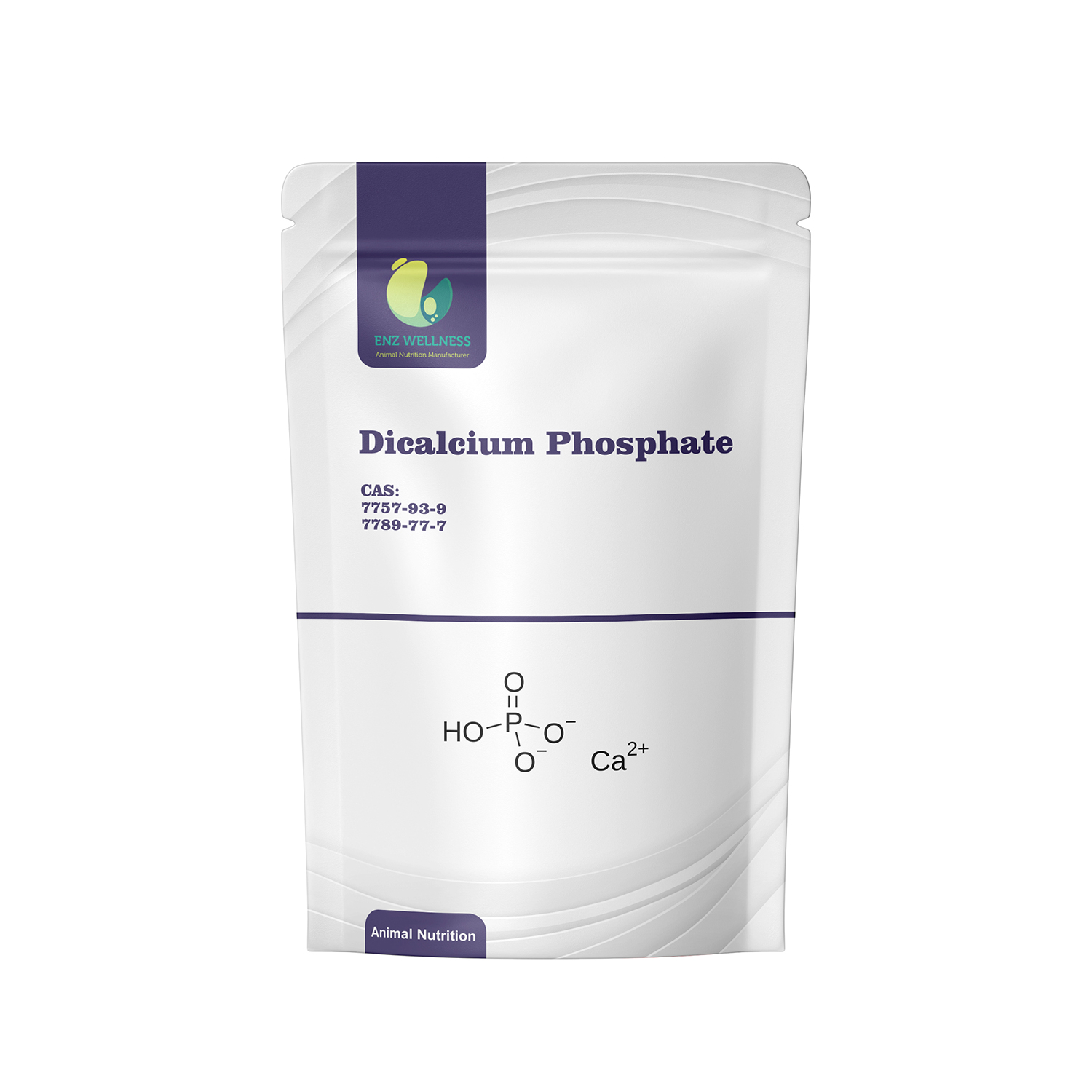
Dicalcium Phosphate
1. Introduction
Dicalcium Phosphate (DCP) is an important mineral feed ingredient and a concentrated source of calcium and phosphorus used extensively in animal nutrition. It is particularly valuable for formulating diets for poultry, swine, cattle, sheep, goats, aquaculture, and other livestock.
Calcium and phosphorus are essential minerals involved in:
- Bone and skeletal development
- Eggshell formation
- Muscle and nerve function
- Energy metabolism
- Cellular functions
- Growth and reproduction
Feed-grade Dicalcium Phosphate is commonly produced in anhydrous (DCPA) and dihydrate (DCPD) forms. Commercial specifications can therefore differ in calcium, phosphorus, moisture, and crystal-water content.
2. Chemical Information
| Property | Information |
|---|---|
| Product Name | Dicalcium Phosphate |
| Abbreviation | DCP |
| Chemical Name | Calcium Hydrogen Phosphate |
| CAS No. | 7757-93-9 (dihydrate form) |
| Anhydrous CAS No. | 7757-82-6 |
| Chemical Formula – Dihydrate | CaHPO₄·2H₂O |
| Molecular Weight – Dihydrate | 172.09 g/mol |
| Chemical Formula – Anhydrous | CaHPO₄ |
| Molecular Weight – Anhydrous | 136.06 g/mol |
| Mineral Category | Calcium-phosphorus source |
| Appearance | White or off-white powder/granules |
Important Note on CAS Numbers
The term “Dicalcium Phosphate” can refer to different hydration states.
The commonly encountered feed-grade form is Dicalcium Phosphate Dihydrate (DCPD):
CaHPO₄·2H₂O — CAS 7757-93-9
The anhydrous form is:
CaHPO₄ — CAS 7757-82-6
For a commercial product page, the CAS number should therefore match the actual grade and specification being supplied.
3. Structural Formula
Dicalcium Phosphate Dihydrate
CaHPO₄·2H₂O
A simplified ionic representation is:
Ca²⁺ + HPO₄²⁻ + 2H₂O
The material contains calcium ions associated with hydrogen phosphate ions and, in the dihydrate form, two molecules of crystal water.
4. Physicochemical Properties
| Property | Description |
|---|---|
| Physical Form | Fine powder or granules |
| Color | White to off-white |
| Odor | Odorless |
| Taste | Practically tasteless |
| Water Solubility | Slightly soluble |
| Acid Solubility | More readily soluble in acids |
| Moisture | Depends on anhydrous/dihydrate form |
| Hygroscopicity | Generally low to moderate, specification-dependent |
| pH | Generally near neutral to mildly acidic depending on concentration and grade |
| Stability | Stable under recommended storage conditions |
DCP is substantially less water-soluble than some highly soluble phosphate salts, but its nutritional value comes from its calcium and phosphorus content and bioavailability.
5. Nutritional Functions
5.1 Calcium Source
Dicalcium phosphate provides a concentrated source of calcium, which is essential for:
- Bone formation
- Skeletal development
- Eggshell formation
- Muscle contraction
- Nerve transmission
- Cellular signaling
5.2 Phosphorus Source
Phosphorus is essential for:
- Bone and teeth development
- ATP and energy metabolism
- Nucleic acid synthesis
- Cell membrane structure
- Phospholipid metabolism
- Normal growth and reproduction
DCP provides phosphorus in a form suitable for use in balanced animal diets.
5.3 Calcium-Phosphorus Balance
One of the major advantages of DCP is that it supplies both calcium and phosphorus in a single feed ingredient.
Maintaining an appropriate dietary Ca:P ratio is important for:
- Skeletal development
- Mineral absorption
- Growth
- Egg production
- Reproductive performance
The exact dietary ratio should be formulated according to species, age, production stage, and the total mineral contribution of the diet.
6. Applications in Animal Nutrition
Poultry Feed
Dicalcium phosphate is widely used in:
- Broiler feed
- Layer feed
- Breeder feed
- Chick starter feed
- Poultry premixes
Broilers
DCP supplies calcium and phosphorus required for:
- Rapid skeletal development
- Bone mineralization
- Growth
- Muscle development
- Normal physiological function
Layers
Calcium and phosphorus are particularly important in laying hens because of the large amount of calcium required for eggshell formation.
DCP can contribute to:
- Eggshell formation
- Bone mineral reserves
- Egg production
- Mineral balance
However, layer diets commonly require additional calcium sources such as limestone or calcium carbonate, because the calcium requirement can be substantially higher than the amount supplied by DCP alone.
7. Swine Feed
DCP is commonly used in pig diets, including:
- Piglet feed
- Grower feed
- Finisher feed
- Sow diets
It provides calcium and phosphorus needed for:
- Skeletal development
- Bone mineralization
- Growth
- Normal metabolic function
In young pigs, mineral nutrition is particularly important because of rapid skeletal development.
8. Ruminant Feed
DCP can be used in diets for:
- Dairy cattle
- Beef cattle
- Calves
- Sheep
- Goats
- Other ruminants
Potential nutritional applications include:
- Supporting skeletal development
- Maintaining mineral balance
- Supporting growth
- Supporting reproduction
- Supplying dietary calcium and phosphorus
DCP can be incorporated into mineral premixes, concentrates, compound feeds, and total mixed rations, depending on formulation requirements.
9. Aquaculture
Calcium and phosphorus are also essential nutrients for cultured aquatic animals.
DCP can be incorporated into feeds for selected:
- Fish
- Shrimp
- Crustaceans
- Other aquatic species
Potential applications include:
- Skeletal development
- Mineral nutrition
- Growth
- Bone formation
- Normal physiological development
The appropriate phosphorus source and inclusion level should be determined according to the specific species and feed formulation.
10. Key Benefits
Dual Mineral Source
DCP provides both calcium and phosphorus, simplifying mineral formulation.
Supports Bone Development
Adequate calcium and phosphorus are essential for normal skeletal formation and mineralization.
Supports Poultry Production
Calcium and phosphorus contribute to normal eggshell formation and reproductive performance.
Supports Growth
Provides essential minerals required during rapid growth and development.
Suitable for Multiple Species
Widely applicable to:
- Poultry
- Swine
- Cattle
- Sheep
- Goats
- Aquaculture
Useful in Premixes
DCP can be incorporated into mineral premixes and compound feeds according to the required nutrient contribution.
11. Dicalcium Phosphate vs. Monocalcium Phosphate
Both are common calcium-phosphorus feed ingredients, but their chemical composition and nutrient concentrations differ.
| Feature | Dicalcium Phosphate | Monocalcium Phosphate |
|---|---|---|
| Abbreviation | DCP | MCP |
| Main compound | CaHPO₄ | Ca(H₂PO₄)₂ |
| Calcium | Relatively high | Relatively high |
| Phosphorus | High | Generally higher concentration |
| Water solubility | Low | Higher |
| Common application | Animal feed/mineral nutrition | Animal feed/mineral nutrition |
| Acidic character | Relatively mild | More acidic |
The choice depends on the required calcium-to-phosphorus ratio, phosphorus concentration, digestibility, formulation, and cost.
12. Dicalcium Phosphate vs. Tricalcium Phosphate
| Feature | DCP | TCP |
|---|---|---|
| Chemical formula | CaHPO₄ | Ca₃(PO₄)₂ |
| Calcium source | Yes | Yes |
| Phosphorus source | Yes | Yes |
| Calcium:phosphorus ratio | Lower | Higher |
| Solubility | Relatively higher | Lower |
| Feed application | Very common | More specialized |
DCP is generally preferred when a balanced calcium-phosphorus source is required.
13. Typical Feed-Grade Specifications
Commercial DCP specifications vary depending on production process and grade. A typical specification may include parameters such as:
| Parameter | Typical Consideration |
|---|---|
| Total Phosphorus | Commonly around 17–19% for DCP grades |
| Calcium | Commonly around 20–24% |
| Fluorine | Controlled according to applicable feed regulations |
| Moisture | Specification-dependent |
| Particle Size | Depending on feed application |
| Heavy Metals | Must meet applicable limits |
| Appearance | White/off-white powder or granules |
Important: Actual nutrient values vary by DCP source, hydration state, production process, and commercial specification. The exact calcium and phosphorus content should always be stated according to the supplier’s CoA/specification.
14. Quality Control
Feed-grade Dicalcium Phosphate should be evaluated for:
- Total phosphorus
- Calcium
- Fluorine
- Moisture
- Water-soluble phosphorus, where applicable
- Particle size
- Heavy metals
- Arsenic
- Lead
- Cadmium
- Mercury, where applicable
- Insoluble matter
- Microbiological quality
- Identification
For phosphate minerals intended for food-producing animals, fluorine and heavy-metal control are particularly important.
15. Packaging
Common commercial packaging includes:
- 25 kg bags
- 500 kg big bags
- 1,000 kg jumbo bags
- Kraft paper bags with PE inner lining
- PP woven bags
- Customized industrial packaging
Packaging should protect the product from:
- Moisture
- Contamination
- Excessive humidity
- Physical damage
16. Storage
Store Dicalcium Phosphate in a:
- Cool
- Dry
- Clean
- Well-ventilated
warehouse.
Recommended practices:
- Keep bags tightly closed.
- Protect from moisture.
- Avoid direct contact with water.
- Store on pallets rather than directly on the floor.
- Avoid contamination from other mineral products.
- Follow the manufacturer’s recommended shelf-life conditions.
Although DCP is relatively stable, excessive moisture can adversely affect its flowability and physical handling characteristics.
17. Regulatory Considerations
Dicalcium phosphate is widely used as an animal feed mineral source, but feed-grade specifications and permitted contaminant limits vary by country and region.
For international sales, suppliers should verify:
- Feed-grade status
- Calcium and phosphorus specifications
- Fluorine limits
- Heavy-metal limits
- Permitted animal species
- Applicable feed-additive/mineral regulations
- Labeling requirements
- Import requirements
- Applicable quality standards
The product specification should be prepared according to the requirements of the intended destination market.
18. Technical Summary
| Parameter | Information |
|---|---|
| Product Name | Dicalcium Phosphate |
| Abbreviation | DCP |
| CAS No. | 7757-93-9 for dihydrate |
| Anhydrous CAS No. | 7757-82-6 |
| Formula | CaHPO₄·2H₂O / CaHPO₄ |
| Primary Nutrients | Calcium + phosphorus |
| Appearance | White to off-white powder/granules |
| Water Solubility | Slightly soluble |
| Main Applications | Poultry, swine, cattle, sheep, goats, aquaculture |
| Main Functions | Bone development, mineralization, eggshell formation, growth |
| Typical P Content | Approximately 17–19%, grade-dependent |
| Typical Ca Content | Approximately 20–24%, grade-dependent |
| Key QC Parameters | Ca, P, F, moisture, heavy metals |
| Storage | Cool, dry, moisture-protected |