Enramycin
1. Introduction
Enramycin is a glycopeptide-class antibacterial feed additive used primarily in animal nutrition to control susceptible Gram-positive bacteria in the gastrointestinal tract.
It is especially associated with poultry and swine feed applications. Enramycin is valued for its activity against Gram-positive organisms and its ability to support intestinal microbial balance and feed efficiency when used in accordance with applicable regulations.
Enramycin is generally supplied as a feed-grade fermentation-derived antibiotic preparation, rather than as a simple single-component small-molecule API. Commercial products are commonly standardized according to potency, typically expressed in activity units such as IU/g.
Regulatory note: Enramycin is an antimicrobial feed additive, and its permitted use, inclusion level, target species, and growth-promotion status vary by country. It should only be marketed and used where specifically authorized.
2. Chemical Information
| Property | Information |
|---|---|
| Product Name | Enramycin |
| Alternative Name | Enramycin A/B |
| Chemical Class | Glycopeptide antibiotic |
| CAS No. | 11115-82-5 |
| Primary Components | Enramycin A and Enramycin B |
| Source | Fermentation-derived |
| Typical Commercial Form | Feed-grade powder / premix |
| Primary Activity | Antibacterial |
| Main Target | Susceptible Gram-positive bacteria |
CAS Number
11115-82-5
Chemical Nature
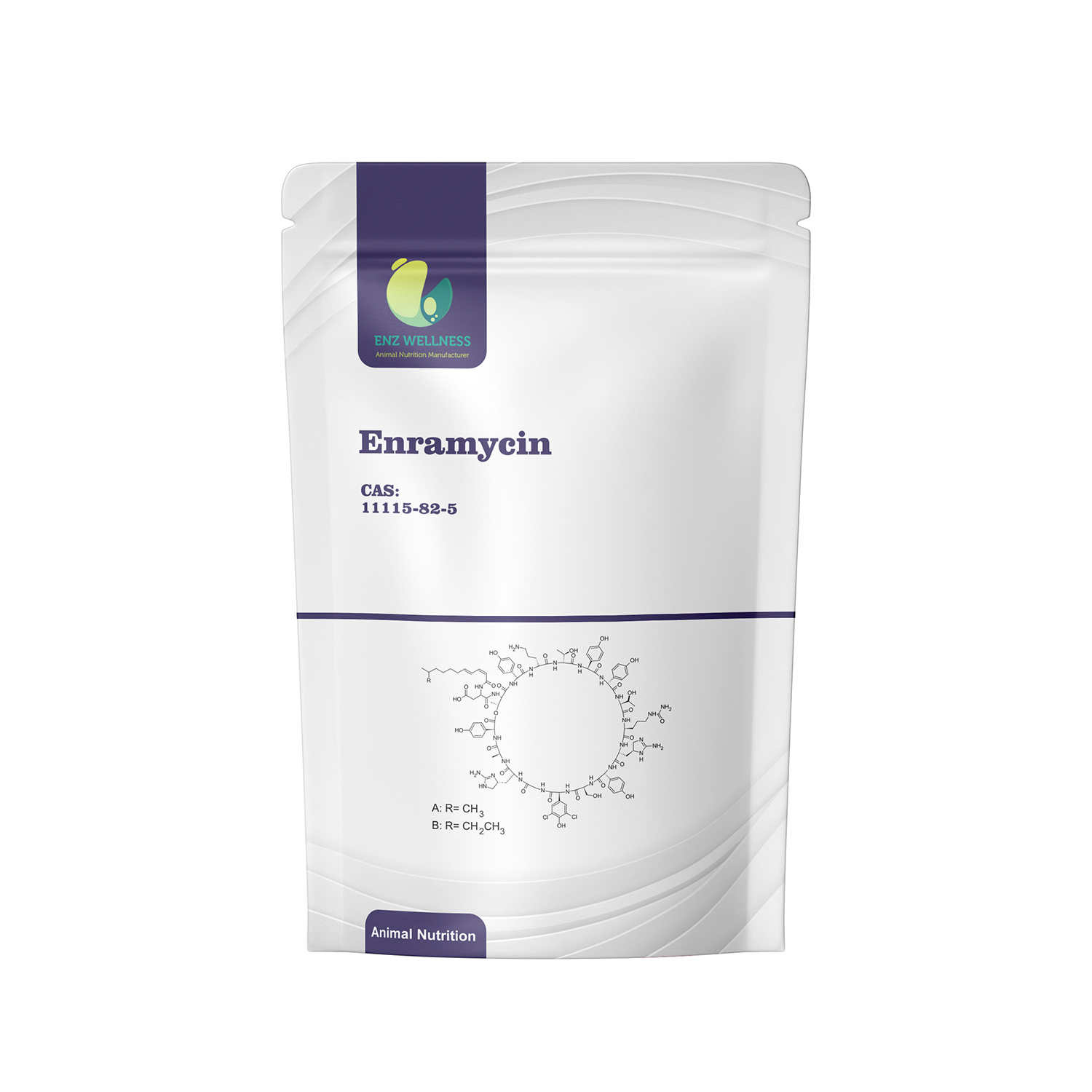
Enramycin is not best represented as a conventional single molecular compound for commercial feed purposes. It is a glycopeptide antibiotic complex, with Enramycin A and Enramycin B as important active components.
Therefore, commercial feed-grade specifications are generally based on antibacterial potency/activity rather than simply reporting the concentration of one pure molecular species.
3. Structural Characteristics
Enramycin is a complex glycopeptide antibiotic consisting of a peptide-based structure associated with sugar-containing components.
Its molecular structure contains:
- Peptide components
- Glycosidic/sugar moieties
- Multiple amino-acid residues
- Several functional groups involved in antimicrobial activity
The complex structure contributes to its interaction with bacterial cell-wall components.
For commercial product pages, it is preferable to describe the material as an Enramycin A/B complex rather than presenting one molecular formula as representative of the entire commercial product.
4. Physicochemical Properties
| Property | Description |
|---|---|
| Physical Form | Fine powder |
| Color | White to pale yellow/yellowish powder, specification-dependent |
| Odor | Characteristic or practically odorless |
| Water Solubility | Limited/poor, formulation-dependent |
| Stability | Product- and formulation-dependent |
| Moisture Sensitivity | Protect from excessive moisture |
| Light Sensitivity | Protect from prolonged direct light |
| Heat Stability | Processing stability depends on formulation and feed conditions |
| Potency | Expressed according to commercial specification, commonly activity units |
Because commercial enramycin is generally supplied as a potency-standardized fermentation product, the manufacturer’s CoA should be used for the exact assay/potency and physical specifications.
5. Mechanism of Action
Enramycin primarily acts against Gram-positive bacteria by interfering with bacterial cell-wall formation.
Its antibacterial activity is associated with interaction with lipid intermediates involved in peptidoglycan biosynthesis, interfering with the construction of the bacterial cell wall.
This ultimately compromises bacterial cell-wall integrity and inhibits growth of susceptible organisms.
Simplified mechanism
Enramycin → interferes with cell-wall precursor utilization → inhibits peptidoglycan synthesis → suppresses susceptible Gram-positive bacteria
Its mechanism differs from antibiotics that primarily inhibit:
- Protein synthesis
- DNA replication
- Folate metabolism
6. Antibacterial Spectrum
Enramycin is mainly active against Gram-positive bacteria.
Susceptible organisms may include:
- Clostridium spp.
- Clostridium perfringens
- Other susceptible Gram-positive intestinal bacteria
Its activity against most Gram-negative bacteria is limited, which is consistent with its mechanism and bacterial target.
Important
Antimicrobial susceptibility can vary by organism and strain. Enramycin should therefore not be described as a universal broad-spectrum antibiotic.
7. Applications in Animal Nutrition
Poultry Feed
Enramycin has historically been used in poultry feed, particularly in production systems where control of susceptible Gram-positive intestinal bacteria is an objective.
Potential applications include:
- Supporting intestinal microbial balance
- Controlling susceptible Gram-positive bacteria
- Supporting feed efficiency
- Supporting growth performance
- Supporting intestinal health
Broilers
Enramycin may be incorporated into broiler diets where permitted and appropriately formulated.
Potential nutritional benefits include:
- Improved feed utilization
- Support for intestinal health
- Reduced impact of susceptible Gram-positive bacterial populations
- Support for production performance
8. Swine Feed
Enramycin is also used in certain swine feed applications, depending on local authorization.
Potential applications include:
- Piglet diets
- Grower diets
- Finisher diets
- Intestinal bacterial management
Its activity against susceptible Gram-positive organisms makes it relevant to feed programs where Clostridium-associated intestinal challenges are a concern.
9. Key Benefits
Gram-Positive Antibacterial Activity
Enramycin provides targeted activity against susceptible Gram-positive bacteria.
Intestinal Health Support
By suppressing susceptible undesirable Gram-positive bacteria, it can help maintain a favorable intestinal microbial environment when appropriately used.
Feed Efficiency
Historically, enramycin-containing feed programs have been associated with improved feed utilization under certain production conditions.
Poultry and Swine Applications
It has established applications in feed programs for poultry and swine in markets where its use is authorized.
Distinct Mechanism
Its cell-wall-related antibacterial mechanism differs from many other commonly used feed antimicrobials.
10. Enramycin vs. Other Feed Antibiotics
| Feature | Enramycin | Bacitracin | Colistin |
|---|---|---|---|
| Antibiotic class | Glycopeptide | Cyclic peptide | Polymyxin |
| Main target | Gram-positive | Mainly Gram-positive | Mainly Gram-negative |
| Main action | Cell-wall synthesis interference | Cell-wall synthesis interference | Membrane disruption |
| Common feed application | Poultry, swine | Poultry/livestock where permitted | Veterinary applications where permitted |
| Typical commercial form | Potency-standardized feed additive | BMD/other preparations | API/pharmaceutical preparations |
| Resistance concern | Yes | Yes | Particularly significant |
11. Commercial Feed Grades
Enramycin is commonly marketed according to antibacterial potency, rather than simply percentage purity.
Commercial specifications may be expressed in:
- IU/g
- Activity units/g
- Other manufacturer-specific potency units
The actual product concentration depends on the formulation and carrier.
For example, a commercial product may be supplied as a standardized premix containing a specified amount of active enramycin potency per gram of product.
Therefore, the website should avoid presenting a single universal “purity %” unless it corresponds to the exact commercial grade.
12. Quality Control
Feed-grade Enramycin should be evaluated for:
- Antibacterial potency
- Identification
- Enramycin A/B profile
- Moisture
- Particle size
- Carrier content, where applicable
- Microbiological quality
- Related substances/degradation products
- Heavy metals
- Stability
- Uniformity of mixing
Potency testing is particularly important because commercial enramycin is a biological/fermentation-derived antibiotic preparation.
The exact analytical method should follow the applicable pharmacopoeial standard, regulatory specification, or validated manufacturer’s method.
13. Packaging
Typical commercial packaging may include:
- 10 kg bags
- 20 kg bags
- 25 kg bags
- Aluminum foil-lined bags
- PE-lined kraft bags
- Fiber drums
- Customized feed-additive packaging
Packaging should protect the product from:
- Moisture
- Excessive heat
- Direct sunlight
- Contamination
14. Storage
Store Enramycin in a:
- Cool
- Dry
- Well-ventilated
- Light-protected
environment.
Recommended practices:
- Keep the original package tightly sealed.
- Avoid excessive humidity.
- Protect from direct sunlight.
- Avoid prolonged exposure to high temperatures.
- Prevent contamination with other feed additives.
- Follow the manufacturer’s specified storage temperature and shelf life.
15. Regulatory and Antimicrobial Stewardship
This is an important section for an international website.
The regulatory status of enramycin varies substantially between markets. Depending on the jurisdiction, it may be authorized as:
- A feed additive
- A veterinary antimicrobial
- An intestinal health-related feed additive
- Or not authorized for particular uses
The permitted:
- Animal species
- Inclusion levels
- Indications
- Duration of use
- Withdrawal requirements
- Labeling
- Growth-promotion applications
must be checked against the regulations of the destination market.
For food-producing animals, products should be used only according to approved labels and applicable veterinary/feed regulations.
Recommended website wording
Enramycin is intended for use in authorized animal feed applications and should be used according to applicable local regulations, approved specifications, and antimicrobial stewardship requirements.
Avoid making universal claims such as “growth promoter approved worldwide” or “safe for unrestricted feed use.”
16. Technical Summary
| Parameter | Information |
|---|---|
| Product Name | Enramycin |
| CAS No. | 11115-82-5 |
| Class | Glycopeptide antibiotic |
| Main Components | Enramycin A and B |
| Source | Fermentation-derived |
| Appearance | White to pale yellow/yellowish powder |
| Primary Target | Susceptible Gram-positive bacteria |
| Main Mechanism | Interference with bacterial cell-wall synthesis |
| Major Applications | Poultry and swine feed, where permitted |
| Typical Commercial Specification | Potency/activity based |
| Common Form | Feed-grade powder/premix |
| Storage | Cool, dry, sealed, protected from light |
| Key Consideration | Regulatory compliance and antimicrobial stewardship |