Salinomycin
Introduction
Salinomycin is a polyether ionophore feed additive widely used in animal nutrition, particularly as an anticoccidial in poultry. It is a fermentation-derived compound produced by Streptomyces species and is valued for its activity against susceptible Eimeria species.
Salinomycin works by transporting ions across biological membranes, disrupting the ionic balance of susceptible coccidia. In poultry production, it is primarily used to help control coccidiosis and support intestinal health and feed efficiency where its use is authorized.
Commercial products are commonly supplied as salinomycin sodium, usually standardized to a specified potency or concentration.
Chemical Information
| Property | Specification |
|---|---|
| Product Name | Salinomycin |
| Common Commercial Form | Salinomycin Sodium |
| Chemical Class | Polyether Ionophore |
| Category | Anticoccidial Feed Additive |
| CAS No. | 53003-10-4 |
| Molecular Formula | C₄₂H₇₀O₁₁ |
| Molecular Weight | 750.02 g/mol |
| Sodium Salt Formula | C₄₂H₆₉NaO₁₁ |
| Sodium Salt Molecular Weight | 772.00 g/mol |
| Origin | Fermentation-derived |
| Typical Form | Powder or formulated premix |
| Main Application | Coccidiosis control in poultry and other approved livestock applications |
Note: Commercial feed products are often based on salinomycin sodium and may be standardized by active concentration/potency. The exact commercial specification should always be verified against the manufacturer’s CoA and product specification.
Structural Characteristics
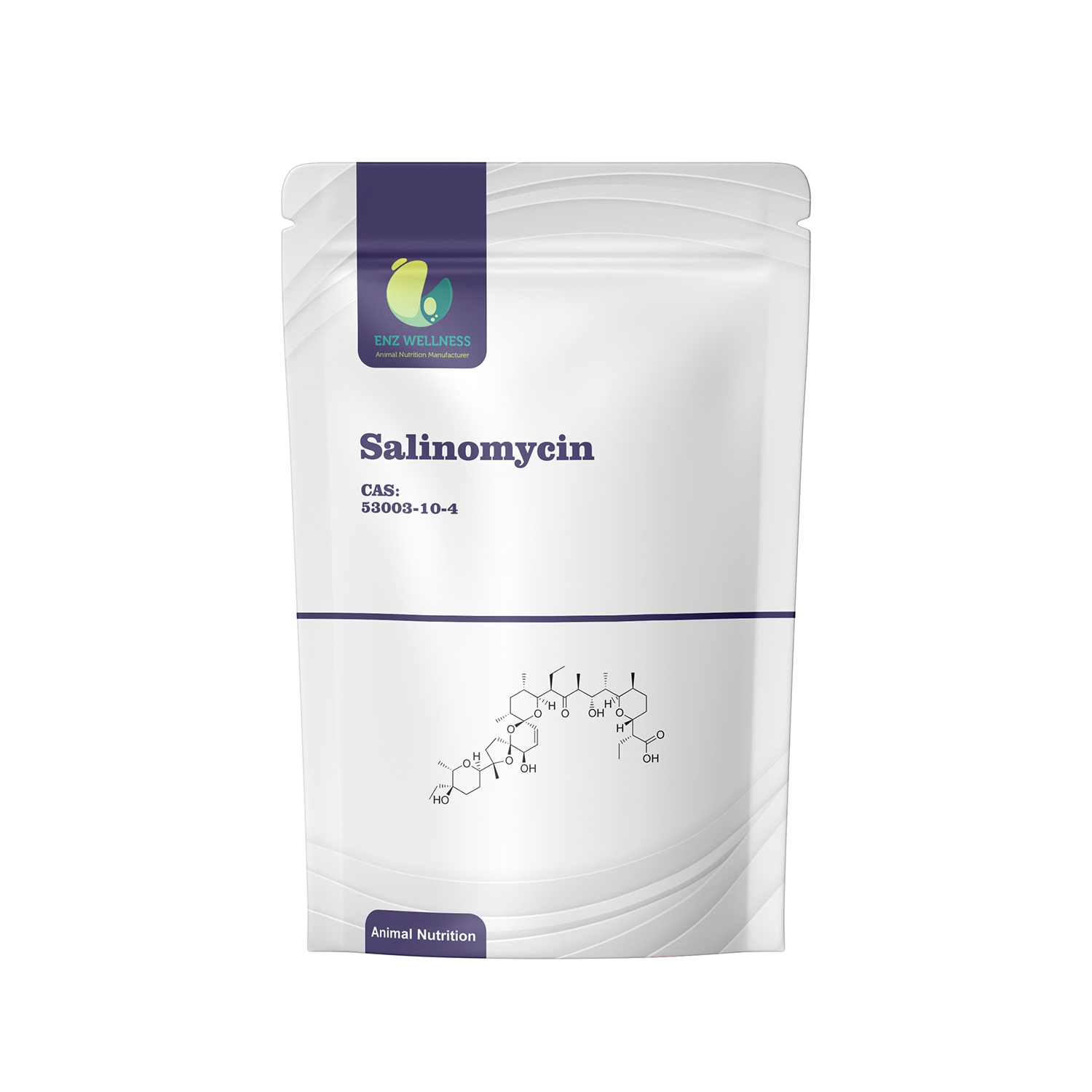
Salinomycin is a monocarboxylic polyether ionophore containing multiple ether functionalities and a carboxylic acid group.
Its highly oxygenated polyether structure allows it to interact with and transport cations such as Na⁺ and K⁺ across biological membranes.
Simplified Structural Characteristics
- Polyether backbone
- Multiple ether oxygen atoms
- Carboxylic acid functionality
- Hydrophobic regions
- Multiple stereogenic centers
- Strong metal-ion complexing capability
This amphiphilic structure is fundamental to its ionophore activity.
Physicochemical Properties
| Parameter | Typical Characteristic |
|---|---|
| Molecular formula | C₄₂H₇₀O₁₁ |
| Molecular weight | 750.02 g/mol |
| Commercial form | Salinomycin sodium |
| Appearance | White to pale yellow/yellowish powder, depending on formulation |
| Solubility in water | Very low / practically insoluble |
| Chemical nature | Polyether ionophore |
| Stability | Sensitive to formulation and storage conditions |
| Odor | Characteristic/slight, depending on grade |
| Active component | Salinomycin |
| Commercial assay | Specification-dependent |
Because commercial feed products may contain carriers and stabilizers, appearance, assay, bulk density, and physical characteristics can vary by grade.
Mechanism of Action
1. Ionophore Activity
Salinomycin forms complexes with certain cations and facilitates their movement across biological membranes.
The resulting changes in intracellular ion concentrations can disrupt:
- Sodium balance
- Potassium balance
- Membrane potential
- Osmotic balance
- Cellular energy metabolism
2. Anticoccidial Action
Susceptible coccidia have limited ability to tolerate these rapid changes in intracellular ion balance.
Salinomycin therefore interferes with the development and survival of susceptible Eimeria organisms.
Its activity is particularly relevant to the intracellular stages of coccidia.
3. Intestinal Microbial Modulation
As an ionophore, salinomycin also affects susceptible bacteria in the gastrointestinal tract.
This can alter intestinal microbial populations and fermentation patterns, although its primary feed-additive application in poultry is generally anticoccidial control rather than conventional antibacterial therapy.
Applications in Animal Nutrition
Poultry
Salinomycin is particularly important in broiler production for the prevention/control of coccidiosis caused by susceptible Eimeria species.
Potential production benefits include:
- Coccidiosis control
- Support for intestinal integrity
- Reduced impact of coccidial challenge
- Improved feed utilization
- Support for growth performance
- Reduced intestinal damage associated with susceptible coccidia
Target Organisms
Activity is directed against susceptible Eimeria species, including species commonly associated with poultry coccidiosis.
However, sensitivity varies between Eimeria species and geographical production systems, and resistance can develop after prolonged or inappropriate use.
Beef Cattle
Salinomycin can also be used in certain cattle production systems where approved.
Its ionophore activity can influence rumen fermentation and microbial populations.
Potential nutritional effects include:
- Improved feed efficiency
- Improved energy utilization
- Modification of rumen fermentation
- Support for production performance
The specific application, dosage, withdrawal requirements, and permitted production category must follow the applicable local authorization.
Other Livestock
Use in sheep, goats, or other livestock should not be assumed based on poultry or cattle applications.
Species-specific safety margins and regulatory approvals can differ significantly.
Key Advantages
1. Effective Ionophore Anticoccidial
Salinomycin provides a well-established ionophore mechanism against susceptible coccidia.
2. Broad Activity Against Poultry Coccidia
It can act against several economically important Eimeria species when the organisms remain susceptible.
3. Feed-Based Application
It can be incorporated into complete feeds or premixes, allowing continuous delivery according to the approved feeding program.
4. Supports Feed Efficiency
Effective coccidiosis management can help protect intestinal function and maintain feed utilization.
5. Distinct Mode of Action
Its polyether ionophore mechanism provides a different mode of action from non-ionophore anticoccidials.
Salinomycin vs. Other Ionophore Anticoccidials
| Feature | Salinomycin | Monensin | Maduramycin | Lasalocid |
|---|---|---|---|---|
| Chemical class | Polyether ionophore | Polyether ionophore | Polyether ionophore | Polyether ionophore |
| Main application | Poultry coccidiosis | Poultry/cattle | Poultry coccidiosis | Poultry/cattle depending approval |
| Ion transport | Yes | Yes | Yes | Yes |
| Main target | Susceptible Eimeria spp. | Eimeria spp. / rumen microbes | Eimeria spp. | Eimeria spp. |
| Commercial form | Often salinomycin sodium | Often monensin sodium | Maduramycin ammonium | Often lasalocid sodium |
| Resistance concern | Yes | Yes | Yes | Yes |
| Species safety | Highly species-specific | Highly species-specific | Highly species-specific | Highly species-specific |
The products should not be considered automatically interchangeable. Their efficacy spectrum, approved species, dosage, withdrawal periods, safety margins, and resistance profiles differ.
Salinomycin and Coccidiosis Management
Effective coccidiosis control should generally be part of an integrated management program rather than relying exclusively on one anticoccidial compound.
Important management factors include:
- Appropriate anticoccidial selection
- Correct feed inclusion rate
- Rotation or shuttle programs where appropriate
- Monitoring of coccidial challenge
- Litter management
- Farm hygiene
- Biosecurity
- Appropriate stocking density
- Vaccination programs where applicable
- Monitoring of production performance and intestinal lesions
Resistance Management
Repeated exposure to the same ionophore can contribute to reduced susceptibility in coccidia populations.
For this reason, producers may use carefully designed rotation or shuttle programs, subject to veterinary and regulatory guidance.
Important Safety Considerations
Salinomycin has a narrow safety margin in certain animal species and must be handled carefully.
Horses and Other Equids
Salinomycin can be highly toxic to horses and other equids.
Feed containing salinomycin should therefore be strictly protected from accidental access by horses.
Particular attention should be given to:
- Feed manufacturing
- Premix handling
- Transportation
- Storage
- Feed mill sequencing
- Equipment cleaning
- Cross-contamination prevention
Species-Specific Use
A dosage suitable for one species must never be extrapolated to another species without appropriate authorization and veterinary guidance.
Commercial Grades and Specifications
Salinomycin feed products may be available in different active concentrations depending on the intended application.
Common commercial products may include:
- Salinomycin sodium technical material
- Concentrated salinomycin premixes
- Feed-grade salinomycin preparations
- Carrier-based premixes
- Standardized potency products
The commercial specification should clearly identify:
| Specification | Control |
|---|---|
| Active ingredient | Salinomycin / salinomycin sodium |
| Assay/potency | According to product specification |
| Appearance | Controlled |
| Moisture | Controlled |
| Carrier | Declared |
| Particle size | Controlled where applicable |
| Heavy metals | Applicable limits |
| Microbiological quality | Applicable requirements |
| Stability | Verified for intended shelf life |
| Homogeneity | Controlled in premix/feed applications |
For a B2B product page, it is preferable to state the actual concentration offered by your factory rather than presenting one universal concentration.
Quality Control
A professional Salinomycin feed-grade specification should normally include:
- Identification
- Active ingredient assay
- Potency
- Related substances/impurities
- Moisture
- Residual solvents where applicable
- Heavy metals
- Microbiological quality
- Particle-size distribution
- Bulk density
- Carrier composition
- Stability
- Homogeneity for premixes
Each batch should be supported by a Certificate of Analysis (CoA).
Packaging
Depending on the commercial form, Salinomycin products may be supplied in:
- 5 kg bags
- 10 kg bags
- 20 kg bags
- 25 kg bags
- Fiber drums
- Cartons with inner PE bags
- Customized packaging
For concentrated products, packaging should provide adequate protection against moisture, contamination, and physical degradation.
Storage
- Store in a cool, dry and well-ventilated area.
- Keep the original container tightly sealed.
- Protect from moisture and direct sunlight.
- Avoid prolonged exposure to excessive heat.
- Keep away from feeds intended for non-target species.
- Prevent access by horses and other sensitive animals.
- Follow the manufacturer’s SDS and storage specifications.
Regulatory and Antimicrobial Stewardship Considerations
Salinomycin is a veterinary/feed pharmacologically active compound, so its use is subject to regulations that vary by country.
Before commercializing or supplying Salinomycin, verify:
- Approved animal species
- Approved production stage
- Authorized inclusion level
- Approved indications
- Maximum residue limits where applicable
- Withdrawal requirements
- Feed labeling requirements
- Import registration requirements
- Local veterinary-feed regulations
For international B2B sales, the product documentation should be aligned with the destination country’s current regulatory requirements.
Because anticoccidial resistance can reduce efficacy, Salinomycin should be used as part of a responsible coccidiosis-control strategy and not at unauthorized inclusion rates.
Technical Summary
| Item | Details |
|---|---|
| Product | Salinomycin |
| Commercial form | Salinomycin Sodium |
| CAS No. | 53003-10-4 |
| Formula | C₄₂H₇₀O₁₁ |
| MW | 750.02 g/mol |
| Sodium salt formula | C₄₂H₆₉NaO₁₁ |
| Chemical class | Polyether ionophore |
| Primary function | Anticoccidial |
| Primary target | Susceptible Eimeria spp. |
| Main application | Poultry nutrition |
| Additional application | Certain cattle production systems |
| Mechanism | Ion transport and disruption of cellular ion balance |
| Form | Powder / premix |
| Water solubility | Very low |
| Key safety issue | Toxicity to horses/equids |
| Resistance concern | Yes |
| Grade | Feed grade / veterinary feed additive |
| Documentation | CoA, SDS, specification, regulatory documents |