Taurine
Introduction
Taurine is a sulfur-containing amino acid derivative that plays important roles in bile acid conjugation, cellular osmoregulation, antioxidant defense, calcium homeostasis, and normal tissue function. Unlike conventional protein-forming amino acids, taurine is not incorporated into proteins as a standard amino acid.
Taurine is naturally present in animal tissues and is particularly relevant in aquaculture, poultry, companion animal, and young-animal nutrition, where endogenous synthesis may be insufficient to meet physiological requirements under certain conditions.
As a feed ingredient, Taurine is typically supplied as a high-purity crystalline powder and can be incorporated into premixes, complete feeds, and functional nutritional formulations.
Chemical Information
| Property | Specification |
|---|---|
| Product Name | Taurine |
| Chemical Name | 2-Aminoethanesulfonic Acid |
| Common Abbreviation | Taurine |
| Chemical Class | Sulfonic acid / Amino sulfonic acid |
| CAS No. | 107-35-7 |
| Molecular Formula | C₂H₇NO₃S |
| Molecular Weight | 125.15 g/mol |
| IUPAC Name | 2-Aminoethanesulfonic acid |
| Appearance | White crystalline powder |
| Odor | Practically odorless |
| Water Solubility | Soluble in water |
| Feed Application | Nutritional amino sulfonic acid / functional feed ingredient |
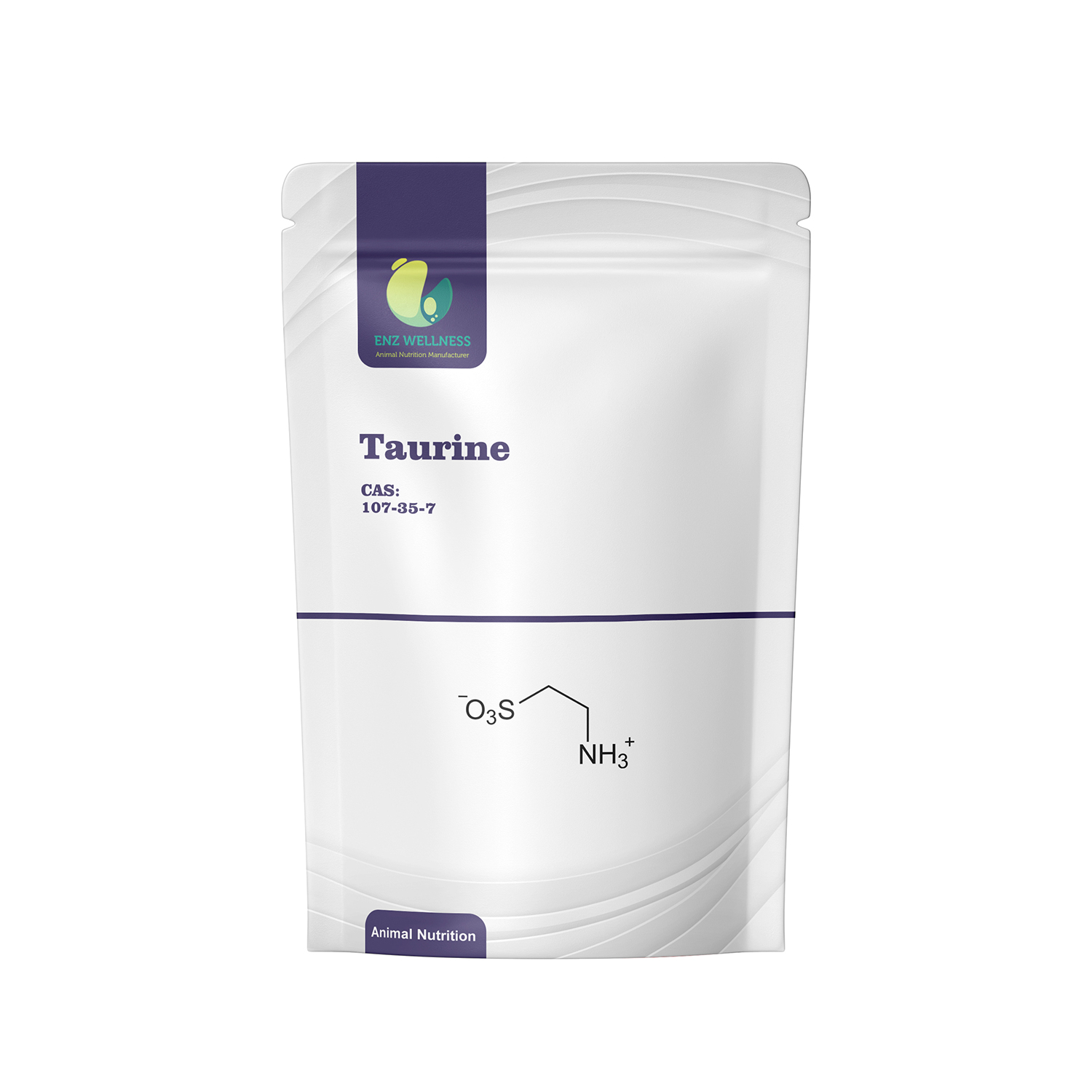
Structural Formula
NH₂–CH₂–CH₂–SO₃H
In aqueous systems, taurine exists predominantly in a zwitterionic form, with a protonated amino group and deprotonated sulfonate group.
Structural Characteristics
Taurine differs from conventional amino acids because its sulfur-containing functional group is a sulfonic acid group (–SO₃H) rather than a carboxylic acid group.
Its structure contains:
- One amino group
- One sulfonic acid group
- Two-carbon backbone
- Strongly polar ionic character
- High water affinity
The sulfonate group remains strongly ionized over a broad physiological pH range, contributing to taurine’s role in cellular osmotic regulation and transport processes.
Physicochemical Properties
| Parameter | Typical Characteristic |
|---|---|
| Molecular formula | C₂H₇NO₃S |
| Molecular weight | 125.15 g/mol |
| Physical state | Solid |
| Appearance | White crystalline powder |
| Odor | Odorless or practically odorless |
| Water solubility | Freely/soluble in water |
| Chemical nature | Amino sulfonic acid |
| pH of aqueous solution | Specification/concentration dependent |
| Hygroscopicity | Generally low to moderate depending on conditions |
| Stability | Generally stable under appropriate storage |
Exact physical and purity specifications should be established according to the commercial grade and confirmed by the product CoA.
Nutritional Functions and Mechanism
1. Bile Acid Conjugation
One of taurine’s best-established physiological functions is its participation in bile acid conjugation.
Taurine conjugates with bile acids to form taurine-conjugated bile salts, which are important for:
- Lipid emulsification
- Fat digestion
- Fat-soluble nutrient absorption
- Intestinal lipid metabolism
This function is particularly relevant in species whose capacity for taurine synthesis is limited.
2. Osmoregulation
Taurine is an important intracellular osmolyte.
It helps cells regulate:
- Water balance
- Cell volume
- Electrolyte balance
- Membrane stability
This function is especially relevant to aquatic animals exposed to changing environmental and osmotic conditions.
3. Antioxidant and Cellular Protection
Taurine participates in several mechanisms associated with cellular protection and oxidative-stress regulation.
It can contribute to:
- Protection against oxidative stress
- Membrane stability
- Normal cellular function
- Support of antioxidant defense systems
Taurine should not, however, be described as a conventional antioxidant enzyme or direct replacement for established antioxidant nutrients.
4. Calcium Homeostasis
Taurine is involved in cellular calcium regulation and can influence calcium-dependent physiological processes.
This is relevant to:
- Muscle function
- Cardiac function
- Cellular signaling
- Normal tissue physiology
5. Mitochondrial and Metabolic Function
Taurine participates in several cellular metabolic processes and has an important relationship with mitochondrial function.
Adequate taurine availability can support normal:
- Energy metabolism
- Cellular respiration
- Mitochondrial function
- Tissue development
Applications in Animal Nutrition
Aquaculture
Taurine is particularly important in aquaculture nutrition, especially for carnivorous fish and species with limited capacity to synthesize sufficient taurine.
It may be incorporated into diets for:
- Marine fish
- Seabream
- Seabass
- Grouper
- Salmonids
- Shrimp and other aquatic species, depending on formulation requirements
Potential nutritional benefits include:
- Improved feed utilization
- Support for bile acid metabolism
- Improved lipid digestion
- Support for growth
- Support for physiological stress tolerance
- Maintenance of normal osmoregulation
Taurine supplementation can be particularly relevant when fishmeal or other marine animal protein sources are partially replaced by plant-based ingredients, because the taurine profile and bioavailability of the resulting diet may differ.
Poultry
Taurine can be used as a functional nutritional ingredient in poultry formulations.
Potential applications include:
- Broiler diets
- Layer diets
- Breeder nutrition
- Stress-support formulations
- Antioxidant-support formulations
Taurine may contribute to normal cellular metabolism and physiological function, although the optimal supplementation level depends on the complete diet and production conditions.
Swine
Taurine may be incorporated into selected swine nutritional programs, particularly where functional amino-acid supplementation is being evaluated.
Potential applications include:
- Young-animal nutrition
- Stress-support formulations
- Functional feed additives
- Specialized nutritional programs
Its inclusion should be based on the total diet composition and the nutritional objective rather than treating taurine as a direct substitute for essential amino acids such as lysine or methionine.
Ruminants
Taurine is naturally present in animal tissues and may participate in physiological processes in ruminants.
However, compared with aquaculture and companion-animal nutrition, taurine is generally a less prominent routine feed additive for conventional ruminant diets.
Use should therefore be formulation-specific and supported by the nutritional requirements of the target animal.
Companion Animals
Taurine is particularly important in cat nutrition.
Cats have a limited ability to synthesize taurine and require dietary taurine to maintain normal physiological function.
Taurine is associated with:
- Normal retinal function
- Cardiac function
- Reproductive function
- Bile acid conjugation
- Normal development
For commercial pet-food applications, taurine levels should comply with applicable nutritional and regulatory requirements.
Key Advantages
1. Functional Sulfur-Containing Nutrient
Taurine provides a highly specific nutritional function distinct from conventional protein-forming amino acids.
2. Supports Bile Acid Metabolism
It contributes to taurine-conjugated bile acid formation and therefore has an important relationship with lipid digestion.
3. Supports Cellular Osmoregulation
Taurine acts as an important intracellular osmolyte.
4. Relevant to Aquaculture
Taurine is particularly useful in diets where the formulation may not naturally provide sufficient taurine, including some plant-protein-based formulations.
5. Supports Normal Physiological Function
Taurine participates in cellular, metabolic, neurological, cardiovascular, and antioxidant-related processes.
6. High Water Solubility
Its water solubility makes taurine convenient for incorporation into:
- Premixes
- Powdered feed additives
- Complete feeds
- Functional nutritional blends
Taurine vs. Conventional Amino Acids
| Feature | Taurine | L-Taurine / Conventional Amino Acid Example: Methionine |
|---|---|---|
| Protein-forming amino acid | No | Methionine: Yes |
| Sulfur-containing | Yes | Yes |
| Main sulfur group | Sulfonate | Methionine: thioether |
| Main role | Functional nutrient | Protein synthesis / metabolism |
| Bile acid conjugation | Important | Not directly |
| Osmoregulation | Important | Not primary function |
| Aquaculture relevance | High in certain species/diets | Essential for protein synthesis |
| Direct protein incorporation | No | Yes for methionine |
Taurine should therefore not be described simply as an alternative to methionine. Their biological roles are fundamentally different.
Taurine in Plant-Based Aquaculture Feeds
One of the most commercially relevant applications of taurine is in modern aquaculture diets.
When animal-derived protein ingredients are replaced with plant proteins, several nutritional characteristics can change, including:
- Amino-acid balance
- Taurine availability
- Palatability
- Mineral availability
- Digestibility
- Bile acid metabolism
Supplemental taurine can therefore be considered when formulating diets with substantial plant-protein inclusion, especially for species with limited endogenous taurine synthesis.
The actual requirement should be determined through species-specific nutritional research and feeding trials.
Typical Feed-Grade Specification
Commercial feed-grade Taurine is generally supplied as a high-purity crystalline material.
| Parameter | Typical Specification |
|---|---|
| Appearance | White crystalline powder |
| Taurine content | High-purity, specification-dependent |
| Identification | Conforms |
| Loss on drying / moisture | Controlled |
| Residue on ignition / ash | Controlled |
| Heavy metals | According to applicable limits |
| Arsenic | According to applicable limits |
| Lead | According to applicable limits |
| Microbiological quality | According to applicable feed requirements |
| Particle size | Available according to customer specification |
For international B2B sales, avoid publishing one universal numerical purity specification unless it matches the actual grade supplied by your factory.
Quality Control
A professional Taurine feed-grade specification should typically control:
- Identification
- Assay/purity
- Moisture
- Residue on ignition
- Heavy metals
- Arsenic
- Lead
- Cadmium where applicable
- Microbiological quality
- Particle size
- Appearance
- Solubility
- Packaging integrity
Each production batch should be supported by a Certificate of Analysis (CoA).
Packaging
Taurine can typically be supplied in:
- 1 kg bags
- 5 kg bags
- 10 kg bags
- 20 kg bags
- 25 kg bags
- Fiber drums
- PE-lined bags
- Customized export packaging
For bulk B2B supply, packaging should protect the powder from excessive moisture and contamination.
Storage
- Store in a cool, dry and well-ventilated area.
- Keep the container tightly closed.
- Protect from moisture and contamination.
- Avoid prolonged exposure to high temperature.
- Keep in the original packaging until use.
- Use clean and dry handling equipment.
- Follow the manufacturer’s SDS and storage recommendations.
Safety and Regulatory Considerations
Taurine is a nutritional ingredient rather than an antibiotic or anticoccidial. Nevertheless, its use in animal feed should comply with the requirements of the target market.
For international supply, verify:
- Feed additive/ingredient classification
- Approved species
- Maximum permitted inclusion levels where applicable
- Feed labeling requirements
- Purity requirements
- Import requirements
- Local feed legislation
For aquaculture and pet-food applications, nutritional requirements can vary substantially by species, life stage, and diet composition.
Technical Summary
| Item | Details |
|---|---|
| Product | Taurine |
| Chemical name | 2-Aminoethanesulfonic acid |
| CAS No. | 107-35-7 |
| Formula | C₂H₇NO₃S |
| Molecular Weight | 125.15 g/mol |
| Chemical class | Amino sulfonic acid |
| Form | White crystalline powder |
| Main functions | Bile acid conjugation, osmoregulation, cellular protection |
| Primary applications | Aquaculture, poultry, pet food, specialized animal nutrition |
| Important species | Fish, cats, poultry and selected livestock |
| Water solubility | Soluble |
| Protein-forming amino acid | No |
| Antibiotic | No |
| Feed grade | Available |
| Quality documentation | CoA, SDS, specification |